

After hearing the reports and opinions at the working session, General Secretary and President To Lam emphasized that perfecting the legal system and reforming the judiciary are closely related and require a central coordinating body to ensure that the stages of lawmaking, law enforcement, and judicial reform constitute a unified and effective whole. Therefore, the restructuring of the two steering committees is necessary, reducing the number of coordinating bodies without diminishing the tasks, ensuring clear responsibilities, clear outputs, and clear results. The name after restructuring will be the Central Steering Committee on Perfecting the Legal System and Law Enforcement (the Steering Committee); the General Secretary and President will serve as the Chairman.
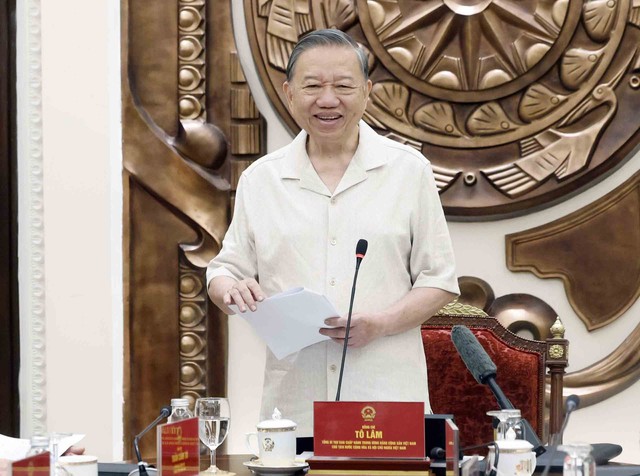
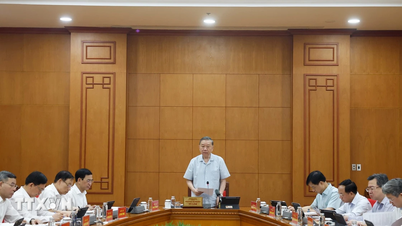
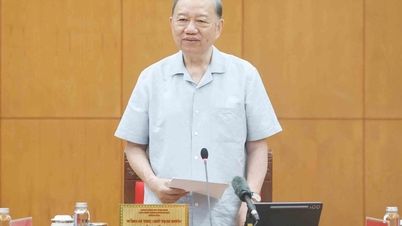
General Secretary and President To Lam delivered a directive speech at the working session.
PHOTO: VNA
The General Secretary and President stated that the restructuring is not a mechanical rearrangement, but essentially a reorganization of the Central Committee's leadership and guidance mechanism for the task of building and perfecting the socialist rule of law state in Vietnam, with two very important axes: perfecting the legal system and enforcing the law.
The General Secretary and President emphasized that the new Steering Committee must be a strategic-level institution for leadership, direction, coordination, supervision, inspection, and monitoring; it should not replace the National Assembly in legislation, the Government in state management and law enforcement, or other competent state agencies. The new Steering Committee should focus only on strategic policies and orientations, major projects, and matters requiring reporting to the Central Committee, the Politburo, and the Secretariat; coordinate the resolution of bottlenecks and inter-sectoral issues; and inspect, supervise, and handle political responsibilities within its authority.
The Steering Committee must have a permanent working body with the capacity to provide strategic advice and experience to coordinate inter-sectoral efforts and monitor, supervise, and inspect complex tasks related to legislation, executive power, the judiciary, internal affairs; combating corruption and negative practices, enforcing laws, disseminating legal information, and judicial reform. In addition, a sufficiently strong inter-sectoral working group is needed, not only for administrative tasks and summarizing meetings, but also as a policy advisory body with expertise in legal matters, internal affairs, justice, state governance, law enforcement, inspection, supervision, and digital transformation.
The General Secretary and President requested that the new Steering Committee review all programs, plans, conclusions, documents, data, and ongoing tasks of the two steering committees, classify tasks to report to the Politburo and the Secretariat for guidance and implementation, ensuring uninterrupted operation; and develop criteria for evaluating results with specific outputs.
The General Secretary and President proposed clearly defining the positions and functions of the Central Internal Affairs Committee and the Ministry of Justice (the permanent agency of the two steering committees before restructuring - PV); simultaneously, a coordination mechanism between the Party Committee of the Ministry of Justice and the Central Internal Affairs Committee should be developed, specifying clearly the responsibilities and tasks of each agency and the coordination mechanism between the two sides; and further improving the organizational structure of the Steering Committee.
The General Secretary and President requested that the new Steering Committee must create substantive changes, demonstrated through removing major legal bottlenecks, resolving inter-sectoral obstacles, improving the quality of lawmaking and the effectiveness of law enforcement, improving the quality of judicial activities, preventing wrongful convictions, protecting justice, reducing compliance costs, improving the investment and business environment, and enhancing people's and businesses' access to justice.
The General Secretary and President instructed the Party Committee of the Ministry of Justice to take the lead, in coordination with the Central Internal Affairs Committee, in fully incorporating the opinions of the meeting, finalizing the submission, and reporting to the Politburo.
Announcement of the President's Order on 9 laws passed by the National Assembly.
On the afternoon of May 13th, in Hanoi, the Office of the President held a press conference to announce the President's Order regarding 9 laws that were passed by the first session of the 16th National Assembly.
These laws include: the Law on the Capital City (amended); the Law on Access to Information (amended); the Law on Civil Registration (amended); the Law amending and supplementing a number of articles of the Law on Emulation and Commendation; the Law on Beliefs and Religions (amended); the Law amending and supplementing a number of articles of the Law on Representative Agencies of the Socialist Republic of Vietnam Abroad; the Law amending and supplementing a number of articles of the Law on Personal Income Tax, the Law on Value Added Tax, the Law on Corporate Income Tax and the Law on Special Consumption Tax; the Law amending and supplementing a number of articles of the Law on Notarization; and the Law amending and supplementing a number of articles of the Law on Legal Aid.
VNA
Source: https://thanhnien.vn/kien-toan-2-ban-chi-dao-cua-trung-uong-185260513222310027.htm

![[Image] Close-up view of the interchange connecting the two expressways and Long Thanh Airport.](https://vphoto.vietnam.vn/thumb/1200x675/vietnam/resource/IMAGE/2026/05/25/1779703378210_ndo_br_z7863716673926-224453a31600126cce10622af6290afd-4549-jpg.webp)

![[Image] Hanoi's urban life under the challenge of a "scorching hot" environment](https://vphoto.vietnam.vn/thumb/1200x675/vietnam/resource/IMAGE/2026/05/25/1779706979265_nang-nong-t5-2026-minh-duy-7-4636-jpg.webp)














































































Comment (0)