From a riverside city to a metropolis extending to the open sea.
In less than a week, the people of Can Gio island district will witness a historic moment: the groundbreaking ceremony for the Can Gio reclaimed land urban area. The project, with a planned area of approximately 2,870 hectares and a total investment of nearly 9 billion USD, is expected to transform Can Gio into a tourism, resort, and investment destination capable of competing with reclaimed land areas around the world in Singapore, Miami (USA), Australia, etc. Alongside this, Ho Chi Minh City is aiming to begin construction of the Can Gio Bridge (over 11,000 billion VND) and the Can Gio International Transshipment Port (nearly 5 billion USD). Initially, the Can Gio Bridge was scheduled to begin construction on April 30th, but because the city's master plan until 2040, with a vision to 2060, has not yet been approved, the project lacks the basis to be submitted to the City People's Council for consideration of investment policy. Following the approval of the city's master plan, the Department of Transport and Public Works announced that it will finalize the documentation and submit the pre-feasibility study report to the competent authority for approval, and commence the project this year, with completion scheduled for 2028.
A reclaimed land urban area will transform Can Gio into a world-class resort; a super container transshipment port will turn Can Gio into an international logistics center; direct connection to the center of Ho Chi Minh City by both road and high-speed rail… All these projects are opening up golden opportunities for Can Gio to restore its once-famous status as an ocean-going port on the Asia-Europe maritime route, realizing its vision of becoming a global city, bordering the river and facing the sea, in accordance with the Politburo 's directives on the Ho Chi Minh City Planning for the period 2021-2030, with a vision to 2050.
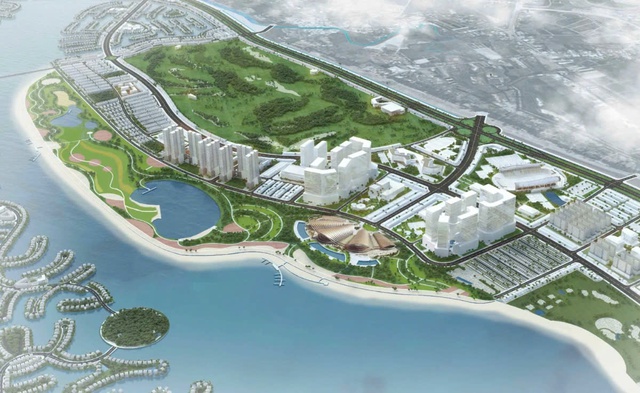
Perspective view of the Can Gio reclaimed land urban area.
PHOTO: VG
Looking back at history, Ho Chi Minh City only connected to the East Sea after Duyen Hai District (now Can Gio District) was merged in 1978. Located about 50 km from the city center, Can Gio is the only district of the city bordering the sea, with 23 km of coastline running in a southwest-northeast direction, and major river estuaries from the Long Tau, Cai Mep, Go Gia, Thi Vai, Soai Rap, and Dong Tranh rivers. Since the 1990s, the Ho Chi Minh City government has pursued a policy of developing the city southward – towards the East Sea. The cooperation of CT&D Group (Taiwan) transformed thousands of hectares of abandoned land (due to acidity) in the South into the Tan Thuan Export Processing Zone, Hiep Phuoc Industrial Park, Phu My Thermal Power Plant, Phu My Hung urban area... these were the first steps. From then until now, development towards the sea has been the desire and will of many generations of leaders and people of Ho Chi Minh City. Ho Chi Minh City has identified a long-term development vision based on a maritime economy , coastal urban areas, and international connectivity. However, there remains a significant gap between aspiration and reality. Only now, with a series of mega-projects like the ones mentioned above, has the city's expansion towards the open sea truly accelerated.
New growth drivers for Ho Chi Minh City.
Associate Professor Dr. Nguyen Hong Thuc (Vietnam National University, Hanoi) frankly stated: "For many years, the potential and advantages of Ho Chi Minh City's marine economy have not been fully exploited in the city's comprehensive development strategy. This is one of the regrettable things that contributes to the 'not-so-pleasant' reality for Ho Chi Minh City, which is that its leading and pioneering position is facing many challenges."
"If in 1995, Ho Chi Minh City's economy was nearly twice the size of Hanoi's, today that ratio has decreased to less than 1.7 times. Many other localities such as Dong Nai, Binh Duong, Hai Phong, Quang Ninh, Vinh Phuc, Thai Nguyen... are not yet, and will not be, competitors on par with Ho Chi Minh City in the next decade, but in some areas they can compete directly. In a way, these localities, not Ho Chi Minh City, are the main factors inspiring competition among localities in the past period," Associate Professor Dr. Nguyen Hong Thuc cited as an example.
According to Associate Professor Dr. Nguyen Hong Thuc, the current development of Ho Chi Minh City is only in its initial stage, not yet reaching the maturity of an urban area of international stature. However, Ho Chi Minh City is located in a position with many geoeconomic advantages in Southeast Asia, possessing all the conditions and potential to develop into a regional and international financial center within the next 1-2 decades. With the support of the Government and strong changes from policy to action by leaders at all levels, this is a golden opportunity for Ho Chi Minh City to reclaim the opportunities it has missed over the past nearly 20 years and reaffirm its position as the leading economic engine.
"Ho Chi Minh City has three main driving forces, all stemming from its river and maritime economy, and for the past 300 years, the city has always lived on this economic lifeline. Therefore, we must connect the river and maritime economy with other water cities to become a driving force for development. The Vung Tau - Can Gio - Go Cong coastal urban chain will become a 'front-facing' maritime economic hub, enabling Ho Chi Minh City to proactively seize opportunities for high-value-added maritime economic development and international maritime trade. This coastal urban corridor will also be a springboard for Ho Chi Minh City to become a stronger gateway connecting with the region and the international community. The city will then not only play a crucial role in the development of the Southern Economic Region, but also be key in international strategies, such as the Indo-Mekong Economic Corridor and the US Indo-Pacific Strategy," Associate Professor Dr. Nguyen Hong Thuc emphasized.
Sharing the same view, Professor Dang Hung Vo, former Deputy Minister of Natural Resources and Environment, commented: Developing the marine economy and reclaiming land from the sea is a global trend. China previously set out a strategy for developing the marine economy, thereby creating resources for the economic development of mountainous regions, and they have been successful. For Ho Chi Minh City, Can Gio is the only area bordering the Cai Mep - Thi Vai deep-water port, and also the only point bordering the sea for developing various types of marine economic activities. In the upcoming planning and reorganization of administrative units, if Ba Ria-Vung Tau merges with Ho Chi Minh City, the Can Gio seaport, along with the well-functioning seaports in Ba Ria-Vung Tau, will together increase capacity and provide new impetus for the city's development.
"Vietnam has been talking about developing its marine economy for a long time, but in reality, there haven't been any large-scale, internationally significant projects. We need to seize every opportunity to reclaim land from the sea, and do so as quickly as possible. Because the longer we delay, the less competitive we will be with other countries, while the driving forces for economic development on land will gradually dry up. Ho Chi Minh City will have new impetus for development when it expands into the sea through the Can Gio gateway. Don't be afraid if land reclamation hasn't been implemented yet, as long as it's done according to plan, with proper environmental impact assessments to select suitable locations, and effectively exploiting the sea areas belonging to Vietnam," shared Professor Dang Hung Vo.
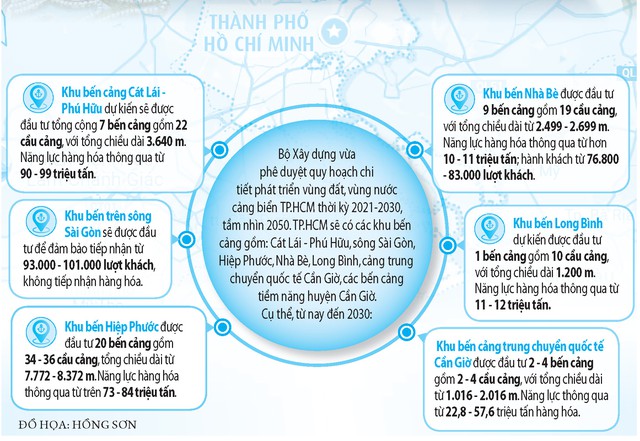
Thanhnien.vn
Source: https://thanhnien.vn/ky-nguyen-tien-bien-185250413214655434.htm





![[Photo] General Secretary and President To Lam receives Amazon's Senior Vice President David Zapolsky](https://vphoto.vietnam.vn/thumb/1200x675/vietnam/resource/IMAGE/2026/05/22/1779466547770_a1-bnd-3513-6601-jpg.webp)















































Comment (0)