

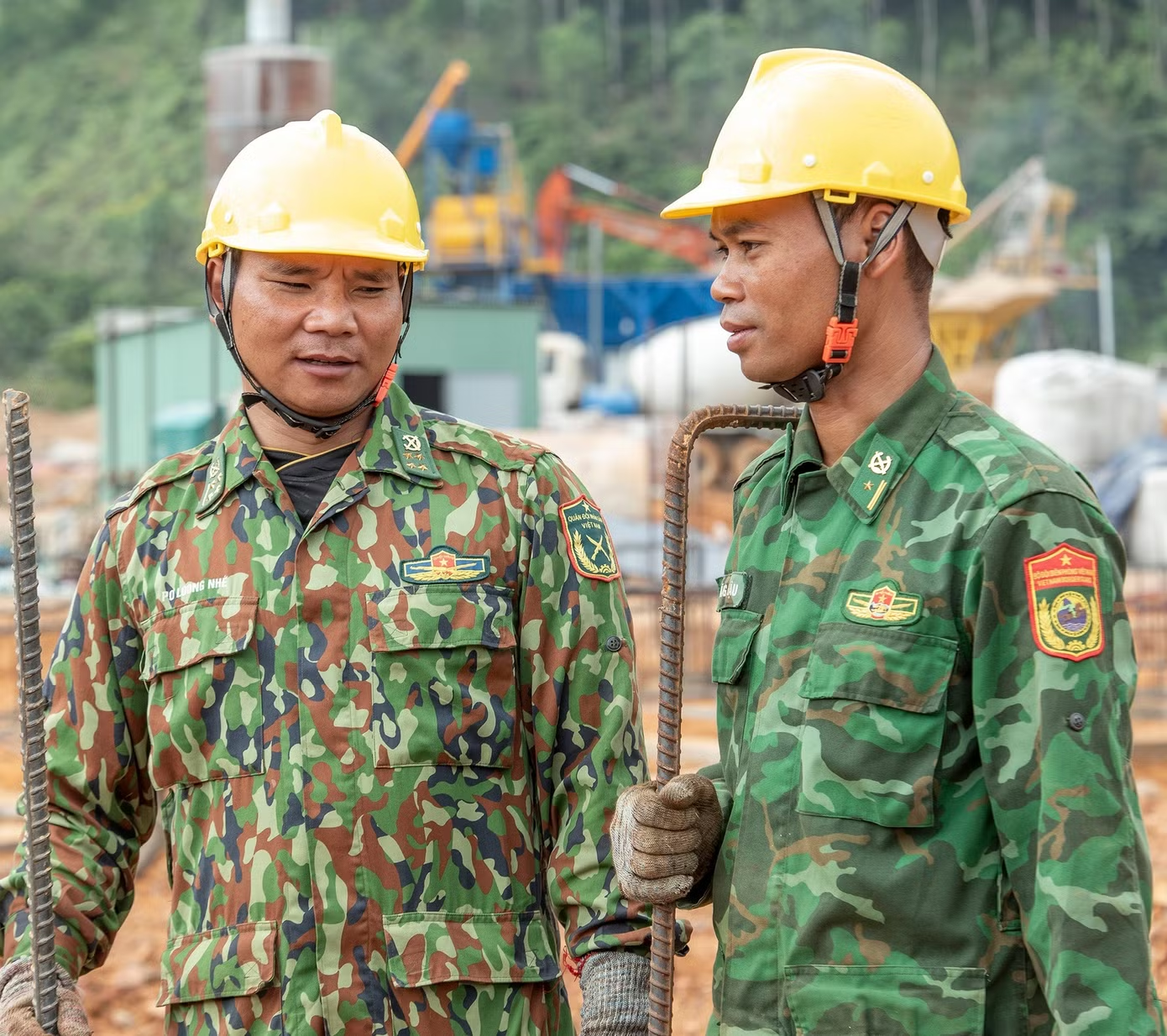
Captain Bloong Nhé and Major A Lăng Hậu are part of the "Progress Acceleration Support Team". Both are delighted to be building schools for their own children.
3 cassava tubers a day
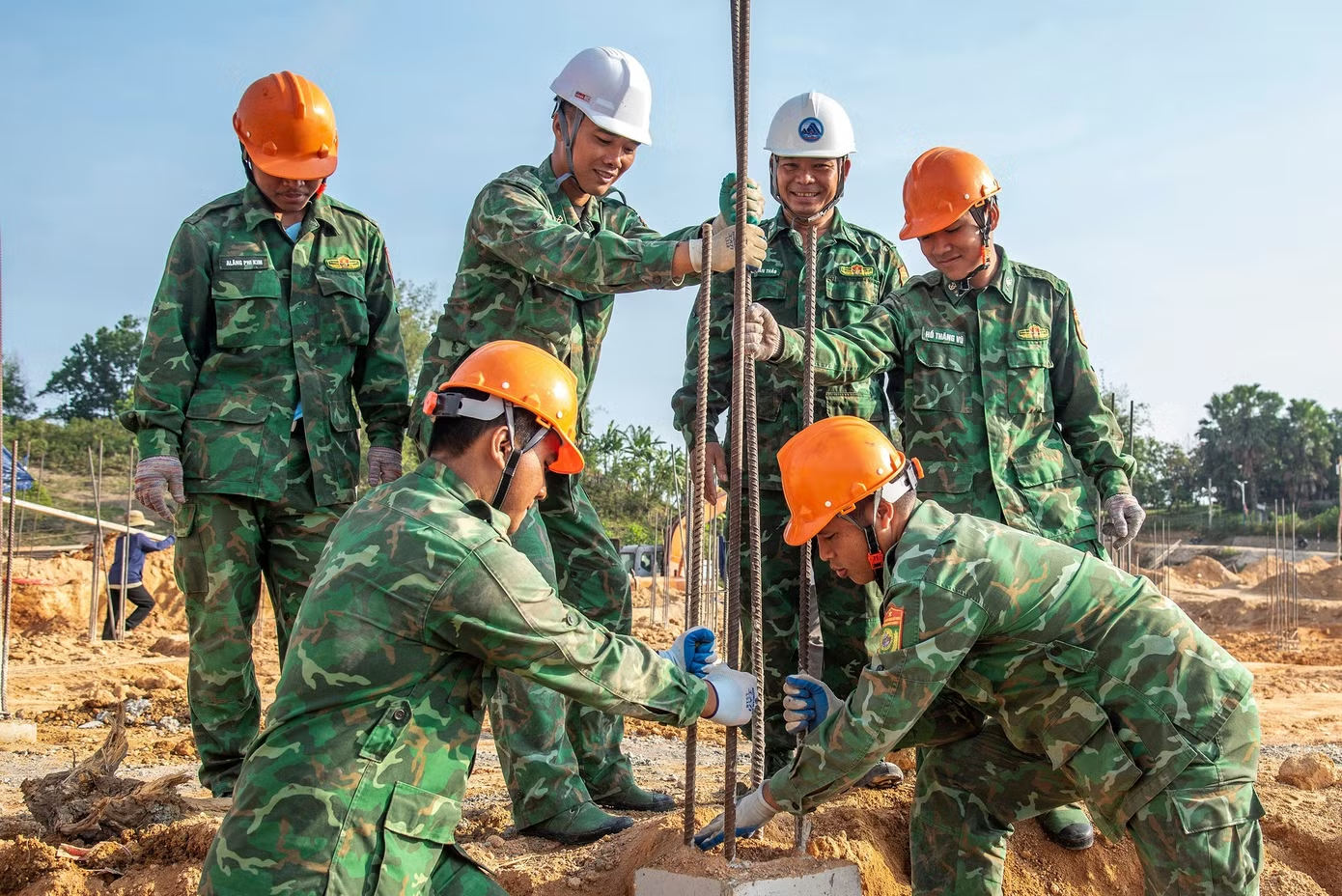
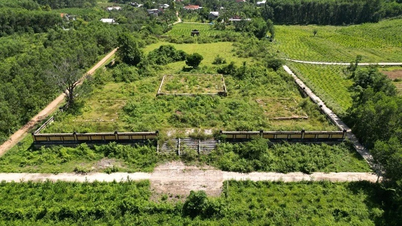
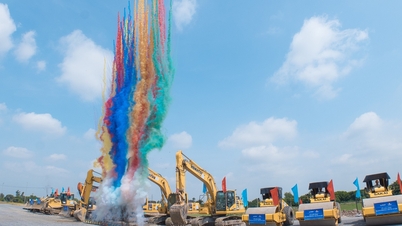
About 1.5 km east of the former Tay Giang district center is a construction site bustling with the sounds of cranes and excavators, along with hundreds of workers diligently working to complete the multi-level school project on schedule by August 30, 2026. Of the 229 multi-level boarding schools under construction nationwide, Da Nang city has a policy of mobilizing the military to support and accelerate progress, in the spirit of the Quang Trung Campaign at the end of 2025.
At the construction site, three rows of buildings were preparing for the second floor concrete pouring, the concrete pillars resembling the trunks of cypress trees, the entire cluster of buildings like silver-colored rocks atop Quế mountain. Captain Nhé, a member of the Cơ Tu ethnic group, wiped away beads of sweat, pointed to the road winding along the mountainside, and said, "When I was a child, it took two days and one night to walk along this road." Recalling his childhood, Nhé's spirit was like the rustling leaves of a tree in the wind, and countless old memories, like clouds of smoke, rushed back.
In 2005, a boy with dark, smooth skin, wearing flip-flops, without a hat, and carrying a sack of cassava on his back, often appeared on the road near the school under construction. He ate three cassava tubers a day, divided into three meals, and after five meals, he would run back to his village to continue carrying cassava. If any of his classmates asked about "a vuông," meaning rice, he would shake his head and immediately say "a sành," meaning cassava.
The house was located in Ch'ơm commune (now Hùng Sơn commune), and to get to school, one had to travel down a mountain pass and cross the Ra Ai, A Xan, and Abal streams.
"What do you dream of doing when you grow up?" When asked by adults, Nhé and his three friends, Bril Thành, Ta Ngol Tới, and Bloong Nơ, who often walked to school together, gave the same answer: "I want to become a border guard or a teacher."
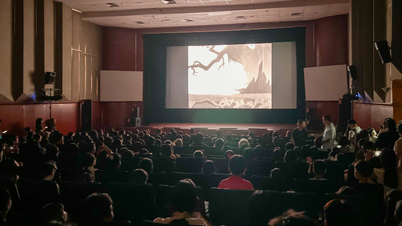
Back then, in Ch'ơm village, there was a teacher named A Lăng Ry, whom the boy likened to a mountain. Teacher Ry was the first to hire young men to walk all the way to Prao town to carry a television, a video player, a generator, and 50 liters of gasoline. When the teacher turned on the projector, the whole village crowded around. Many people brought a can of rice or a bunch of vegetables instead of money to enter the gate. Everyone who watched the film went home and dreamt about it, because the scenes were so dramatic that people flew through the trees, and fire and smoke seemed to come out of the screen.
The dream of the T'năng bird's wings
The Tây Giang Commune's boarding and semi-boarding school project, once completed, will provide accommodation and meals for the students. Back when Bloong Nhé walked through the forest, crossed streams, and carried cassava roots to school, the school could only provide students with a makeshift hut about 6 meters wide and 20 meters long, with a temporary roof made of leaves and plastic. Because of the cramped living conditions, Nhé built another hut out of leaves. The hut was located at the foot of the mountain. He invited a few friends from the village to live there. Bril Thành, Ta Ngol Tới, and Blong Nơ lived in their own hut.
Occasionally, the group of classmates, including A Lang Toi, would sneak into the tent where the four students lived and find four sacks of cassava roots, a fire made of three stones, and a pot for boiling the roots. They would boil the roots and eat them with salt; only occasionally would they have fish sauce. These students, from the villages of Ga Ry and Ch'um, only ate cassava roots; sweet potatoes and rice were luxuries, and the other children in the class had never seen them before.
Sometimes, after school, Tới would sit looking up at the mountain peak, gazing at the T'năng bird, wishing he had wings to fly home quickly. Suddenly, Tới's father, Mr. Bloong A Hiệp, appeared. He was a hardworking father who toiled in the fields, growing cassava to provide food for the whole family. In March, he would trek through the Da Ding and Tà Xiên mountains to collect beehives, then carry dried bamboo shoots and honey, walking for 4-5 days and nights down to Đông Giang town to trade for salt, MSG, fish sauce, and noodles.
Among the border guards assisting with the construction of the La Dêê Commune's boarding and semi-boarding primary and secondary school project, Senior Lieutenant A Lăng Minh Thắng, an officer at the Nam Giang International Border Gate Border Guard Station, shared that when the project is completed, seven of his nephews will be studying at the new school. Senior Lieutenant Thắng's family has four members serving in the Border Guard.
Every time he met his daughter, the father would talk about Nhé's three sisters, Bloong Nhéo, Bloong Thị Nhen, and Bloong Nhế, all of whom had to drop out of school. Only Nhé was able to continue her education through secondary and high school, so she had to study hard to become a border guard or a teacher in the future.
Of the two choices, Nhé preferred to become a border guard, because her teacher at school explained, "A border guard lives in a barracks, has a gun, a bunker, and is ready to fight the enemy to protect the homeland." But Nhé secretly wished that if she became a border guard, she would immediately buy a sack of white rice to share with her family, because all her siblings were eating tubers and craving rice.
The four schoolboys who shared the hut with Nhé all grinned when they heard him share his dream of "making a living." It was just a dream, though; achieving it was like catching a catfish on the summit of Mount Tà Xiên or chasing a T'năng bird in the fields.
Children and grandchildren have schools.
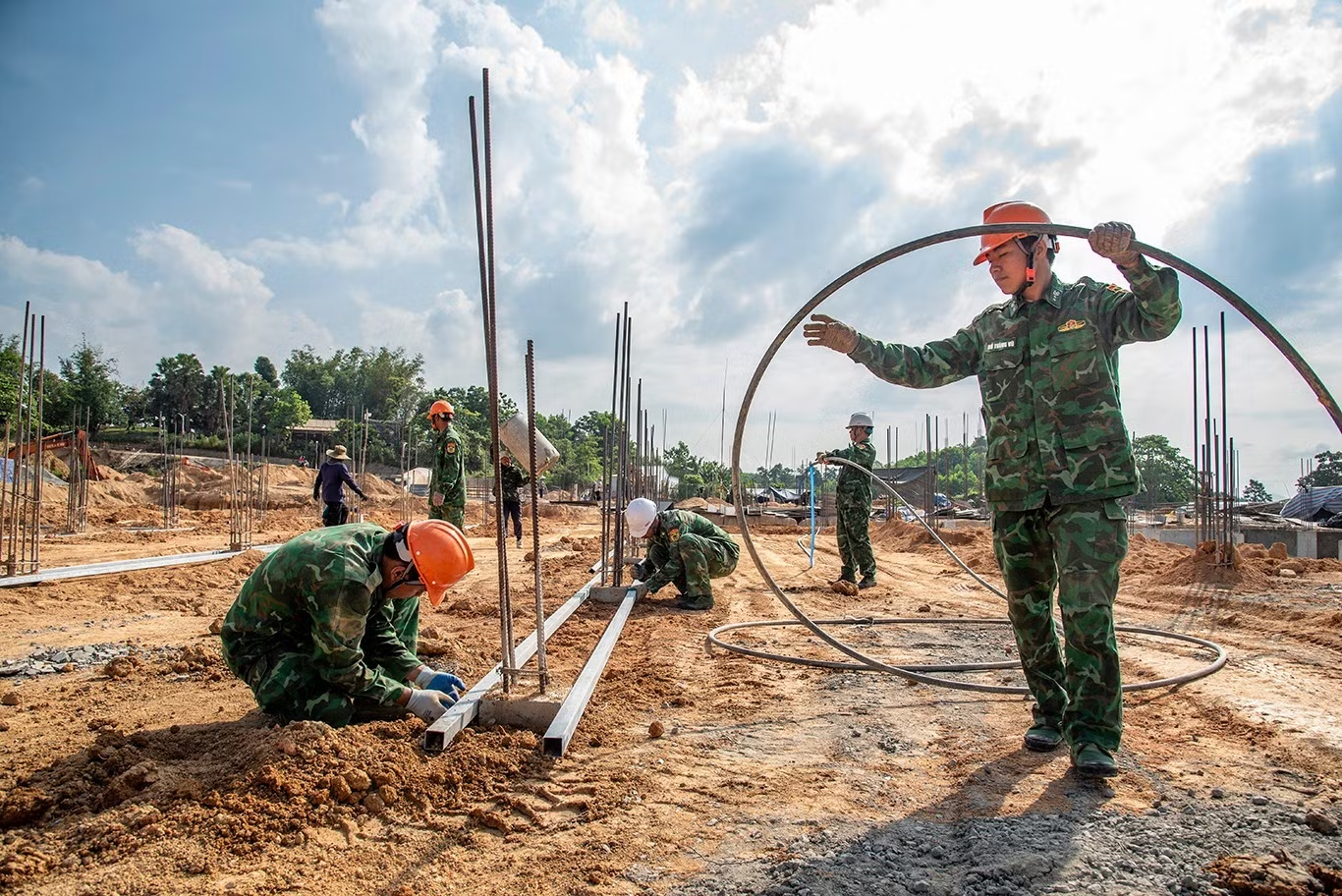
In La Dêê commune (formerly part of Nam Giang district), Major Dinh Van Thao, a member of the Gie Trieng ethnic group, brought his two children, Dinh Van Thiet and Dinh Thi Phuong Thuy, to the top of the mountain slope to look down at the construction site shrouded in dust and smoke. Major Thao is the team leader of the team supporting the accelerated progress of the project (an officer at the Nam Giang International Border Gate Border Guard Post). His wife passed away three years ago due to a serious illness, and he had planned to send his children to boarding school so he could focus on his work.
For over 20 years in the Border Guard Force, having served at border posts along the Tay Giang border, then on the coastal front, and finally back on the Nam Giang border, this soldier has repeatedly helped the Co Tu and Gie Trieng people transport food along muddy roads, build houses for them, and carry sick people across streams. Occasionally, while on duty, he would stop in front of the Gươl houses and point to the bird carved on the roof, telling stories about the Grứ bird, a sacred bird and the lucky charm of the Gie Trieng people.
For over a month working at the construction site, he often reminisced about his childhood, trudging dozens of kilometers to school, meals consisting only of a cassava root dipped in fish sauce, or occasionally a sweet potato. The new school had sprung up, and to him, it was like a symbol of the Grứ bird. He looked up at the La Dêê mountain, its peak resembling a mother's breast, and said, "Every day I come down to the construction site, I encourage my colleagues. This project is very meaningful, like the century-long project in the Trường Sơn mountain range."
Source: https://tienphong.vn/ky-uc-cu-mi-tren-cong-trinh-xay-truong-lien-cap-post1844970.tpo


![[Photo] General Secretary and President To Lam presides over a meeting on preparations for the review of one year of operation of the three-tiered government system.](https://vphoto.vietnam.vn/thumb/1200x675/vietnam/resource/IMAGE/2026/06/02/1780391821195_a1-bnd-4595-9717-jpg.webp)














































































Comment (0)