

The buffalo herding season embodies a unique cultural aspect, likened to a vibrant ink painting, where humans and animals adapt to the generosity of nature.
And as industrial life developed, people suddenly realized that this picture was gradually fading, leaving only scattered, meager patches of color remaining.
MEMORIES OF THE OLD BUFFALO HERDER GROUPS
For people in the Mekong Delta, herding buffalo is not just an activity, but a season.

According to the simple definition of the late writer Son Nam, a researcher of Southern Vietnamese culture, "herding buffalo" is simply letting buffalo roam freely.
The Mekong Delta, especially the upstream provinces bordering Cambodia such as Dong Thap and An Giang, has always lived under the regulation of the Mekong River.
Around the seventh or eighth lunar month, when water from the upstream rushes down and floods the fields, it is called the flood season.
When the fields are flooded, the lush green rice paddies and meadows suddenly turn into vast expanses of water. Food for buffaloes – a valuable asset for farmers – becomes scarce.
To ensure the health and survival of the buffalo herd, the herders will drive the buffalo to other areas, usually higher ground that has not been flooded, or harvested rice fields in border or adjacent areas, to find food. This is known as the "buffalo herding" journey.
During the months of flooding, buffaloes are left to graze freely, rest, and regain their strength after a long year of plowing and hauling rice. When the floodwaters recede and grass grows back in the fields, people ride the buffaloes, herding them back to tie them up beside their houses or in familiar bamboo groves, preparing for the new planting season.
"Late in the afternoon, as the sunset cast its light over the fields, the sight of young men riding and herding buffalo across the fields quickly caught my eye." That image contributes to a vibrant picture of nature, evoking a sense of peace that is unique to this tranquil delta region. |
And so, the buffalo herding season has been intertwined with the Mekong Delta region for a long time, since time immemorial, creating a harmonious way of life in harmony with nature.
There's a proverb that says, "The buffalo is the foundation of one's livelihood." Buffaloes spend the whole year plowing, hauling rice, and assisting farmers in production. They are the greatest asset, the source of labor, and the livelihood of entire families in rural areas.
Therefore, the flood season months are when their owners allow the buffaloes to "rest," find grass to eat, regain their strength, and prepare for the new season when the water recedes.
The buffalo herding journey is a way for farmers to express their gratitude and thoughtful care for their "friends" who have accompanied them through countless hardships.
The people of the Mekong Delta, especially the older generation, carry within them memories of the buffalo herding season like a poetic film. It is an indispensable part of their childhood, a scene they once witnessed.
My father, who came from a farming background in the upstream border region, often told me stories about the buffalo herding season from my childhood, a time when buffalo herds were still numerous.
Growing up, I used to go to the fields with my relatives and was lucky enough to see herds of buffaloes grazing. The memories of buffalo grazing seasons have stayed with me to this day.
I used to witness herds of buffaloes, ranging from a few dozen to a few hundred, moving in a line from one field to another to graze. These large herds were often accompanied by herders.
I saw people of all ages, from rugged, experienced young men to children as young as 9 or 10. In the old days, in poor rural areas where people didn't have the opportunity to go to school, working as a buffalo herder for wealthy families was a way to make a living.
The atmosphere during the buffalo herding season back then was incredibly lively and bustling. The buffalo herders lived a nomadic lifestyle, setting up tents and lighting fires to cook rice in the fields or on high ground.
They let their buffaloes graze freely for several months during the flood season. They gather together to chat, joke, exchange experiences, and tell stories of the countryside and legends of the river.
Personally, I used to think that the buffalo herding season was a thing of the past, memories that could only be seen through old documentary footage.
However, recently, while walking along the fields bordering Cambodia during the flood season, I unexpectedly came across a herd of buffaloes.
The scene, which I thought had long since disappeared, suddenly appeared before my eyes. I tried to use my camera to capture the peaceful scene of a herd of buffaloes.
Encountering the sight of buffalo herding is still a rare and precious occurrence in the Mekong Delta.
Despite my efforts to recapture the scene of the buffalo herd to document it, I noticed that the herd had thinned out, no longer gathering in herds of several hundred animals.
The bustling atmosphere of riding and herding buffaloes is no longer the same as before; the scene of buffalo herders gathering together to chat and joke is no longer as crowded and lively as it used to be.
WHEN THE BUFFALO IS NO LONGER THE "FIRST LIVELIHOOD OF THE PROFESSION"
The decline of the traditional buffalo herding season is not a random event, but an inevitable consequence of socio-economic development. Agricultural mechanization is the most direct and powerful cause.

Gradually, increasingly modern mechanization in agricultural production has replaced human labor, taking over the work of large, strong buffaloes.
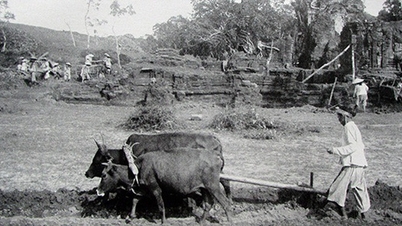
Plows, harrows, and combine harvesters have completely replaced the strenuous work of buffaloes. The sight of buffaloes plowing, harrowing, and hauling rice in the fields, as in the old days, is no longer seen.
With the advent of machinery, the buffalo no longer holds the position of "foundation of livelihood" as it once did.
Farmers no longer raise many buffaloes for agricultural production, but only keep a few for sale or other purposes.
The number of buffaloes in the Mekong Delta is no longer as large as before, making it rare, if not impossible, to see herds of several hundred buffaloes grazing in the fields after the rice harvest.
Besides mechanization, changes in farming models have also significantly impacted the buffalo herding season: Many areas have switched to growing three rice crops per year and built closed dike systems to prevent flooding, leading to the disappearance of the natural flood season as before.
Continuous rice cultivation or land-use conversion leads to a reduction in natural grassland areas, leaving buffaloes with nowhere to forage for food.
Nowadays, the distinctive image of the buffalo herding season, closely associated with the culture of the Mekong Delta, is gradually fading away with the passage of time and changes in the living environment.
DUONG UT
Source: https://baodongthap.vn/ky-uc-mua-len-trau-a235251.html
![[Image] Checking the security conditions at the exam site, ready for the 10th grade exam.](https://vphoto.vietnam.vn/thumb/1200x675/vietnam/resource/IMAGE/2026/05/28/1779943458889_z7872507660648-d764421a26e8cd7b61d70d142a48a685-jpg.webp)


![[Photo] Opening Ceremony of the National People's Council Conference on the Implementation of Directions and Tasks for the 2026-2031 Term](https://vphoto.vietnam.vn/thumb/1200x675/vietnam/resource/IMAGE/2026/05/28/1779939257690_ndo_br_bnd-1991-jpg.webp)










































































Comment (0)