

Microneedling creates tiny micro-injuries that help the body activate the skin-healing process, stimulating the production of more collagen and elastin, resulting in firmer, smoother skin.
According to Dr. Dang Thi Ngoc Bich, a dermatologist and cosmetic skin specialist at Tam Anh General Hospital in Ho Chi Minh City, microneedling (Dermaroller) is becoming increasingly popular to combat signs of aging such as loss of skin firmness, wrinkles, reduced pore size, decreased oil (sebum) production, and improvement of stretch marks, acne, and dark scars.
Microneedling is a minimally invasive skin procedure in which dermatologists use thin needles to create tiny holes on the skin's surface, without damaging the outer layer of skin, to break down scar tissue. These controlled wounds cause superficial bleeding, triggering the body's wound-healing response. This allows the skin to release substances that stimulate the growth of new blood vessels, creating more collagen. After 5 days, the collagen produced by the body will deposit in the treated area, resulting in firmer skin and reduced appearance of fine wrinkles.
If the skin is treated with 4 microneedling sessions, spaced one month apart, it can increase collagen production in the body by 400%, helping to regenerate the skin. This method is commonly applied to the face but can also be used on the legs, back, neck, or other areas of aging or damaged skin.
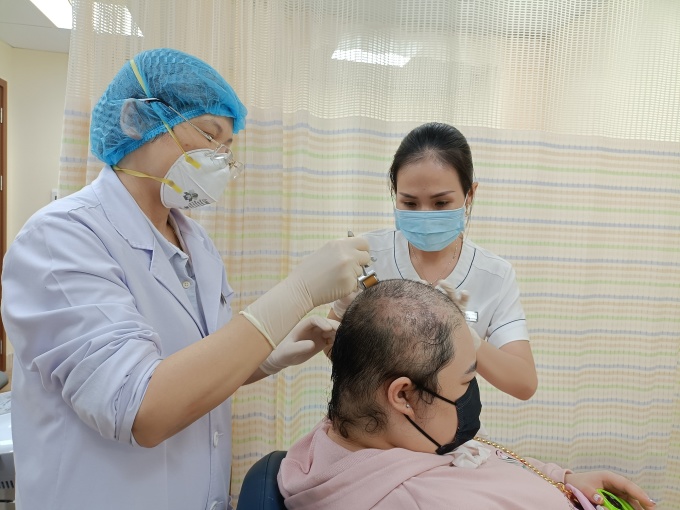
Dr. Dang Thi Ngoc Bich (left) uses microneedling to regenerate skin and stimulate hair growth. Photo: Provided by the hospital.
Microneedling is now widely used to treat problems such as:
Treating pitted scars
Acne scars can form from cystic acne or from squeezing pimples, and can last for months or years. Microneedling uses ultrafine needles to break down acne scar tissue, cutting away fibrous tissue and scar tissue that constricts the skin, helping the skin produce more collagen to heal the wound. The newly formed collagen helps to smooth the skin's surface, filling in crow's feet, wrinkles, and scars. The American Academy of Dermatology indicates that microneedling is effective for pitted scars, and even better when combined with vitamin C or PRP (platelet-rich plasma).
Microneedling is safe for darker skin tones, does not damage or remove the outer layer of skin, and is safe for thin and sensitive skin. Possible side effects of microneedling for acne scars include redness, bruising, and inflammation. However, these signs will disappear within a few days.
For the first few days after microneedling, avoid direct sunlight and exercise. Do not use exfoliating products or skincare products containing alcohol as they can harm the skin.
Microneedling is an effective, relatively inexpensive, and safe treatment for mild acne scars. It requires minimal downtime and improves skin conditions such as dark spots, brightens skin, evens skin tone, reduces wrinkles, and rejuvenates the skin.
Treatment for large pores
Microneedling for enlarged pores is a pore-minimizing treatment that uses rollers with numerous ultra-fine needles to create micro-injuries on the skin's surface, stimulating regeneration and collagen production. Pores become smaller after each treatment, while also improving other skin issues such as: treating freckles, reducing dark spots, and regenerating skin.
Treating melasma
Microneedling for melasma treatment uses a specialized, ultra-fine roller, measuring 0.25-0.5mm, to create tiny wounds on the skin's surface. This stimulates collagen production and allows for the delivery of medications, stem cells, and platelet-rich plasma into the skin. These substances penetrate deep into the skin, regenerating its structure, breaking down and eliminating melanin pigments, forming new skin, and restoring skin tone.
The advantages of this method are that it leaves no scars, does not damage the skin, increases collagen production, deeply regenerates from within, uses small, thin needles of moderate length so it acts quickly, reaches the correct skin layer for treatment, the skin recovers quickly, and the results are effective after each treatment stage.
Dr. Dang Thi Ngoc Bich noted that microneedling helps regenerate and improve skin, but patients need to consult a dermatologist or cosmetic skin specialist for advice on their skin condition and appropriate treatment. Patients should not attempt microneedling at home to avoid side effects, infections, or scarring.
Mai Hoa
Source link




![[Image] Hanoi's urban life under the challenge of a "scorching hot" environment](https://vphoto.vietnam.vn/thumb/1200x675/vietnam/resource/IMAGE/2026/05/25/1779706979265_nang-nong-t5-2026-minh-duy-7-4636-jpg.webp)
![[Image] Close-up view of the interchange connecting the two expressways and Long Thanh Airport.](https://vphoto.vietnam.vn/thumb/1200x675/vietnam/resource/IMAGE/2026/05/25/1779703378210_ndo_br_z7863716673926-224453a31600126cce10622af6290afd-4549-jpg.webp)






























































































Comment (0)