


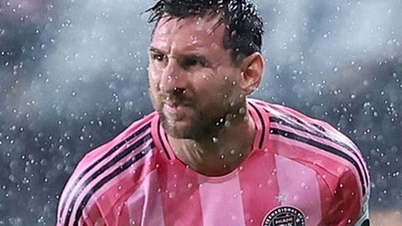
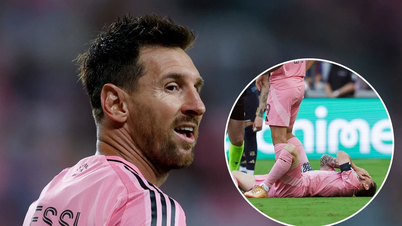
Messi has been carrying the Argentine national team on his shoulders for the past two decades - Photo: REUTERS
"The curse" for the champion
Argentina is one of the last teams to announce its official squad for the 2026 World Cup. And the moment of anxiety created by Messi could further disrupt coach Lionel Scaloni's plans.
Fortunately, after more than a day, the Inter Miami medical team sent positive news about Messi's condition. He simply had "muscle fatigue," not an injury as feared.
Unless something unexpected happens, Messi will participate in his sixth World Cup, and almost certainly his last as a professional player.
Nearly four years have passed since the 2022 World Cup, yet Argentinian fans still feel the euphoria of their glorious victory in Qatar.
From that state of euphoria, they could easily be "pulled back down to earth" when they participate in the 2026 World Cup. For a long time, the world of football has been plagued by a terrifying "curse" for champions.
That's the pattern: the reigning champion team will often fail in subsequent World Cups. This has been the case from the 2002 World Cup to the 2018 World Cup.

Messi is causing concern among Argentinian fans - Photo: REUTERS
Indeed, the defending champions, France (winners of the 1998 World Cup), were eliminated in the group stage before entering the 2002 World Cup.
At the 2006 World Cup, defending champions Brazil fared better, but still only made it to the quarter-finals. Then, at the 2010 World Cup, Italy even finished last in the group stage.
At the 2014 World Cup, the mighty Spain were eliminated in the group stage, and then the champions that year - Germany - finished last in their group at the World Cup four years later.
The "curse" will only end when 2018 World Cup champions France reach the 2022 World Cup final.
We need a generation of talented young people.
In reality, the "curse" is just a figure of speech; the decline of the World Cup-winning team in the tournament four years later stems from an inevitable cause – decline. A generation of players at their peak, usually between 24 and 30 years old, are likely to lose their form after four years.
And the next generation is always under immense pressure from the title of "champion," in which they didn't really play a part.
For example, 21 out of 26 Argentinian players who won the World Cup were 24 years old or older. And as many as 10 of them were 30 or older, including Messi.
A significant portion of this generation of veteran stars has retired from the national team, like Di Maria, while a considerable number are still actively competing, including Messi, Otamendi, Acuna, Pezzella, and goalkeeper Martinez.
It's difficult to expect the aforementioned stars to maintain the form they showed at the 2022 World Cup, especially with Messi about to celebrate his 39th birthday.
Usually, only center-backs, goalkeepers, or strikers can compete at the highest level at this age. Meanwhile, Messi takes on so many roles for the national team – from playmaker, ball control, dribbling, breakthroughs to goalscoring, always at the center of every battle on the field.
But fans shouldn't worry too much. Messi has repeatedly expressed, "I don't want to be a burden at the 2026 World Cup," when speaking about this issue.
He could happily take on a reserve role in the national team, accepting being substituted when needed, and reducing his overall role in the team.
France's success at the 2022 World Cup proved that no "curse" exists when a football system has sufficient depth.
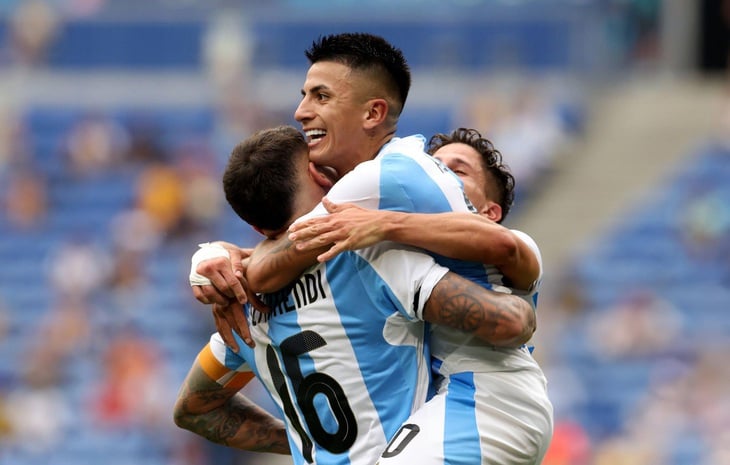
Argentina is undergoing a generational transition - Photo: REUTERS
In Qatar, France played just as well as they did four years earlier in Russia, because they have a young generation capable of succeeding the aging one.
Argentina could be in a similar situation right now. Although coach Scaloni hasn't finalized the squad, Argentina could participate in the 2026 World Cup with a young and talented team including Almada, Giuliano Simeone, Nico Paz, Barco, Mastantuono, and others.
Of course, none of them are the new Messi. But filling the void left by Di Maria, or gradually replacing De Paul, is entirely possible.
Messi has carried the Argentine national team for the past two decades, leading the team through five World Cups, four of which he played the role of "orchestrator." Now it's time for the world's number one star to calmly step back and let his younger teammates shine in his place.
Source: https://tuoitre.vn/lan-nay-argentina-se-ganh-messi-du-world-cup-20260526082842342.htm

![[Photo] The courage of new recruits of Brigade 144 on the training ground.](https://vphoto.vietnam.vn/thumb/1200x675/vietnam/resource/IMAGE/2026/05/27/1779881651341_anh-man-hinh-2026-05-27-luc-18-32-52.png)
![[Photo] The heat at the fireworks display site on the opening night of the Da Nang International Fireworks Festival 2026](https://vphoto.vietnam.vn/thumb/1200x675/vietnam/resource/IMAGE/2026/05/27/1779889741485_ndo_br_z7872039145157-fecaba5112f39e8352544099d7ef4738-5140-jpg.webp)



























![[Photo] The courage of new recruits of Brigade 144 on the training ground.](https://vphoto.vietnam.vn/thumb/402x226/vietnam/resource/IMAGE/2026/05/27/1779881651341_anh-man-hinh-2026-05-27-luc-18-32-52.png)



















Comment (0)