

Many small-scale production facilities, garment processing workshops, and traditional craft villages are facing difficulties or being forced to leave the market due to pressure from cheap imported goods, especially Chinese goods sold online.
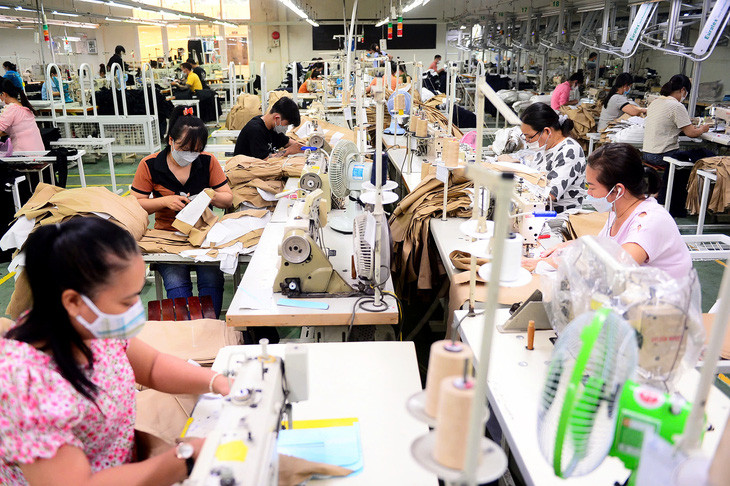
Besides the difficult economic situation which has led people to limit their spending, many businesses believe that Chinese goods Low cost is a major reason. However, it's not easy to emulate the Chinese approach.
Fading away
Sharing why he couldn't do garment manufacturing for businesses, Mr. Nguyen Van Dang, the owner of a garment manufacturing shop in the Tan Binh market area (Tan Binh district, Ho Chi Minh City), said that he had once gone to China to buy a few pairs to try making them himself, but he couldn't produce them at the price customers wanted, so he had to cancel the order.
According to Mr. Dang, Chinese -made sneakers and canvas shoes sell for only 100,000-300,000 VND per pair, depending on the type, while the production cost in Vietnam, even with the best efforts, still exceeds their selling price. Therefore, it is understandable that many similar Chinese clothing and footwear items are 30-35% cheaper than Vietnamese products.
"Our raw materials and machinery are entirely dependent on China, so garment processing or self-production units are facing fierce price competition. Prices that are 'livable' don't attract customers, while prices that attract customers are almost unprofitable, so I had no choice but to close the factory," Mr. Dang said.
Similarly, the area around Ton Dan Street (District 4), formerly known for its many garment factories and retail stores selling shoes and clothing, has seen a decline in business in recent years, with many businesses now closing down.
According to Ms. Ngo Thu Linh, the owner of a shoe factory here, many areas in Ton Dan used to be long-standing shoe-making villages, with some alleys having 30-40 households producing shoes, and wholesale and retail orders pouring in. But now, business is so slow that they are gradually closing down, and the number of households still producing shoes can be counted on the fingers of one hand.
"Chinese goods sold online and offline are everywhere, you can find any kind for just a few tens of thousands of dong, and new designs are constantly being released. Meanwhile, we mainly make handmade products with higher costs and only basic designs. This reality has forced us to abandon our traditional craft," Linh sighed.
The streets surrounding Tan Binh Market (Tan Binh District), formerly a bustling area for shoe and clothing manufacturing and processing, with a constant stream of wholesale and retail customers, are now noticeably quieter.
According to Ms. Dang Thi Nga, the owner of a business here, garment factories usually sew mainly for companies, but now businesses can't sell their goods, so they're no longer placing orders. Sewing to sell to customers is even worse because both wholesale and retail sales are slow.
"Sewing buttons, attaching zippers, stitching details to complete the clothes... in general, there's a lot of work to do. Contract manufacturing is almost like working for free; each product only brings in a few hundred to a few thousand dong, but now there's hardly any work to do," Ms. Nga said.
Speaking to Tuoi Tre newspaper on November 22nd, a representative from VT Bead Company (Tan Phu) stated that they now only make iron-on beads to preserve the craft, while garment manufacturing and bead setting are now things of the past.
"Previously, large shoe companies placed orders continuously, but for about three years now, their demand has dropped sharply, so I stopped. Now it's hard to sell, so companies are producing less and less. When they need something, they import finished goods from China to sell."
While accepting the rules of competition, some small business owners are concerned about whether Chinese goods are subject to taxes, even though they are certain that many products violate regulations by counterfeiting brand labels, making them easy to sell. Some garment factories have switched to quick tailoring services for customers, but they also hope for fair competition in the market.
Learning from China is not easy.
Despite having over 20 years of experience in the business of manufacturing and selling leather clothing and shoes, Mr. Dinh Van Hung, owner of the Dinh Dao production facility (Thu Duc City), said that although he participates in dozens of trade fairs in Ho Chi Minh City and other provinces each year to sell leather shoes and sandals priced between 350,000 and 2 million VND per pair, the results are quite low.
"Nowadays, at fairs, customers mainly look for pairs of shoes costing a few tens of thousands of dong, or at most 150,000 - 200,000 dong. Even with increased promotions, customers still ignore them. There was a three-day fair where I only sold four pairs. The profit wasn't enough to pay the staff's wages," Mr. Hung recalled.
Talk with According to Tuoi Tre newspaper , Mr. Nguyen Van Khanh - vice chairman of the Ho Chi Minh City Leather and Footwear Association - said that cheap goods at many trade fairs are often from China, or almost all stages of production and materials come from that country. However, making cheap goods that follow the designs of Chinese goods is not easy.
Specifically, according to Mr. Khanh, China has its raw materials at the source while we have to import them. Their large-scale production and highly automated machinery, capable of producing millions of pairs of shoes and sandals per hour, result in production costs that are among the lowest in the world .
"Thanks to selling large quantities, possibly thousands or even tens of thousands of pairs for a single design, Chinese businesses confidently invest in producing new molds continuously, leading to their designs always being ahead. We are almost at a disadvantage in every way," Mr. Khanh pointed out the difficulties.
Sharing that view, Mr. Nguyen Huy Thanh, the owner of a company specializing in supplying machinery and materials for garment manufacturing in Ho Chi Minh City, said that leather accounts for about 40-45% of the cost, and shoe soles account for about 20-25% of the production cost.
A set of five molds for shoe soles costs tens of millions of dong, but if a design is produced that customers don't like and doesn't sell, it's almost impossible to discard. Meanwhile, Chinese companies create new molds to produce new designs, and thanks to competitive pricing and good sales policies, these designs are usually easy to sell and generate profits quickly.
"Thanks to having a stable profit margin, they are willing to further reduce the price of any remaining inventory to push it to other countries, which is why they can sell at almost any price," Mr. Thanh explained.
Source












































































Comment (0)