

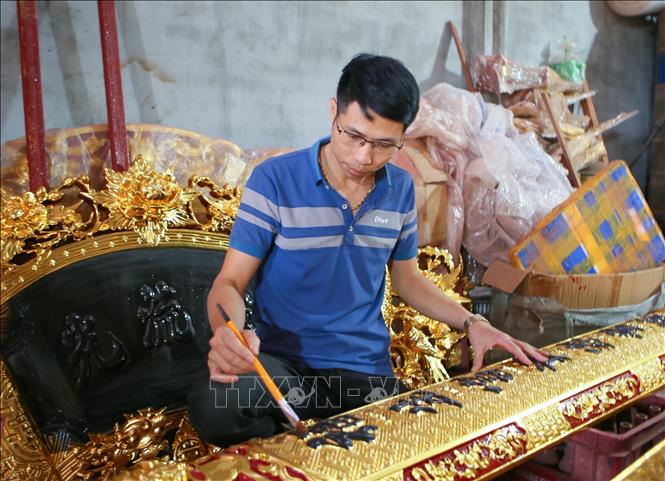
Despite the hectic workload, the faces of the villagers still radiated joy, because each completed product was a part of the approaching Tet holiday atmosphere.
The Hai Minh woodcraft village in Hai Anh commune has long been famous throughout the country for its handcrafted wooden furniture production. The village currently has approximately 200 establishments producing and trading wooden products such as tables, chairs, beds, wardrobes, traditional wooden platforms, and religious artifacts. In Hai Minh, up to 90% of the population, from the elderly and young people to women and even students, are involved in woodcraft production. The total annual income from households in the village averages over 70 billion VND.
According to Mr. Vu Van Nguyen, owner of Nguyen Hong furniture workshop, in response to increasingly stringent consumer demands, the workshop has proactively improved designs and diversified products to suit contemporary aesthetic trends. The new designs retain the exquisite craftsmanship of traditional woodworking while being modernized to bring a luxurious and harmonious look to various interior spaces.
To reach a wider consumer base, in addition to traditional sales channels, the business also extensively promotes itself on social media platforms such as YouTube, TikTok, and Facebook.
According to Mr. Nguyen, during Tet (Lunar New Year), the demand for tables, chairs, and religious items doubles compared to normal days. To meet customer demand, the workshop has proactively hired additional seasonal workers and organized overtime to ensure production progress. Some simple tasks are even assigned to workers to take home, allowing them to manage their time more effectively and increase their income during the end of the year.

In the woodworking village of Dang Chuong, Van Thang commune, in the days leading up to Tet (Lunar New Year), wood production and trading establishments are busy working day and night to meet market orders. The sounds of saws, chisels, sandpaper, and vehicles transporting goods fill the air from early morning until late at night.
Mr. Vu Dinh Chung, owner of Trung Yen religious artifacts workshop, said that his family specializes in making religious artifacts, incense burners, ornate doors, scrolls, and horizontal plaques with couplets. On average, the workshop sells hundreds of sets of religious artifacts each month, but in the last months of the year, the number increases three or four times; the selling price of each set of religious artifacts ranges from 50 to over 100 million VND, depending on the wood material, design, and size. The main market is around Ninh Binh province and some other provinces and cities such as Hai Phong, Bac Ninh, Hanoi …
Currently, Mr. Chung's religious artifacts workshop employs 11 workers and approximately 30 households that process and finish products at home. Wages range from 350,000 to 500,000 VND per person per day. During the days leading up to Tet (Lunar New Year), when market demand increases sharply, workers have to work an extra 2-3 hours each day to meet order deadlines, often working until the 27th or 28th of the 12th lunar month, only getting a break when the last orders are completed. The wooden products here are usually made from woods such as gõ, dổi, gụ, and hương đá, imported from Laos and Africa.
Mr. Vu Dinh Chung shared that to create a complete product that satisfies customers, the wooden products here must go through many stages. First, the imported wood is processed (sawn), then skilled craftsmen will paint, carve, and engrave the details. After that, the surface is sanded smooth and then painted with PU paint or gilded with gold leaf. Each stage requires meticulousness and skill from the craftsman. The craft village here has a long history, passed down from generation to generation, so the craftsmen are highly skilled, and the carvings are more substantial than in other places.
Pham Van Trinh's family is one of many households in the craft village that take on contract work, bringing raw materials home for processing. Working from home allows them to manage their time more effectively and also helps with other household chores. Trinh said that during the end-of-year rush, he and his wife often work from 7 am until 11 pm before resting. Although it's tiring, the craft village is bustling with orders all year round, so they have to work meticulously and carefully to meet customer expectations.
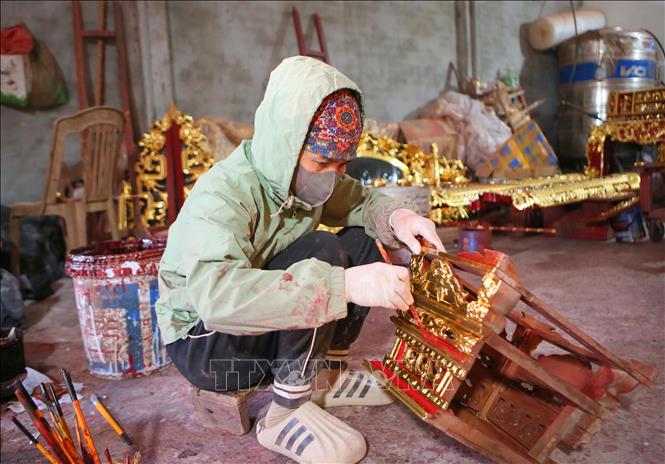
Like other woodworking households, in the days leading up to Tet (Lunar New Year), those households in Dang Chuong village that undertake the final painting and finishing of products are also busy. Painting is the final step before the product reaches the consumer, and it is also considered a key factor in determining the price of wooden furniture.
Ms. Pham Thi Tuoi, the owner of a wood painting workshop in Dang Chuong village, said that her workshop has three workers who work from early morning until late at night, and on many days they even turn on the lights and work until 11 or 12 midnight.
Despite the large volume of work, all wooden products from the village, upon arrival here, are meticulously sanded to a smooth surface, then coated with PU paint or gilded with gold leaf as requested, ensuring quality and customer satisfaction.
Van Thang commune has two villages specializing in woodworking, renowned throughout the country: Dang Chuong and Cat Dang villages, with over 580 households engaged in the craft. The woodworking trade here has a long history, passed down from generation to generation. With skillful hands, the craftsmen create exquisite products that meet the demanding needs of the market. Woodworking not only provides a stable income, averaging 10-12 million VND per month for workers, but also plays a significant role in the local economic development.
Mr. Do Van Giap, Head of the Culture and Social Affairs Department of Van Thang commune, said that since the two-level local government came into operation, the locality has always paid attention to and focused on developing traditional craft villages, considering this a key task in socio-economic development.

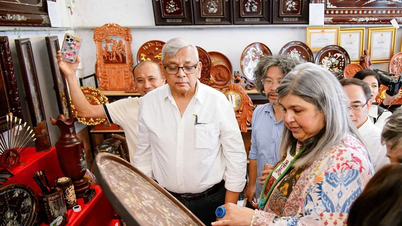
In addition to promoting handicraft products through fairs and exhibitions, the locality also coordinates with banks to facilitate loans for households to purchase modern machinery to meet production requirements, thereby increasing product value, contributing to improved income, and creating momentum for the stable and sustainable development of handicraft villages in the new phase...
Source: https://baotintuc.vn/kinh-te/lang-nghe-moc-chay-dua-voi-thoi-gian-san-xuat-hang-tet-20260204070107283.htm




![[Photo] General Secretary and President To Lam presides over a meeting on preparations for the review of one year of operation of the three-tiered government system.](https://vphoto.vietnam.vn/thumb/1200x675/vietnam/resource/IMAGE/2026/06/02/1780391821195_a1-bnd-4595-9717-jpg.webp)






















































































Comment (0)