

Once a prosperous village beside the picturesque Perfume River, after the Nguyen dynasty built the imperial city of Hue , the village was demolished, causing its inhabitants to scatter…
THE ONLY VILLAGE TEMPLE PRESERVED BY THE KING
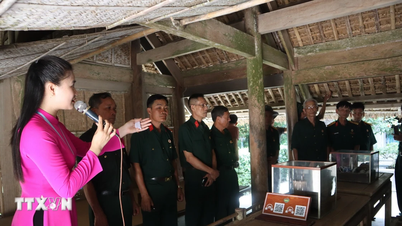
Phu Xuan communal house, currently located on Thai Phien Street (Tay Loc Ward, Hue City, Thua Thien-Hue Province), is the only village communal house preserved by the Nguyen Dynasty within the Imperial City and entrusted to the Ministry of Rites for annual ceremonies. The communal house currently has two main structures. The meeting hall is a three-bay, two-wing house measuring 17.8 meters long and 10.6 meters wide. Although later rebuilt, it has seriously deteriorated. The main communal house, located behind it, is a 10.5-meter-long, 15.9-meter-wide house built in the "upper window, lower panel" style. The connecting beams and railings are made of ironwood, carved with stylized floral motifs, and the roof is covered with flat tiles. This is where the village guardian deity, the local earth god, and the seven founding clans are worshipped: Ho, Le, Nguyen, Huynh, Truong, Tran, and Pham.
Mr. Nguyen Van Diem (87 years old, advisor to the Phu Xuan village representative board, former Deputy Head of the village's culture and history committee) said that the history of Phu Xuan village is recorded from the year 1306, when the Champa king Che Man offered the two provinces of O and Ri as a dowry to marry Princess Huyen Tran of the Tran dynasty. In 1307, King Tran Anh Tong renamed them Thuan and Hoa provinces and appointed General Doan Nhu Hai to take over the land and divide the army to govern.

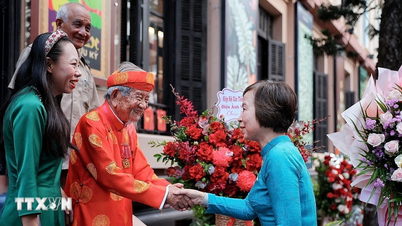
Mr. Nguyen Van Diem, who has spent many years researching the history and culture of Phu Xuan village.
Once stability was established, King Tran Anh Tong ordered Grand Scholar Hoang Thai So (originally from Thuy Loi village, Son Nam Thuong district, Ha Nam province) to lead people south to reclaim land and establish settlements. Before leaving, he recruited seven clans—Ho, Le, Nguyen, Huynh, Truong, Tran, and Pham—who joined him, bringing their families and servants. Upon reaching the banks of the Lo Dung River (the present-day Perfume River), seeing the lush greenery, fertile land, and auspicious feng shui, he ordered the setting up of camp and the establishment of a village, initially named Tong Thuy Loi. Initially, Tong Thuy Loi extended from Kim Long to An Hoa, Bao Vinh, Phu Hiep, Cho Cong, An Cuu, Tu Hieu, Bach Ho, and also included Lam Loc (on the other side of the Perfume River)... Later, the inhabitants of Tong Thuy Loi built a village temple next to the Perfume River (now the Phu Van Lau area in front of the Imperial Citadel), and renamed the village Phu Xuan. "Phú means rich, Xuân means young, with the aspiration that this land will forever remain youthful and prosperous in the future," Mr. Diem explained.
N. HUONG LAND TO BECOME THE CAPITAL CITY
When the Tay Son army defeated the Nguyen dynasty, King Quang Trung ascended the throne at Mount Ban, retaining the name Phu Xuan. At this time, the imperial city of Hue had not yet been built. In 1802, after defeating the Tay Son army and recapturing Phu Xuan, King Gia Long of the Nguyen dynasty ordered the city's supervisor, Mr. Nguyen Van Yen, to demarcate and plan the area for the construction of the new imperial city. The king ordered the people of the Phu Xuan communes to evacuate from the construction area, including temples and shrines. However, the king allowed the Phu Xuan communal house to remain, but moved it behind the imperial citadel.
According to Mr. Huynh Viet But (70 years old, Thuan Loc Ward, currently the Deputy Head of the Standing Committee of Xuan Phu village), legend has it that when the village temple was moved to a new location during the reign of Emperor Minh Mang, the initial team carrying the palanquin consisted of 4 people, but they couldn't lift the altar of the village guardian deity. The Emperor gradually increased the number, up to 20 people, but they still couldn't lift the palanquin. At this point, the Emperor himself had to personally preside over the ceremony and issue a decree stating that, obeying the will of Heaven, the capital had to be established on the village's land to ensure the stability of the nation, and therefore the village temple had to be moved to a new location. The Emperor promised to move the village temple to the most beautiful and elevated location in the capital, to the west of the imperial palace. Immediately, the 4 people carrying the palanquin lifted it easily, Mr. But recounted.
The king granted special permission for Phu Xuan communal house to hold its annual lễ tế (ritual ceremony) on the 5th and 6th of the 6th lunar month. Only after Phu Xuan village in the capital city completed its lễ tế could other villages hold theirs. According to Mr. Nguyen Van Diem, the ancestors of Phu Xuan village made great contributions and were granted many royal decrees by the Nguyen dynasty kings (the village currently keeps 20 of these decrees). In 1994, Phu Xuan communal house was classified by the state as a national historical, architectural, and artistic monument.
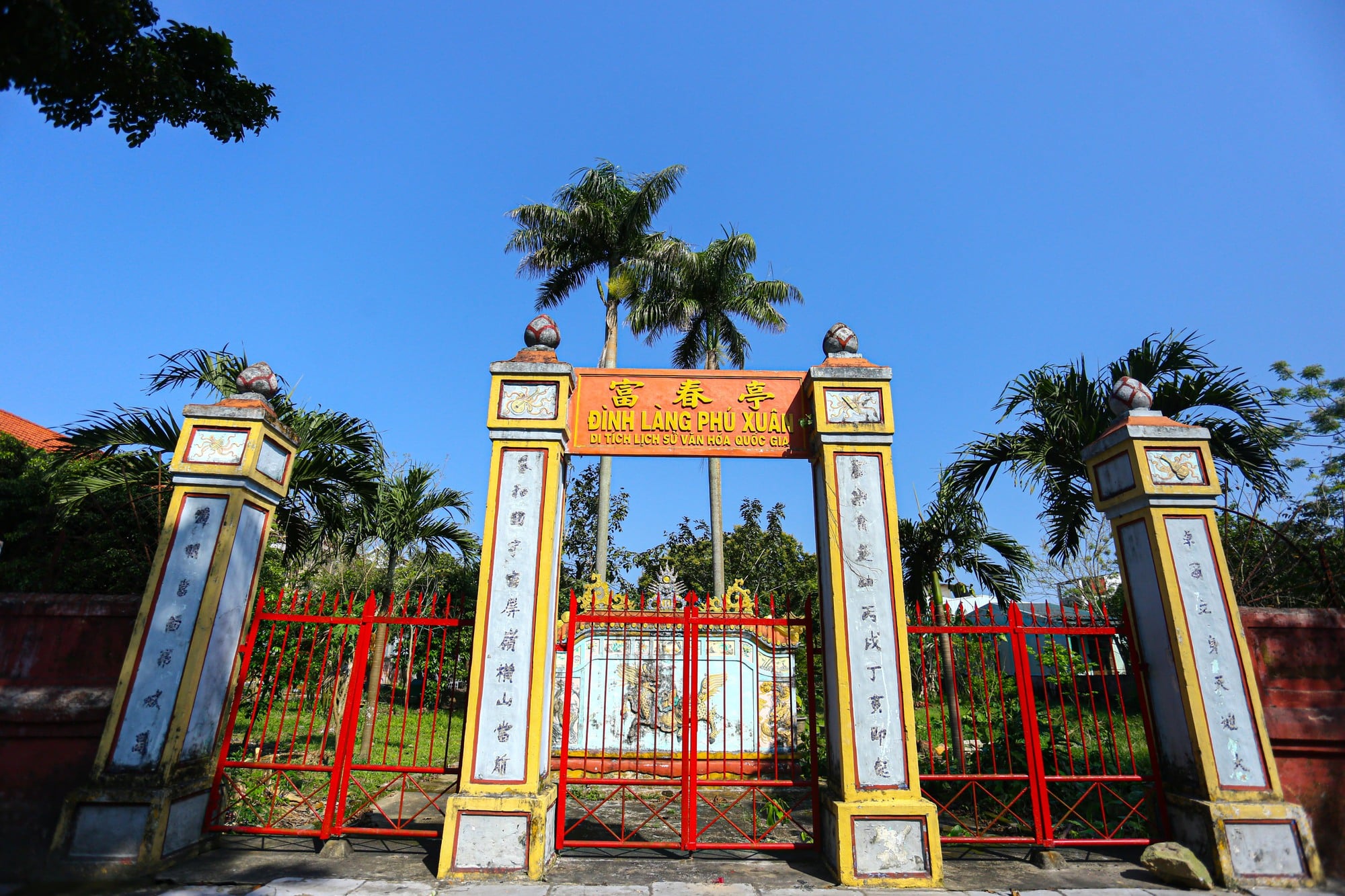
Since the construction of the Hue citadel, the communal house of Phu Xuan village has been moved to the west.
DO NOT FORGET YOUR ROOTS
After relocating the village, the king issued a decree allowing people from Phu Xuan village to travel anywhere to establish settlements, and they could establish villages named Phu Xuan wherever they went to identify their origins from the Hue capital. Therefore, later, Phu Xuan village was established west of the capital (now in Kim Long ward); some moved east to the Bai Dau area, forming Bau Chau and Hop Pho hamlets, which became Phu Xuan village (now in Gia Hoi ward). The remaining people moved southeast, establishing Phu Xuan village (now in Xuan Phu ward). Phu Xuan village, near Phuoc Tich village, also merged with Phuoc Tich to form Phuoc Phu cultural village (in Phong Hoa commune, Phong Dien district). In Hai Lang district (Quang Tri province), there are still two villages originally from Phu Xuan village, now belonging to Hai Phu and Hai Xuan communes. Later, when the government implemented the New Economic Program, people from Hue migrated to the Central Highlands, establishing Phu Xuan villages in Lam Dong, Krong Nang (Dak Lak), etc., and most of them had roots in Phu Xuan village of Hue.
Mr. Nguyen Van Diem said that the greatest wish of the people of Phu Xuan village is for the village communal house to be preserved and maintained. Currently, the communal house still uses industrial corrugated iron roofing, which is dilapidated and leaking. "This is a national historical site, so we can't arbitrarily renovate it. We hope the authorities will pay attention to fixing it," Mr. Diem said. According to Mr. But, each year, representatives from families originating from Phu Xuan village attend the ceremony, but the total number of villagers is too large to be accurately counted. "Recently, a scholarship program was organized to reward the children of the village. The elders are always concerned about how to ensure their children understand history and know their roots. Even if they are scattered far and wide, they will not forget their roots in Phu Xuan, the capital city," Mr. But said.
(to be continued)
Source link
![[Photo] General Secretary and President To Lam and his wife begin their official visit to Thailand.](https://vphoto.vietnam.vn/thumb/1200x675/vietnam/resource/IMAGE/2026/05/27/1779881249412_anh-man-hinh-2026-05-27-luc-18-10-51.png)


















































Comment (0)