

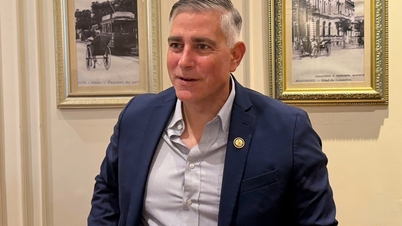
Last night, May 26th, in Ho Chi Minh City, on the sidelines of the event announcing the 35 companies in the Best Workplaces in Vietnam 2026 ranking, organized by the global workplace culture organization Great Place To Work, Mr. Raymund Chua shared his perspective on Vietnamese students and recent university graduates entering the business world with a reporter from Thanh Nien Newspaper.
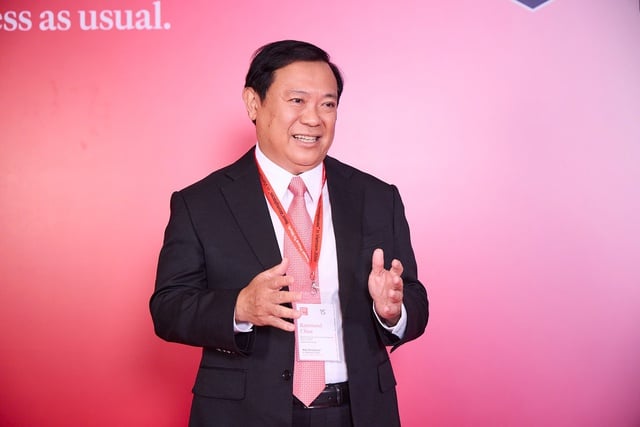
Mr. Raymund Chua shared this with a reporter from Thanh Nien Newspaper.
PHOTO: THUY HANG
Vietnamese students currently lack a lot of experience.
Mr. Raymund Chua, a speaker at the program, is a leader with nearly four decades of experience in business and human resources. He is known as a think tank in the field of artificial intelligence (AI) and is currently a speaker and university advisor, supporting programs related to RMIT University Vietnam and Massey University, New Zealand.
In an interview with Thanh Nien Newspaper, Mr. Raymund Chua stated that, based on his personal observations, "currently, students in general graduate with a wide range of knowledge, but lack experience, especially experience working in businesses and in commerce."
Mr. Raymund Chua, a Malaysian, lived and worked in Singapore for many years before moving to Ho Chi Minh City and choosing it as his "retirement home." He has won numerous awards for his leadership experience in Asia and the EMEA region (an acronym for Europe, the Middle East, and Africa). Mr. Raymund Chua noted that many Vietnamese students are graduating with excellent academic records and university degrees, but he cautioned against complacency. They face intense competition from young people globally.
"Nowadays, young people are proficient in AI skills and tools, but they must also be proficient in foreign languages. Being fluent in Vietnamese alone is not enough in the current context," he added.
However, the man, who is currently coaching several individuals and also serving as a board advisor for Jemmia Diamond in Vietnam, stated, "With my experience as an international recruiter, I would advise you not to adopt everything according to foreign standards. Preserve your Vietnamese identity – your strength – and maintain it for generations to come."
A good academic record and some part-time work experience are not enough.
Raymund Chua stated that for the past 20-40 years, when recruiting recent graduates, employers typically focused on academic results, whether the student had worked part-time, or participated in community activities. However, the reality is different now. Those things are commonplace. What truly matters is whether you have real experience in your field.
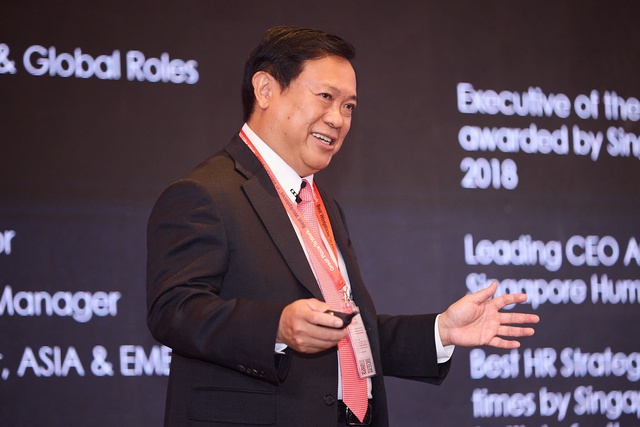
Mr. Raymund Chua's presentation was very emotional.
PHOTO: THUY HANG
He gave an example: at the company where he works, they hired six students from RMIT University Vietnam, and they had six months to work. He has been working directly with the students for the past five months, meeting with them every three weeks. Initially, everyone was shocked by how fast everything was happening. In university, students learn everything sequentially, one module after another. But in reality, things don't wait to be taught in that order.
Currently, many Vietnamese students graduate with excellent grades, are proficient in AI, and are fluent in foreign languages. So, what are the key aspects of skills and attitude needed to achieve success?
In an interview with Thanh Nien Newspaper, Mr. Raymund Chua mentioned two things. Firstly, proactive creativity. Previously, newly recruited employees would wait for their boss to ask questions or for guidance. Now, each person needs to have their own ideas, and truly excellent ideas, to convince not only their direct supervisor, but also their superiors at levels 2, 3, and even higher. Secondly, in the age of AI, the age of computers, each student should pay attention to and prioritize the human element within themselves.
"In the digital transformation process, AI tools are also very important. You often think that with AI, you can do anything, but first and foremost, you must be human. Learn to listen. Learn to understand issues in depth, equip yourself with many skills, and be truly humble," Raymund Chua concluded.
What should workers prepare for in 2026?
At the program, Roland Wee, Chairman of Great Place To Work ASEAN and ANZ, stated that AI has achieved truly incredible growth rates over the past year, with milestones previously predicted to take a decade now compressed into just 18 months.
Roland Wee argues that the workforce of 2026 urgently needs to build adaptability as a core skill – not just enhancing technical expertise, but also developing cognitive and emotional flexibility to work within constantly changing team structures, technologies, and priorities. In this era, the most valuable personnel are not necessarily the most specialized, but those who are most resilient and collaborative.
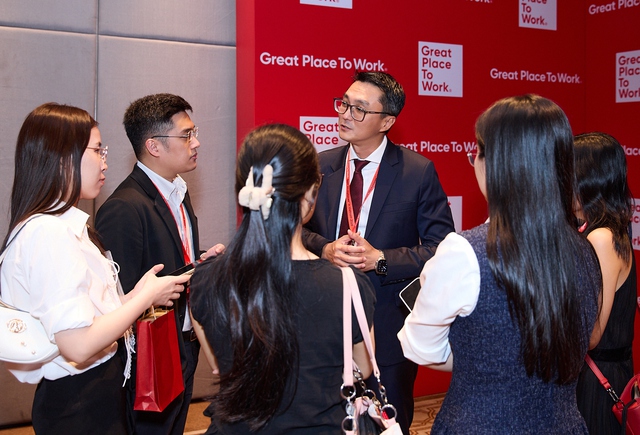
Roland Wee gave an interview to reporters.
PHOTO: PHUONG HA
Raymund Chua, on the other hand, stated that in the age of AI, the biggest challenge is not the technology, but human attention.
"Recently, while training a group of university students, I asked them how many AI applications they regularly used. Most of them had mastered at least three AI tools by their early years of university. Then I asked, 'What would happen if you entered the workplace and realized that your seniors weren't proficient in AI?' One student responded with just one word: 'annoying.' That single word says a lot about the future of the workplace," he recounted.
He compared the past generation of young people to one who spent more time outdoors, reading, socializing, and building social connections. Today, people live in a world constantly stimulated by digital technology, endlessly scrolling but losing the ability to truly be present in the moment. "In the age of AI, mindfulness may become one of the rarest and most valuable human abilities," he reflected.
Therefore, according to Raymund Chua, what is now necessary is for each person to learn how to manage themselves, focusing on clearly understanding their own beliefs and presence, and being truly humble. Leaders also need humility to realize that they cannot hold all the answers and must learn from everyone, including recent graduates.
"The future of work will not belong solely to organizations with the most advanced technology. The future will belong to organizations that maintain human depth. Organizations built on: trust, consensus, purpose, clarity, reliability, humility, and attentiveness," the expert stated.
Source: https://thanhnien.vn/sinh-vien-viet-can-that-su-khiem-ton-185260526214447696.htm

![[Photo] The heat at the fireworks display site on the opening night of the Da Nang International Fireworks Festival 2026](https://vphoto.vietnam.vn/thumb/1200x675/vietnam/resource/IMAGE/2026/05/27/1779889741485_ndo_br_z7872039145157-fecaba5112f39e8352544099d7ef4738-5140-jpg.webp)

![[Photo] The courage of new recruits of Brigade 144 on the training ground.](https://vphoto.vietnam.vn/thumb/1200x675/vietnam/resource/IMAGE/2026/05/27/1779881651341_anh-man-hinh-2026-05-27-luc-18-32-52.png)




































![[Photo] The courage of new recruits of Brigade 144 on the training ground.](https://vphoto.vietnam.vn/thumb/402x226/vietnam/resource/IMAGE/2026/05/27/1779881651341_anh-man-hinh-2026-05-27-luc-18-32-52.png)























Comment (0)