

At two in the morning, the street was asleep. Darkness enveloped the houses, with only a few lights outside remaining. In the silence, I heard the sound of wheels rolling.
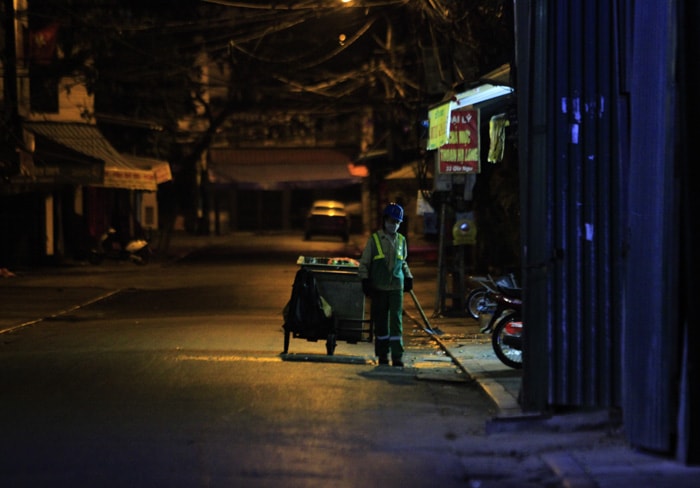
The sound came from the wheels, occasionally hitting stones and causing the truck bed to clatter. It echoed from the beginning of the alley to the front gate of the house, then stopped for a moment.
From the eaves, a figure hunched over could be seen lifting a bag of trash. The cleaning lady disappeared into the darkness, diligently working under the glow of the streetlights. Her shifts always began when everyone else was asleep.
The nature of our work made my colleague and I "sleep-attentive friends." We only saw each other through a gate and never really saw each other's faces. One face hidden behind the window, the other concealed beneath a mask and hood, leaving only the eyes visible.
Occasionally, we'd exchange a few words through the gate. Casual conversations. "You're late today, aren't you?" "This Styrofoam box won't empty; we need to tear it into smaller pieces and put them in bags." Days passed, and as two people struggled to survive in the city, we suddenly realized we weren't so alone. We tried to find a place to anchor ourselves, clinging to the city for our livelihoods, for our concerns, and sometimes, even for our sense of service.
She started the job at 18, a beautiful age for a girl to know how to dress up and be stylish. But the clothes she wears are always reflective, along with a hood and a mask that completely covers her face. "It's a family tradition; I've loved this job since I was little," she said when talking about her reasons for choosing it.
She loved seeing the clean streets lined with green trees. The dedication overflowing in her voice, no longer youthful, moved me deeply. Suddenly, a song lyric popped into my head, "Everyone chooses the easy path, who will take on the hardships?"
Looking at her, I think about myself, about the lives of migrants from all corners of the world. Lost and alone. After each day of struggle, we long for the sound of the garbage truck every night, as a way of feeling the rhythm of the city. A rhythm not hurried amidst the congested traffic of the morning, but slow and quiet, so as not to wake anyone. A rhythm that testifies to the uninterrupted flow of life in the city. A life that persistently flows on, nourishing other interwoven lives. Like me and her.
On some nights, heavy rain and thunder drowned out the sound of the garbage truck. She was soaked in her raincoat, trudging through the flooded streets. I intended to offer her a cup of hot tea, but only caught a glimpse of her back behind the flickering streetlights. She quickened her pace, rushing straight through the downpour. Even after the first time I opened the gate separating us, I still couldn't clearly see her face behind the mask. A person who lives by giving silently.
She pushed the small garbage cart, weaving her way through the intricate network of alleyways. The sound of the garbage cart echoed in the silence, making the rhythm of the street seem a little more relaxed. I felt as if I could hear, in that late-night work sound, the ceaseless heartbeat of the city.
According to Truc Nguyen (Quang Nam Newspaper)
Source: https://baophutho.vn/lao-xao-tieng-pho-ve-dem-225164.htm
































































































Comment (0)