

The appeal comes not just from the taste.
The past year marked a remarkable leap forward for Vietnamese cuisine, rising to 16th place in the ranking of the world's top 100 cuisines, as published by the renowned food website Taste Atlas. In this ranking, Vietnam is praised as a "flavor paradise," a place where diverse dishes reflecting the nation's cultural identity converge. From pho, banh mi, banh xeo, spring rolls, bun bo Hue, bun cha, to com tam… all are suggested by Taste Atlas as must-try culinary experiences when visiting Vietnam.
But that's not all; Vietnam has also been named in numerous prestigious culinary rankings such as: best culinary region in the world, global food city, best food on the planet... Notably, the honored dishes are not limited to the familiar names that have become the "brand" of Vietnamese cuisine, but also include dishes less known to international diners. This achievement is not only a source of pride but also affirms the special appeal of Vietnamese cuisine.

As someone who has always dedicated herself to preserving and spreading the heritage value of pho in particular, and the essence of Vietnamese cuisine in general, culinary artist Le Thi Thiet – Vice President of the Vietnam Culinary Culture Association and President of the Ninh Binh Provincial Culinary Culture Association – expressed her joy and excitement at witnessing the strong mark that Vietnamese cuisine has made on the world culinary map. According to her, the special appeal of Vietnamese cuisine stems primarily from its flavor. It is this refined, harmonious, and distinctive flavor, created from characteristic spices and traditional ingredients, that has allowed Vietnamese cuisine to easily conquer the palates of a wide range of diners.

Besides flavor, another equally important factor contributing to the special appeal of Vietnamese cuisine is the story hidden within each dish – a story about the country, its culture, its people, and the recipes preserved and passed down through generations. Because each dish carries its own story, international diners can easily recognize it as Vietnamese cuisine. A prime example is pho – the pride of the Vietnamese people. “The pho-making craft has been preserved and passed down through generations by many families. For example, Van Cu village (Nam Dong commune, Ninh Binh province) is considered the cradle of the Nam Dinh pho brand, where families have continued the tradition for 3-4 generations, spanning hundreds of years. From this land, many famous pho restaurants have emerged, spreading the flavor of Van Cu pho throughout the country and many countries around the world,” shared culinary artist Le Thi Thiet.

To help Vietnamese cuisine "take off".
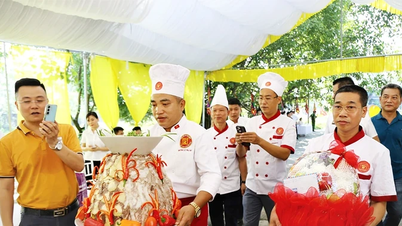
With its unique appeal stemming not only from its flavors but also from its stories, Vietnamese cuisine is gradually winning over international diners, offering experiences that both tantalize the taste buds and touch the depths of Vietnamese culture and people. Each dish is like a cherished slice of memory, inviting international diners to discover the sparkling yet enduring beauty of Vietnamese cuisine.

In the realm of cultural values, cuisine is considered one of the areas with the fastest and widest spread. Many foreigners, even those who have never set foot in Vietnam, have come to know and love Vietnamese cuisine in their own home countries. Furthermore, cuisine has become a crucial factor attracting a large number of international tourists to choose Vietnam as a destination, helping them better understand the history, traditions, lifestyle, and spirit of the Vietnamese people.

However, to fully realize its role as a cultural "ambassador," Vietnamese cuisine still needs a more systematic, long-term, and comprehensive development strategy. According to culinary artist Le Thi Thiet, for Vietnamese cuisine to truly "take off," the most important thing is to preserve the distinctive flavors, unique stories, and cultural essence of each dish. To achieve this, Vietnamese cuisine needs a unified approach to storytelling, while also redefining the excellence and representativeness of its dishes. It also requires the development of appropriate production and processing procedures, ensuring quality, food safety, and the traceability of ingredients.
“Clearly disclosing the ingredients, nutritional value, and recipes of each dish will help international diners gain a deeper understanding of Vietnamese cuisine. In addition, it is necessary to focus on building and developing culinary villages, promoting and training in the F&B industry, and creating conditions for Vietnamese chefs to succeed not only domestically but also internationally. This direction will gradually make cuisine one of the pillars of ‘soft power,’ contributing to spreading not only Vietnamese culture but also the national brand to the world,” affirmed culinary artist Le Thi Thiet.
The Vietnam Culinary Culture Association is implementing a project called "Vietnam Culinary Map," which involves digitizing data and systematizing typical dishes from each locality, from ingredients and processing methods to their origins and accompanying cultural values. Through this, diners both domestically and internationally can easily search, learn about, and access the treasure trove of Vietnamese cuisine in a visual, scientific, and modern way.
Source: https://baophapluat.vn/lap-lanh-am-thuc-viet-nam.html
![[Photo] Admire the coral "masterpiece" amidst the million-year-old heritage of Dak Lak province.](https://vphoto.vietnam.vn/thumb/1200x675/vietnam/resource/IMAGE/2026/05/31/1780221235105_anh-man-hinh-2026-05-31-luc-16-53-27.png)

![[Photo] Solemn bathing ceremony and Buddha procession in Hue](https://vphoto.vietnam.vn/thumb/1200x675/vietnam/resource/IMAGE/2026/05/31/1780228263543_1-jpg.webp)
![[Image] Hanoi Police officially crowned champions of V-League 2025/2026](https://vphoto.vietnam.vn/thumb/1200x675/vietnam/resource/IMAGE/2026/05/31/1780244769054_ndo_br_039d561b692be875b13a-jpg.webp)
![[Photo] The General Secretary, President and his wife begin their state visit to the Philippines.](https://vphoto.vietnam.vn/thumb/1200x675/vietnam/resource/IMAGE/2026/05/31/1780230559452_anh-man-hinh-2026-05-31-luc-19-28-11.png)















![[Video] Sunset at Lap An Lagoon – Where the sun sets over the fishing nets](https://vphoto.vietnam.vn/thumb/340x192/vietnam/resource/IMAGE/2026/05/31/1780192137701_beach-landscape-sea-water-nature-grass-745871-pxhere-com.jpeg)






























































Comment (0)