

Celebrating cultural values
Many literary and artistic works have been created from the special inspiration of the land and people of Dong Nai (including the former Binh Phuoc), with its diverse and unique cultural heritage. Notable examples include: the late musician Xuan Hong with " The Sound of the Pestle in Bom Bo Village ," musician Van Thanh Nho with "Mother's Memories ," musician Tran Cao Van with "I Love My S'tieng ," and musician Ngo Minh Tai with "Binh Phuoc, the Nostalgia Calls Your Name "... These songs are like a colorful painting, depicting in the listener's mind the lush green land of Dong Nai with its hills, flowers, and the bright black eyes of the pure and gentle S'tieng girls...
 |
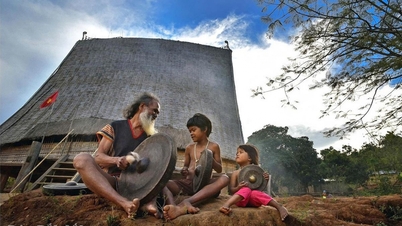
| The longhouse built on stilts (stilt houses) is a cultural symbol of the S'tieng ethnic community. |
Composer Van Thanh Nho, a member of the Vietnam Musicians Association, recounted: During a field trip to Phuoc Long for songwriting, he was introduced to S'tieng folk music when the local community organized a campfire night for him at Long Tan Team, Phu Rieng Rubber Company Limited. “That’s where many S'tieng people live. They lit a fire, men and women played gongs and drums, singing and dancing. It was the melodies of the S'tieng people that resonated with me, urging me to write about this land,” shared composer Van Thanh Nho. Following this trip, he composed the song “Mother’s Memories,” deeply imbued with folk music and featuring imagery of the Be River and the majestic Ba Ra Mountain.
Beyond the majestic sounds of gongs and cymbals, and the graceful dances of ethnic minority boys and girls around the flickering campfire in the villages during festivals, the material and inspiration for many musicians also come from cultural symbols, including stilt houses.
Dong Nai province currently has 37 ethnic minority groups. Although most people have integrated into modern lifestyles, it is not difficult to find traditional stilt houses. These are not only places to live and shared spaces for the community but also cultural symbols.
In the song "Binh Phuoc, the Nostalgia Calls Your Name," composed by musician Ngo Minh Tai in late 2018, stilt houses appear as a striking feature amidst the picturesque village landscape. It's where S'tieng and M'nong ethnic girls grow up, cherishing their maiden dreams; it's where many young men hold dear a fleeting glance, a memory that lasts throughout their youth…
The stilt house nestles with dreams.
The stilt house where nostalgia originates…
Writer Khoi Vu, a member of the Vietnam Writers Association, affirmed: "During my research on the old Binh Phuoc province, I found many topics that I could enthusiastically write about, such as the story of the Be River and the story of the S'tieng ethnic minority people. I believe that in the future, when I research more documents and conduct fieldwork in the old Binh Phuoc province, I can write a book tentatively titled ' Beside the Be River '."
Promoting the leading role of the people in building and developing culture.
Not only artists and writers, but also the people and ethnic minorities in Dong Nai have played a leading role in building, preserving, and spreading unique ethnic cultural values. The story of the family of artisan Ka Thi Ngoc Huong in Ta Lai commune is one example.
 |
| Ms. Ka Huong (right in the photo) and her mother actively pass on the traditional brocade weaving craft of the Ma ethnic group to their children and grandchildren. |
Ka Huong's maternal grandmother, Ka Bao, was a folk artist specializing in the practice and teaching of brocade weaving. She also made significant contributions to teaching the Ma ethnic group's folk dance and song art, participating in the restoration of traditional festivals, and teaching gong performance and brocade weaving to her children, grandchildren, and the younger generation of the Ma ethnic group. Ka Huong's love for her ethnic culture was kindled and grew stronger within her own home.
“As a child, lying next to my grandmother, listening to her tell folk tales and learn about the culture of the Ma people, those values have deeply permeated Ka Huong's mind. Later, when I attended classes at the Dong Nai College of Culture and Arts, and then returned to my village to work at Ta Lai Longhouse, I witnessed the festivals of the Ma people, listened to their love songs, and saw performances of traditional musical instruments such as gongs, zithers, and Chapi… Ka Huong's love for the beauty of her people's culture grew even stronger. Seeing the elderly gradually passing away and the unique musical instruments, weaving, and handicrafts of the Ma people in the village fading away, Ka Huong couldn't bear to accept that loss, so she sought ways to restore them. First, weaving, then performances and traditional musical instruments…” – Ka Huong shared about what motivated her to preserve the traditional cultural values of her people.
 |
| Ms. Ka Huong introduced the brocade patterns of the Ma ethnic group to Mr. Nick and Ms. Jessica, teachers at the South Saigon International School. |
Master Phan Dinh Dung, a lecturer at the Ho Chi Minh City University of Culture, affirmed: Folk artisan Ka Bao in the past, later Mrs. Ka Rin (mother of Ka Huong), and now Ka Huong herself, have played an active role in transmitting the cultural heritage of the community, including experience in brocade weaving.
| Enthused to hear Ms. Ka Huong share about the meaning of brocade patterns and how plant-based dyes are used to color the threads, Mr. Nick, a teacher at the South Saigon International School (Ho Chi Minh City), expressed: “We love sharing knowledge. If the people here can continue to teach other generations within the community, and then tourists can also see and appreciate these values, that would be wonderful.” |
Culture is the root.
Not wanting her people's traditional weaving craft to disappear but wanting to preserve it proactively, Ms. Ka Huong, together with experts from the Southern Vietnam Women's Museum, has preserved knowledge about the craft through documentary films, images, and the collection of related artifacts. On November 18, 2025, an exhibition of the traditional brocade weaving craft of Ma ethnic women was inaugurated at the Southern Vietnam Women's Museum and will run until April 18, 2026. This exhibition not only preserves and introduces the cultural identity of the Ma people in the contemporary context, but each piece of brocade also "tells" visitors about how it was created, about the creativity and patience of the women...
 |
| Traditional brocade fashion show at the "New Day in Bom Bo Village" event (March 2025). Photo: Tien Dung |
Deputy Director of the Southern Vietnam Women's Museum, Nguyen Quoc Chinh, emphasized: "Through surveys, we have found that the traditional weaving craft of the Ma people has been declining. Therefore, organizing the collection and display of artifacts, and producing films and photographs about the traditional weaving craft of the Ma people aims to affirm a very unique cultural aspect of the Ma people, from the patterns to the weaving techniques, thereby preserving and introducing it to future viewers."
After directly visiting the exhibition area, the Chairman of the Ho Chi Minh City Cultural Heritage Association, Le Tu Cam, expressed his confidence: “The craft of brocade weaving is a type of intangible heritage, and intangible heritage always relies on some tangible means to be preserved and passed down from generation to generation. The Ma people have done this, and I believe it is the right trend, and I think other ethnic groups will choose to follow this trend.”
Here, the significance extends beyond simply preserving a memory; it encompasses the preservation of the cultural heritage of an entire ethnic community. Many ethnic communities combine to form a nation. Preserving these values is essentially preserving national identity—something we often talk about.
Ms. LE TU CAM, President of the Ho Chi Minh City Cultural Heritage Association
At the opening session of the 14th National Congress of the Communist Party of Vietnam on the morning of January 20, 2026, presenting the "Report on documents submitted to the 14th Congress of the Communist Party of Vietnam," General Secretary To Lam emphasized: Sustainable development must first and foremost be based on people and culture. The Resolution of the Dong Nai Provincial Party Congress for the 2025-2030 term also affirms: Developing culture, sports, and tourism on par with economic development.
Regarding the contributions of culture to the country's development, Dr. Nhi Le, former Deputy Editor-in-Chief of the Communist Magazine, emphasized: "Having a strong economy in an integrated world is difficult, but not as difficult as achieving sustainable development. This is also confirmed by the nation's history. During the most turbulent times, Vietnamese culture has become a miraculous elixir for the Vietnamese nation to survive and develop. And encompassing the entire history of our nation's development, it is encapsulated in six words: 'Independence - Freedom - Happiness'. This is also the goal of the Party's activities, the goal of the 40 years of reform, and our vision for 2050."
Given the powerful impact of culture, as proven throughout development, preserving cultural identity must begin with each individual and each community. And along that journey, artists and folk artisans are always important subjects in the creation and preservation of culture.
Southern
Source: https://baodongnai.com.vn/bao-xuan-2026/202602/van-hoaneo-giu-coi-nguon-5a21582/



























































Comment (0)