

This is the latest effort by the European Union to crack down on misinformation, which EU officials warn has been thriving in recent years, particularly following the recent emergence of AI technologies.
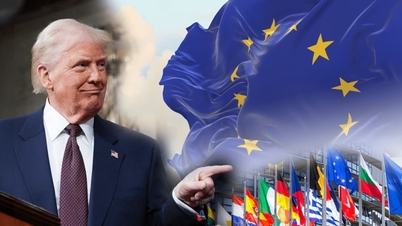
![The European Union is demanding that big tech companies take notice of the content created by [image 1].](https://vstatic.vietnam.vn/vietnam/resource/IMAGE/2025/1/18/8c6788cb7fc749ebbbb61c92dc7deed8)
Photo: DPA
"Advanced chatbots like ChatGPT are capable of generating complex content and images, with a very credible-looking source of information, in just seconds," European Commission Vice President Vera Jourova told reporters.
She urged the 44 companies that signed the EU's voluntary code of practice to help users better identify which content is AI-generated. "Labeling should be done now and immediately," she said.
Will Big Tech companies have to comply?
In fact, tech giants are not obligated to comply with Brussels' latest requirements and will not be punished because this code of practice is entirely voluntary. In May, Twitter even withdrew from the EU code of practice.
But in August, the EU's Digital Services Act will come into effect and will require censorship of key content on Big Tech platforms, including Twitter.
The Digital Services Act will force companies to be more transparent about their algorithms, strengthen processes to prevent the spread of harmful information, and ban targeted advertising based on sensitive data such as religion or sexual orientation.
Companies will face fines of up to 6% of their annual global revenue if found to be in violation of the new law and could even be banned from operating in the European Union.
This means that, although Twitter, Facebook, and TikTok may be able to avoid the latest EU requirement to immediately label AI-generated images or videos , they will still be fined if they allow them to appear on their platforms and violate the new regulations.
EU races to control AI
The European Union is also developing other laws to regulate artificial intelligence, known as the AI Act. Under the plan, some uses of AI would be completely banned, such as "social scoring" and facial recognition in public spaces. The proposals would also restrict AI in "high-risk" areas, including recruitment and public transport.
But these rules are still being drafted and are expected to take at least two years before they are adopted and come into effect. The EU is currently pursuing several interim safeguards, including a new voluntary AI code of conduct and an "AI pact," under which companies can choose to follow future rules right now.
Hoang Ton (according to DW)
Source


![[Photo] Prime Minister Pham Minh Chinh presides over a meeting on private sector economic development.](/_next/image?url=https%3A%2F%2Fvphoto.vietnam.vn%2Fthumb%2F1200x675%2Fvietnam%2Fresource%2FIMAGE%2F2025%2F12%2F20%2F1766237501876_thiet-ke-chua-co-ten-40-png.webp&w=3840&q=75)


![[Photo] Prime Minister Pham Minh Chinh presides over the conference announcing the establishment of the International Finance Centre in Vietnam.](/_next/image?url=https%3A%2F%2Fvphoto.vietnam.vn%2Fthumb%2F1200x675%2Fvietnam%2Fresource%2FIMAGE%2F2025%2F12%2F21%2F1766309817714_ndo_br_dsc-3400-jpg.webp&w=3840&q=75)






















































































Comment (0)