

As Thanh Nien newspaper raised the question in its article "Does Vietnam have too many or too few airports?", according to the recently updated Decision on adjusting the overall planning of the national airport system, the list of airports from now until 2030 has been increased from 30 to 32 airports, including 15 international airports and 17 domestic airports. The vision for 2050 is for this network to further expand to 34 airports.
The arrival of numerous "newcomers" has raised concerns about operational efficiency, especially as many existing airports are still struggling to cover costs. The fear of underutilized airports is becoming even more real as ground transportation infrastructure is experiencing historic leaps forward.
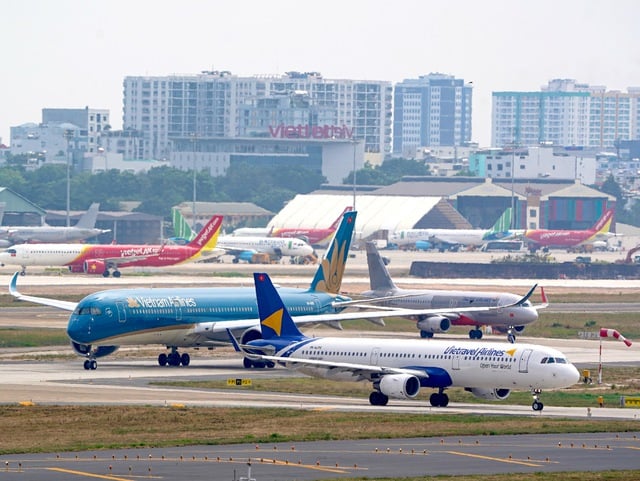
Vietnam's airport network is facing an unprecedented wave of expansion with numerous new projects being included in the planning.
PHOTO: INDEPENDENT
At altitudes below 1,000 km, will the aircraft be overwhelmed?
To date, the Eastern North-South Expressway has been largely completed, shortening travel time by road from Hanoi to Central Vietnam or from Ho Chi Minh City to the Mekong Delta and Central Highlands provinces by half. The trend of self-driving cross-Vietnam tours is also increasingly popular, especially during peak holiday seasons when airfares skyrocket.
From now until 2030, the Ministry of Construction has planned to build approximately 2,000 km of expressways, completing the goal of having 5,000 km of expressways nationwide by 2030. By then, the proportion of people choosing buses and private cars for travel within a 200 km - 500 km radius will be very common.
Meanwhile, the North-South high-speed railway mega-project has officially launched, currently focusing efforts on completing the feasibility study report and preparing for the commencement of priority sections such as Hanoi -Vinh and Ho Chi Minh City-Nha Trang. Many localities have also been rushing to acquire land and clear the site, preparing for the commencement of construction on each section in December of this year.
Mr. Le Hoang Chau, Chairman of the Ho Chi Minh City Real Estate Association, believes that short-haul air travel will be seriously threatened when high-speed rail (350 km/hour) appears.
He cited the example of France: This was the first country in the world to officially enact a law banning short-haul domestic flights if the route could be replaced by a high-speed train with a travel time of less than 2.5 hours (applicable to routes connecting Paris Orly to Bordeaux, Nantes, or Lyon).
"A 2.5-hour train journey at 350 km/hour is equivalent to a distance of 1,000 km or less. This means that high-speed trains only take about 1.5 to 3 hours to connect one city to another. If traveling by plane, even though the flight time is only 1 hour, passengers have to add at least 2-3 hours for traveling to the airport, queuing for check-in, security screening, and waiting for baggage... Thus, for distances under 1,000 km, road and rail transport will be advantageous," Mr. Le Hoang Chau analyzed.
According to Mr. Le Hoang Chau, the North-South high-speed railway network, as planned, will not stop at Ho Chi Minh City; in the next 20-30 years, it will continue to extend all the way to Ca Mau. At that time, the entire economic corridor along the length of the country will be connected by a high-speed mechanical artery.
Therefore, airport construction must be based on practical efficiency and prioritize effectiveness, rather than following a trend where every province tries to build a huge international airport. If the distance is too short and ground transportation connections are too convenient, yet every locality demands to build a large-scale, dual-use, or international airport, then regardless of the funding source, it will be a waste of national resources.
Airport planning needs to be clearly categorized according to geographical characteristics and strategic objectives: In mountainous, rugged areas with heavily fragmented terrain like Dien Bien, Lai Chau, and Ha Giang, a moderately sized airport will break the isolation, serve the needs of the population, facilitate search and rescue operations, and boost the local economy.
"In addition, attention should be paid to areas of national security and defense importance such as the Truong Sa and Hoang Sa islands, or some locations along the central coast. These are infrastructures where efficiency cannot be calculated solely based on commercial profit/loss, but rather the flight range must be considered to be ready for military and defense missions," the Chairman of the Ho Chi Minh City Real Estate Association noted.

According to experts, the concept of "efficiency" for a privately-invested airport project will be much broader than that of a publicly funded project, thanks to its synergy with the ecosystem of tourism and real estate development projects.
PHOTO: SG
The "pie" is still too big to worry about squeezing.
Dr. Huynh The Du (Fulbright School of Public Policy and Management Vietnam) acknowledges that in the future, the efficiency of some airports will face significant pressure as the North-South expressway network becomes increasingly complete, and further along the line with the high-speed rail.
International experience shows that when road and rail infrastructure is sufficiently developed, short-haul flights under 300-500 km often decline sharply as people prioritize lower costs and greater convenience. This means that domestic air travel will no longer have a monopoly as it did in the past.
Furthermore, the greening trend is also a real pressure. Europe, especially France, has begun restricting short-haul flights and replacing them with rail transport to reduce carbon emissions. Vietnam may not be able to move that quickly in the short term, but in the long term, it will certainly be impacted by the global green development trend.
However, Mr. Huynh The Du affirmed that this does not mean the airport network will become redundant. The role of airports will shift: reducing dependence on mass short-haul flights, increasing their role as international transit hubs, high-quality tourism, air logistics, and connecting remote areas that rail or highways cannot completely replace.
"Therefore, the issue is to properly stratify and position the function of each airport. Not every province can expect to become a major transit hub. Some airports will function as gateways for tourism; some will serve logistics, rescue, and defense; and some will only need to be small in scale to anticipate the future development of electric aircraft and flying taxis. If planning is flexible and aligned with regional development strategies, small airports can still be meaningful," said Dr. Huynh The Du.
Regarding concerns that high-speed trains will "steal" passengers from airplanes, aviation and tourism expert Luong Hoai Nam argues that high-speed rail is primarily a supplement, and in some ways, it is also a means of competing with air travel, especially over distances of 500 km or more. However, looking at the world, from Japan and Europe to the United States, nowhere else have high-speed rail tickets been cheaper than those of low-cost airlines.
Therefore, while high-speed rail offers consumers another quality option, it's completely inaccurate to consider it a potential "threat" that could replace air travel, especially low-cost airlines. High-speed rail isn't cheap enough to eliminate airplanes.
According to Dr. Luong Hoai Nam, the domestic flight network connecting Hanoi and Ho Chi Minh City currently ranks 4th in the world in terms of the number of flights and seats offered. The scale of this flight network is "enormous".
"Imagine, even if the North-South high-speed railway line comes into operation and trains run non-stop between Hanoi and Ho Chi Minh City, the railway can only provide a certain number of additional train trips per day. If we consider the number of seats on those few trains in the context of the enormous overall market capacity of both modes of transport, we will see that this increase in total supply is actually insignificant, negligible compared to the current transport capacity of the aviation industry. Therefore, continuing to develop aviation infrastructure to be competitive remains the right direction," Mr. Nam emphasized.
Source: https://thanhnien.vn/lo-duong-bo-duong-sat-cao-toc-se-hot-het-khach-cua-san-bay-185260521160747125.htm


![[Photo] General Secretary and President To Lam presides over a meeting on preparations for the review of one year of operation of the three-tiered government system.](https://vphoto.vietnam.vn/thumb/1200x675/vietnam/resource/IMAGE/2026/06/02/1780391821195_a1-bnd-4595-9717-jpg.webp)


























































































Comment (0)