A modern-day call to arms to save the nation.
The victory of the August Revolution in 1945 ended the colonial and feudal regimes in our country, ushering in a new era in the nation's history: the era of national independence and socialism. However, at that time, our country faced internal enemies and external aggressors. In the North, there were over 200,000 Kuomintang troops, accompanied by the Viet Quoc and Viet Cach groups. In the South, the French colonialists, hiding behind the British army, were disarming the Japanese but in reality wanted to seize our country again. Internally, famine had caused the deaths of over 2 million of our compatriots, and more than 95% of the population was illiterate.
|
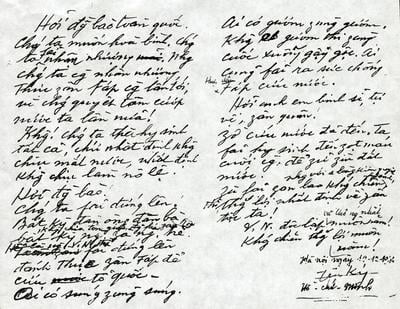
Draft of President Ho Chi Minh 's National Call to Arms for Resistance. |
Faced with the aggressive ambitions of the French colonialists, the Party and President Ho Chi Minh devised many strategies to appease Chiang Kai-shek and the French in order to build and consolidate their forces. However, the French colonialists continuously provoked conflict, launching attacks in the South, encroaching further into the North, and issuing an ultimatum demanding the disarmament of the self-defense forces and control of the capital, Hanoi . In this extremely tense and urgent situation, to rally the entire nation against the French, on December 19, 1946, President Ho Chi Minh, on behalf of the Central Committee of the Party and the Government, wrote the Call to Arms for National Resistance. At 8 PM on December 19, 1946, the cannon fire from the Lang fortress signaled the nationwide resistance, and the resistance against the invasion erupted throughout the country.
Beginning his appeal, President Ho Chi Minh wrote: “We want peace, we must make concessions. But the more concessions we make, the more the French colonialists advance, because they are determined to seize our country once again.” This affirmed the righteousness of the resistance against French colonialism. At the same time, he called on all people, regardless of age, gender, or wealth; whoever has a gun should use a gun, whoever has a sword should use a sword, and if they don't have one, they should use hoes, shovels, sticks… all to rise up against the enemy. This concise but powerful nationwide call for resistance contained the fundamental principles of the resistance against French colonialism, strongly encouraging and arousing national pride, self-respect, and the patriotic, indomitable spirit of the Vietnamese people. Responding to his call to save the country, the entire nation rose up to fight the enemy and save the country with the spirit of “Determined to die so that the Fatherland may live” and a fervent belief in the great victory of the nation.
The "heart" of the protracted resistance war.
When the nationwide resistance war broke out, Tuyen Quang – the capital of the liberated zone during the August Revolution – continued to be chosen as the capital of the protracted resistance war, the central base for leading the entire nation in resistance and national reconstruction. From 1947 to 1954, Tuyen Quang was the residence and workplace of President Ho Chi Minh and the Central Committee of the Party, the Government, the National Assembly, the Viet Lien Front, and various organizations; 13 out of 14 ministries and ministerial-level agencies of the Government, 65 central agencies; the Lao resistance government... Because it was the location of most of the leading resistance agencies, Tuyen Quang was the site of many important events of the Party, Government, and National Assembly… formulating many correct policies and guidelines to lead and direct the resistance war against France to complete victory.

|
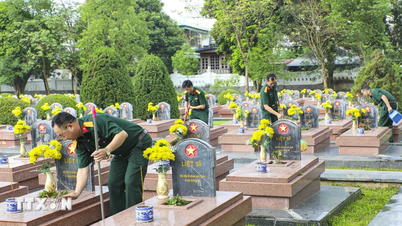
Officers and soldiers from various military units visited the Tan Trao Special National Historical Site to commemorate their historical origins. |
In the dense forests and peaceful villages, the Tay, Nung, Dao, and Cao Lan ethnic groups gave up their homes for cadres, shared their food and clothing with the soldiers, kept secrets, and sheltered the revolution with unwavering faith. Forest trails became vital communication arteries. Villages became "fortresses of the people's hearts." Tuyen Quang was not just a "headquarters," but a space where the wisdom of the resistance was crystallized. It was here that the strategy of a people-to-people, comprehensive, protracted, and self-reliant resistance was concretized through decisions appropriate to the reality, and the belief in ultimate victory was nurtured and spread from the mountains of Viet Bac to all parts of the country. In particular, it directed important campaigns such as the Viet Bac Campaign, the Border Campaign, and the Dien Bien Phu Campaign. Tuyen Quang also had the honor of being the venue for the Second National Congress of the Party. This was the first Congress held in the country and, to date, the only one held outside the capital, Hanoi.
Associate Professor Dr. Nguyen Van Nhat, Deputy Secretary General of the Vietnam Historical Science Association, affirmed: Among the six provinces of the Viet Bac region, Tuyen Quang was not only the place where President Ho Chi Minh, the Central Party Committee, and various ministries and departments were most frequently stationed, but also the site of important events that decisively shaped the direction and success of the Vietnamese people's struggle for independence and resistance against French colonialism. Tuyen Quang deserved and fulfilled its role as the center of the Liberation Zone Capital and the Resistance Capital.
The history of the Vietnamese revolution will forever remember the immense contributions of the Party Committee and the people of Tuyen Quang province to the victory of the resistance war against French colonial aggression. This is also a source of pride for the Party Committee, the government, and the people of Tuyen Quang province today to inherit and develop in building a prosperous and strong Tuyen Quang homeland.
An Giang
Source: https://baotuyenquang.com.vn/van-hoa/du-lich/202512/loi-hieu-trieu-non-song-0106fb8/





























































Comment (0)