

 |
| "Chi chi chanh chanh" is a captivating game that attracts many children to participate. |
The rhythm of childhood
In this digital age, it's not uncommon for children to play games on electronic devices. But it's also wonderful to see that in many places, especially in rural areas, the sounds of folk songs and traditional games still resonate, with children enjoying themselves in the courtyard of the community cultural center, by the bamboo groves of their village, or in a spacious yard at home.
The amazing thing is that folk games and nursery rhymes, often taught orally by children themselves, have become ingrained in people's hearts and minds. Each song and each rule has nurtured the souls of many, so that even when far away, they always remember a time of "Dragons and snakes climbing the clouds / There are swaying trees / There are houses of valiant soldiers..."
These simple, rustic nursery rhymes accompany children as they grow up, deeply ingrained in the memories of generations. They are not just joyful songs, but also the rhythm of childhood, the very soul of national culture, naturally passed down through games and the infectious laughter of children.
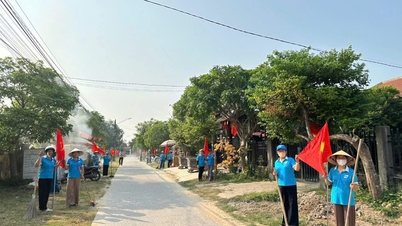
Witnessing groups of children of various ages playing traditional games like "O An Quan" (a board game), tug-of-war, "Rong Ran Len May" (a traditional Vietnamese game), blindfolded tag, "Nang Nu Trong Hoa" (a traditional Vietnamese game), "Chuyen Chat" (a traditional Vietnamese game), jump rope, and "Chi Chi Chanh Chanh" (a traditional Vietnamese game) along the village road and in the courtyard of the community cultural center, my heart calmed down and I fully appreciated the innocence that has existed for generations in the countryside.
Children's rhymes and playful folk games draw young children in. Through these activities, children acquire a wealth of vocabulary, develop a poetic sensibility, and improve their physical abilities. The rhymes in rhymes are poetic, lyrical, and literary. Folk games, on the other hand, train children's agility, endurance, and quick reflexes. Each game is a lively exercise that requires no modern equipment or expensive costs.
Profound humanistic lessons
While games on electronic devices are appealing because of their visuals and sound effects, traditional folk games attract children in open spaces. Electronic games captivate children, making them sit for hours at the keyboard, even skipping meals to pursue a game.
 |
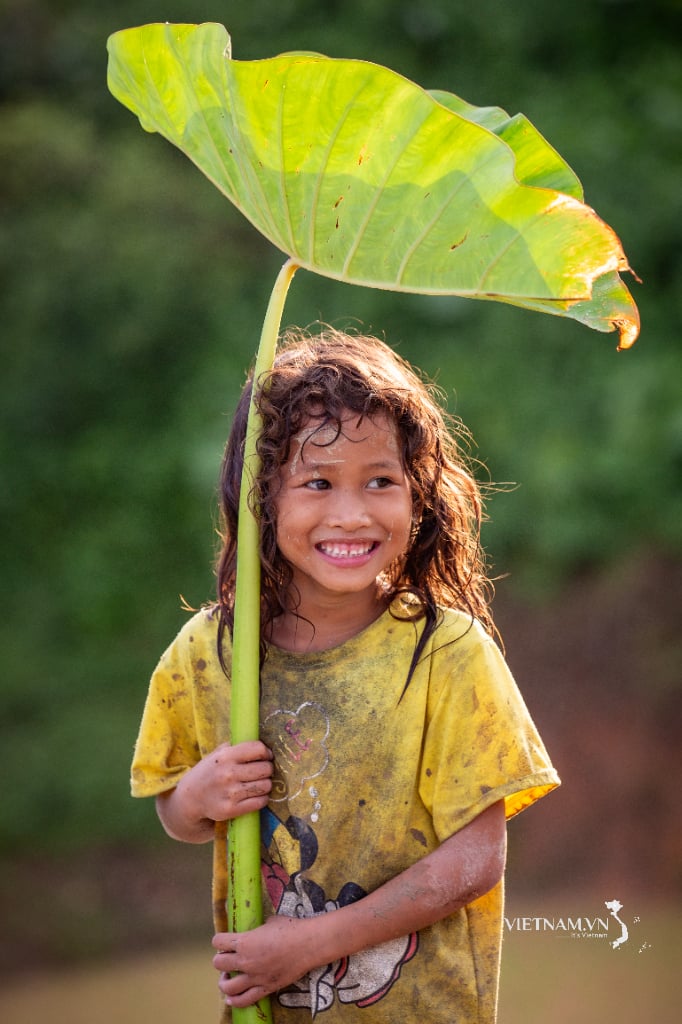
| Children are always cheerful and enjoy participating in games. |
Consequently, many health problems arise, such as memory loss, nearsightedness, obesity, and stress. Traditional games, on the other hand, allow children to meet and play together under the bright sunshine and fresh breeze. Their bodies get comprehensive exercise, and their minds become relaxed. For children, it's an effective learning environment for developing thinking skills and life skills through practical experience and the natural joy of play.
For example, the traditional Vietnamese board game "O An Quan" requires calculation, prediction, strategy building, and careful consideration of moves. These are fundamental lessons in logical thinking and strategy. Playing catch hones concentration and dexterity. Through this, children learn patience and meticulousness.
Group games like "dragon and snake," tug-of-war, hide-and-seek, and "chi chi chanh chanh" help children learn to cooperate and respect the rules of the game. When disagreements arise, children find ways to resolve conflicts through dialogue and agreement. This process develops communication skills, problem-solving skills, and a sense of responsibility.
A key characteristic of folk games is their collective nature. No folk game is exclusively for an individual. To play, children must find friends, invite each other to play, run together, share laughter, and share both wins and losses. It's the most equal playing field in any society. Because the rules are set by the children themselves and strictly followed, there is no distinction between rich and poor children. All agile and skillful children can become "heroes."
Traditional folk games are accompanied by nursery rhymes. Nursery rhymes have a simple, rhythmic, and easy-to-remember rhyming structure. It is precisely this characteristic that allows children to acquire language naturally. For example, rhymes like: “Chi chi chành chành/The nail blows fire”; “Dung dăng dung dẻ/Taking children out to play/To the gate of heaven/Praying to uncle and aunt/Let the child go home”; “Pulling saws, sawing wood/Which carpenter is strong/Goes to eat the king's rice/Which carpenter is weak/Goes to suckle mother's breast”… have naturally entered the subconscious of generations. Through nursery rhymes, children “voluntarily” become familiar with the rhythm of the Vietnamese language, with rich imagery and sounds, and their memory is trained through the repetition of rhyming verses.
Especially in the context of the increasing prevalence of internet slang and borrowed words, children's "voluntary" exposure to simple, expressive folk language contributes to preserving the purity of the Vietnamese language. Deep within these folk songs lie moral and humanistic lessons. Many folk songs convey messages about filial piety, friendship, love of nature, and the virtue of hard work.
Source: https://baothainguyen.vn/van-hoa/202603/lon-len-cung-cau-hat-dong-dao-7eb16fa/


































































Comment (0)