

 |
| Developing the Van Cu vermicelli-making village: a driving force for poverty reduction in the locality. |
Diverse support options
Taking us on a tour of Van Cu noodle-making village, Mr. Mai Van Xuan, Vice Chairman of the Kim Tra Ward People's Committee, informed us that after being recognized as a national intangible cultural heritage, Van Cu noodle village has further solidified its brand. Thanks to this, households have proactively invested in machinery and equipment for noodle production, such as semi-manual noodle presses, dough mixers, and rice processing machines, to increase productivity and supply the market. Each day, the noodle factories here supply the market with tens of tons of various types of noodles. Smaller households produce about 1-2 quintals (100-200 kg), while larger ones produce 3-4 quintals per day. The market is throughout Hue city and neighboring provinces and cities. As a result, the village's revenue is expected to reach nearly 110 billion VND in 2025...
A prime example is the noodle production facility of Mr. Nguyen Sanh Minh – the largest-scale producer in Van Cu noodle-making village. For many years, he has applied a continuous production machine method, supplying the market with 5-6 quintals of fresh noodles daily. His facility also provides stable employment for 4-5 workers. “Thanks to the local government’s support in providing production loans and promoting our products, my family has boldly expanded production, bringing in a monthly revenue of 150 million VND…” – Mr. Nguyen Sanh Minh happily stated.
Currently, in Van Cu residential area, nearly 50% of households are directly involved in vermicelli production, while the remaining households provide services such as supplying raw materials and distributing vermicelli throughout the market. Each day, the vermicelli factories here supply the market with nearly 30 tons of various types of vermicelli, not including periods when production doubles during holidays and Tet (Lunar New Year). Thanks to this, households providing services to the craft village have increased their income and risen out of poverty.
Meanwhile, in Binh Dien commune, after the administrative merger, the biggest challenge is the relatively high poverty rate. The majority of poor and near-poor households are ethnic minorities. To motivate these poor households to improve their economic situation , in addition to promoting traditional craft products, the departments and agencies of Binh Dien commune have developed specific poverty alleviation plans and proactively mobilized resources to support poor households, contributing to a rapid reduction in poverty in the area.
Ms. Le Thi Hiet, a member of the Pa Hy ethnic minority in Hamlet 1, expressed: "The commune provided me with two cows to create a livelihood, which suits my family's working conditions very well. Currently, my family continues to be included in the list of those receiving support for agricultural development, creating additional income to help my family escape poverty sustainably."
The poverty rate has decreased over the years.
In practice, localities such as Binh Dien and Kim Tra have integrated poverty reduction support policies in general, and projects under the National Target Program for Sustainable Poverty Reduction in particular, with their local socio-economic development programs. Simultaneously, they have created policy mechanisms to enable joint investment by the people and the State to improve access to basic social services. Priority has been given to investing in disadvantaged areas, providing focused support to poor and near-poor households, rather than spreading resources thinly.
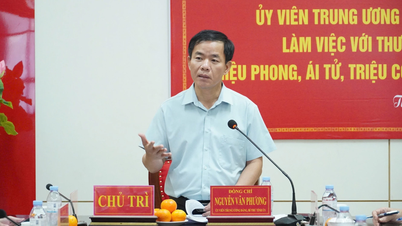
According to Mr. Tran Dang Quang, Vice Chairman of the People's Committee of Binh Dien commune: The commune focuses on disseminating information to help people access policies and funding sources, thereby developing appropriate poverty reduction plans. The commune's departments and organizations are also assigned to guide people in effectively using preferential loan capital to invest in models of growing specialty fruit trees such as green pomelo, planting large timber forests, and raising livestock and poultry... As a result, the local poverty rate has rapidly decreased from 3.4% in 2023 to only 1.13% currently.
The program to provide breeding cattle to poor households in Binh Dien commune has been assessed as highly effective in the local poverty reduction efforts. Thanks to this, many poor households have overcome difficult times and have a stable source of livelihood. In addition, various levels of government and local authorities have also focused on organizing technical training courses, job placement, preferential loans, and health insurance for newly-escaped-poverty households, contributing to preventing re-poverty.
In Kim Tra ward specifically, the Party Committee directed the local government, departments, and mass organizations to actively disseminate information to residents about support policies to ensure that beneficiaries are selected according to the correct poverty reduction targets, and to clearly identify the advantages and difficulties in implementing poverty reduction work. Each department and mass organization is assigned to be responsible for a specific number of poor households. Based on this, plans are developed to address any shortcomings and ensure that the criteria for escaping poverty are met. Mr. Mai Van Xuan added that from 277 poor households (3.48%) and 336 near-poor households (4.23%) in 2021, by mid-2025, Kim Tra ward aims to reduce these numbers to 96 poor households (1.14%) and 178 near-poor households (2.11%). The goal by the end of 2025 is to reduce the poverty rate to below 1%.
Source: https://huengaynay.vn/chinh-polit-xa-hoi/an-sinh-xa-hoi/long-ghep-cac-chinh-sach-de-giam-ngheo-hieu-qua-161255.html
































































































Comment (0)