

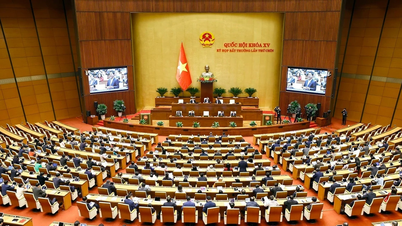
Contributing her opinions during the discussion on amending the Press Law at the 10th Session of the 15th National Assembly , delegate Tran Thi Thanh Huong - Deputy Secretary of the Provincial Party Committee, Head of the Provincial National Assembly Delegation, and Chairwoman of the Vietnam Fatherland Front Committee of the province - argued that a journalistic work requires a series of multi-platform, multi-media, and multi-format skills. A reporter must carry the entire "newsroom on their shoulders." After 10 years of implementation, Government Decree No. 18/2014/ND-CP on the remuneration regime in the fields of journalism and publishing has increasingly revealed shortcomings such as not clearly distinguishing the mechanism for paying royalties for works created from different financial sources; the remuneration levels are too outdated compared to the current situation, leading to difficulties for press agencies in attracting and retaining high-quality human resources.

A journalistic work requires a range of skills spanning multiple platforms, media, and formats. Photo: GIA KHÁNH
“The amended Press Law is only the first step; many other sub-laws are still needed. In reality, the Ministry of Culture, Sports and Tourism needs to quickly advise the Government to amend Decree No. 18/2014/ND-CP and adjust the authority to implement Circular 05/2024/TT-BTTTT to suit the practical situation, creating conditions and motivation for press and media agencies to strive and successfully fulfill their assigned political tasks in the new context,” suggested delegate Tran Thi Thanh Huong.
Journalist Tan Van Ngu - Chairman of the Provincial Journalists Association - highlighted a prominent point that has a significant impact on the development of local media agencies and journalists. The law supplements policies for media development, ensuring resources for implementation, from financial mechanisms to infrastructure investment and tax incentives, in a more feasible direction. The State will have policies to invest in media development, training, fostering, and developing human resources for digital transformation in journalism, applying modern technology to media agencies; a national digital media platform; digital media data infrastructure; and digital tools to monitor journalistic activities in cyberspace.

According to Mr. Tan Van Ngu, social media currently dominates and surpasses mainstream media outlets due to the lack of a strict and comprehensive legal framework for managing cyberspace. Social media operates almost without any oversight, with sensational and attention-grabbing information readily available to cater to popular tastes. Harmful and toxic information attracts a large number of readers and commentators. Meanwhile, mainstream media outlets are losing their traditional readership and failing to attract new readers, especially young people. The number of newspapers published is decreasing; listeners and viewers are declining, leading to dwindling advertising revenue to the point where it cannot cover operating costs, or even pay salaries and fees to staff and reporters.
“The adoption of the amended Press Law will contribute additional solutions to help press agencies generate more revenue and provide a clear and solid legal basis for planning long-term development. This includes mechanisms and policies for assigning tasks, placing orders, bidding, and supporting transportation costs, publication, transmission, and broadcasting expenses to enable the press to serve political objectives; and preferential tax policies as stipulated by law…”, journalist Tan Van Ngu expressed his expectations.
Journalist Nguyen Hoang Anh Tuan, former Deputy Editor-in-Chief of An Giang Newspaper, stated: “It can be seen that ‘unleashing’ the economic constraints of journalism is the most important change to reduce the dependence of media organizations on the state budget, especially as traditional advertising is declining. The law allows media organizations to operate more flexibly in linking and doing business in related fields such as media, event organization, digital content, and e-commerce on their platforms. The law concretizes the mechanism of the State ordering and assigning tasks to provide public services using the state budget.”
From an overall perspective, the amended Press Law not only addresses the immediate economic and resource challenges facing the press but also lays the foundation for a sustainable long-term development model. When the press is given more autonomy in organizing content production, service partnerships, and technology applications, it simultaneously demands increased social responsibility, adherence to principles and objectives, and the political integrity of journalists. A more open mechanism does not mean loosening management, but rather a shift from administrative management to modern, transparent governance based on law and professional standards.
More importantly, the amended Press Law opens up opportunities for local press agencies to reinvent themselves, shifting from a mindset of dependence and subsidies to one of proactiveness, creativity, and adaptability. When empowered by a progressive legal framework, revolutionary journalism can both fulfill its political mission and develop a sustainable press economy, contributing to building a healthy and humane information space in the digital age.
GIA KHANH
Source: https://baoangiang.com.vn/luat-moi-van-hoi-moi-cua-bao-chi-a471028.html



















































![[Video] Sunset at Lap An Lagoon – Where the sun sets over the fishing nets](https://vphoto.vietnam.vn/thumb/1200x675/vietnam/resource/IMAGE/2026/05/31/1780192137701_beach-landscape-sea-water-nature-grass-745871-pxhere-com.jpeg)



























Comment (0)