

With the number of people still working as horse-drawn carriage drivers dwindling, it was difficult for us to meet Mr. Chau Da (Vinh Lap hamlet, An Cu commune, An Giang province), who has over 20 years of experience in the profession. The 60-year-old carriage driver was diligently feeding his horses.
Mr. Da began the story in a somber tone: "The profession of horse handler is gradually dying out, and the decreasing income is causing many people to abandon the profession."
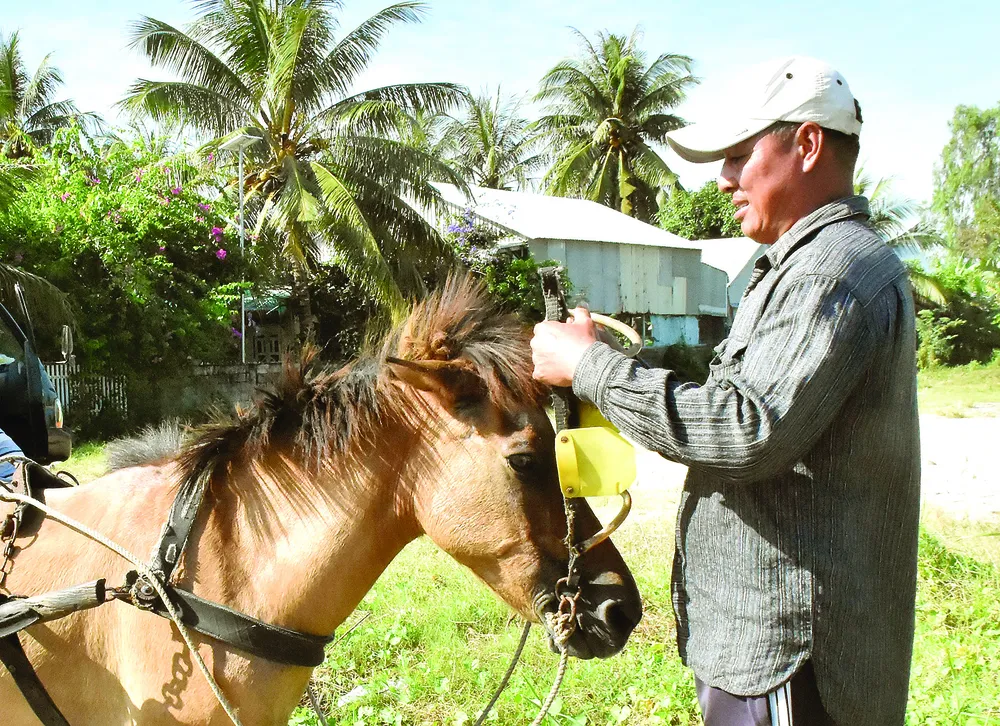
In its heyday more than a decade ago, the Bay Nui region had about 200 horse-drawn carts, but now only 5-7 people remain committed to the profession, concentrated mostly in An Cu commune. According to Mr. Da, most of the cart pullers are men, mostly Khmer. They see this as a way to earn a living and support themselves and their families. The job of pulling horse-drawn carts is easy to make money from, but it's quite hard work because they have to carry goods for customers.
Previously, when business was good, he would do 4-5 trips a day, but now it's only 1-2 trips, and sometimes he sits all day without anyone hiring him. The goods Mr. Da transports are mainly firewood, trees, and scaffolding; the price depends on the distance and the quantity of goods. Sometimes he's hired to transport goods for wedding processions, earning around 1 million VND per trip. Occasionally, during festivals or Tet (Lunar New Year), visitors from afar often hire him to ride horse-drawn carriages to visit Mount Cam, costing around 300,000-500,000 VND per trip...
With over 10 years of experience driving horse-drawn carriages, Mr. Nonh Oanh No (43 years old, residing in Vinh Tam hamlet, An Cu commune, An Giang province) shared: “My parents used to raise horses and passed on their experience to me. The important thing is to train the horses to pull the carriage; it's not difficult, but it's not easy either.”
Because horse-drawn carts are highly maneuverable and can navigate mountainous terrain and steep slopes, they are often hired by people in Khmer villages to transport rice, wood, and timber. Prices vary depending on the weight of the goods; for distances of 8-10km, the average cost is around 300,000 VND per trip, while shorter distances cost around 100,000 VND. "I only transport a few loads a day. During peak rice seasons or festivals, I transport until late at night, making several trips a day, and the income is quite good," Mr. Nô said.
Compared to horse-drawn carriages in other areas, the carriages in the Bay Nui region have very distinct characteristics: they are made by the Khmer people, with a rudimentary design, open roof, and no handrails, making them easy to sway back and forth for those unaccustomed to the ride. These are "single-horse" carriages, meaning they are pulled by only one horse. Each carriage can carry approximately 500-800 kg of goods or 4-5 people.
When driving the cart, the driver pulls the reins to make the horse go or run as desired. Some carts also have bells or rattles attached to the horse's neck to create a jingling sound. To avoid distractions during transport, the horse is often partially blindfolded, only needing to obey the driver's commands and the force of the reins (strong, weak, left, right) to move forward.
Sharing more with us, Mr. Nô said that horse breeders usually pay close attention to the selection of breeding horses. A good horse must have essential qualities such as a long ridge of hair running from the lower leg up to the back, and a central whorl of hair on the forehead, because horses with off-center whorls are often unruly and aggressive. Horses with many good qualities and robust health are often converted by horse breeders from pulling carts to breeding horses.
The image of horse-drawn carriages rattling along the roads may now only exist in memories...
Source: https://www.sggp.org.vn/nang-no-voi-nghe-post838192.html






















![[Photo] Reception to welcome General Secretary and President To Lam and his wife on their State visit to the Philippines](https://vphoto.vietnam.vn/thumb/1200x675/vietnam/resource/IMAGE/2026/06/01/1780295488620_vna-potal-chieu-dai-chao-mung-tong-bi-thu-chu-tich-nuoc-to-lam-va-phu-nhan-tham-cap-nha-nuoc-toi-philippines-8798060-7855-jpg.webp)


























































Comment (0)