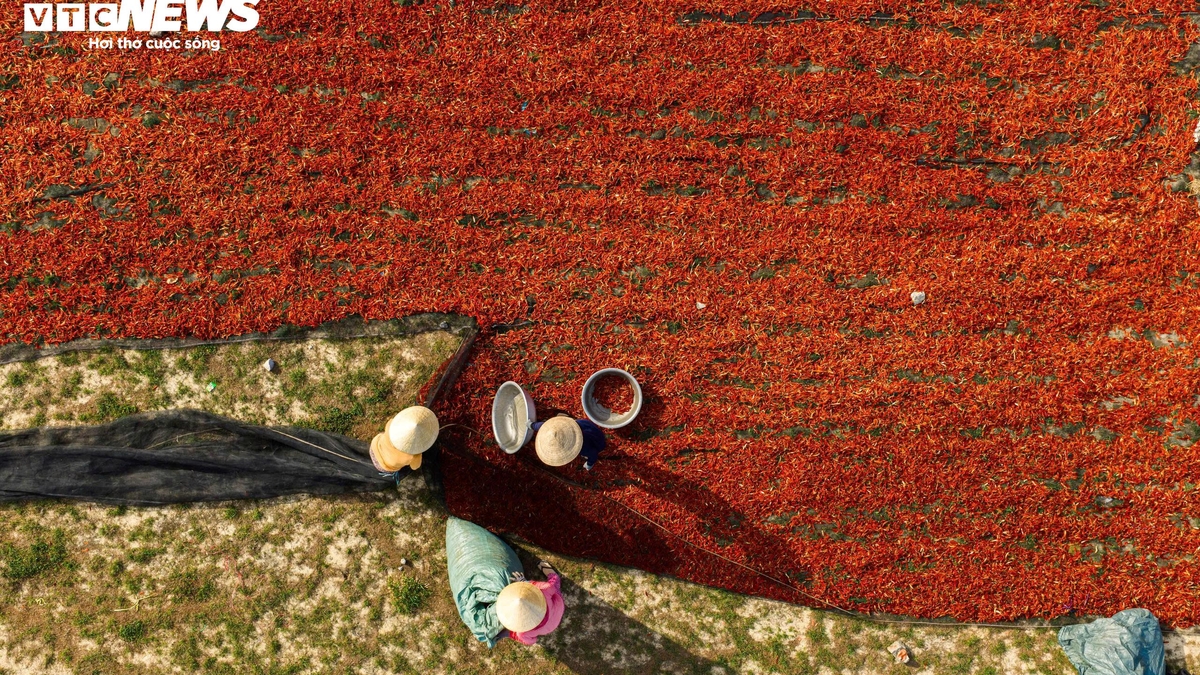
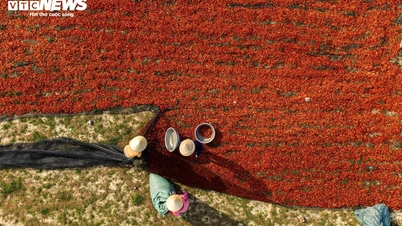
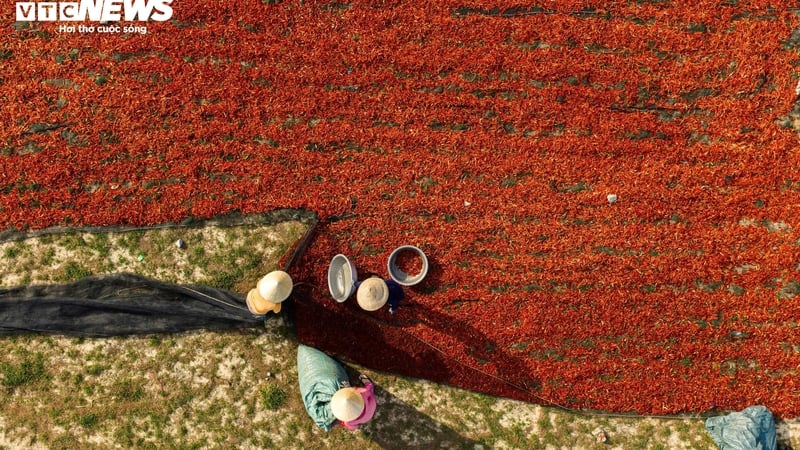
A close-up view of the last chili peppers of the season drying in the fiery red sun on the sandy soil of Gia Lai.

In late May, the coastal areas of Gia Lai are scorched by the sun, heating up the fine sand dunes. This is the time when farmers in communes like An Luong and Phu My Dong take advantage of the heat to dry chili peppers along the roads and sandy coastal areas.

On the sandy slopes and in the fields, batches of red chili peppers are drying like "flames".

Chili peppers from these regions are famous for their spiciness, aroma, and pungency. They are not only sold fresh domestically and exported to China and South Korea, but the locals also dry them and sell them as dried peppers.
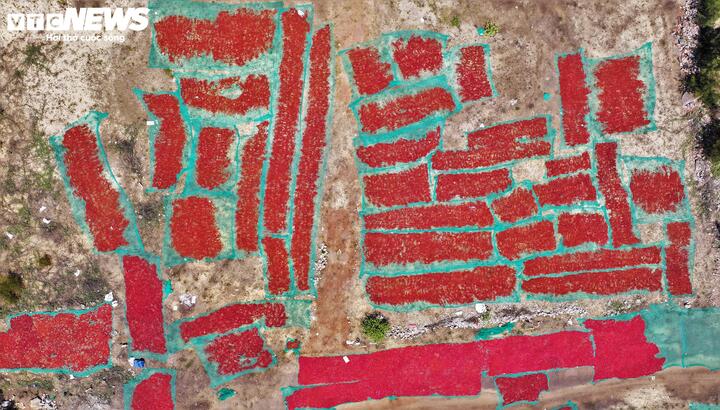
The rows of sun-dried chili peppers, a vibrant red, stretch out, emitting a pungent, strong, and distinctive aroma characteristic of this coastal chili variety.

Over the past few days, coastal areas of Gia Lai have experienced outdoor temperatures of 37-38 degrees Celsius. Drying chili peppers under the scorching sun is an advantage, but it is also a strenuous and exhausting process for farmers, causing them to sweat profusely and have teary eyes.

Farmers have to spend hours in the sun, constantly turning, raking, and stirring to ensure the chili peppers dry evenly without burning, bruising, or losing their color.

To produce high-quality dried chili peppers, farmers in Phu My Dong and An Luong communes have to endure the arduous journey of working the land under the sun and the intense spiciness of the chili peppers.

The hardship isn't limited to the harvesting stage; it begins from the seedling stage, from preparing the soil and watering to the flowering and fruiting plants. Caring for chili peppers is like caring for a newborn baby; just one thrips infestation or a frost can wipe out everything.

The barren sandy coastal area, where one might think no plant could withstand the scorching heat of the dry season and the salty sea breeze, actually provides ideal conditions for the growth of bird's eye chili and horn chili peppers, making chili farming here famous.

According to Mr. Nguyen Van Ty, a chili farmer in An Luong commune, a chili crop in this sandy soil usually begins in October or November, and after a period of care, it is typically harvested after about 5-6 months.

"Currently, the price of chili peppers that traders are buying has dropped sharply compared to last year, only about 15,000 - 20,000 VND per kilogram for fresh peppers and 80,000 - 90,000 VND per kilogram for dried peppers. Growing chili peppers is extremely hard work, but it's our livelihood, our lifeline during each lean season," Mr. Ty shared.

According to the farmers, the current price is only "reasonable," allowing them to recover their costs for fertilizer and labor, leaving little left over for accumulation and reinvestment in the next crop.

Despite enduring the ups and downs of bumper harvests and falling prices, the chili pepper fields have been maintained thanks to the hard work and perseverance of the people in the coastal region of Gia Lai.
Source: https://vtcnews.vn/man-nhan-nhung-tham-ot-do-ruc-บน-mien-xu-cat-gia-lai-ar1020983.html
























![[Photo] Reception to welcome General Secretary and President To Lam and his wife on their State visit to the Philippines](https://vphoto.vietnam.vn/thumb/1200x675/vietnam/resource/IMAGE/2026/06/01/1780295488620_vna-potal-chieu-dai-chao-mung-tong-bi-thu-chu-tich-nuoc-to-lam-va-phu-nhan-tham-cap-nha-nuoc-toi-philippines-8798060-7855-jpg.webp)












































Comment (0)