

This is also the goal that Ho Chi Minh City is pursuing: in the next 10 years, the metro system will cover every corner, meeting all the transportation needs of residents and tourists.
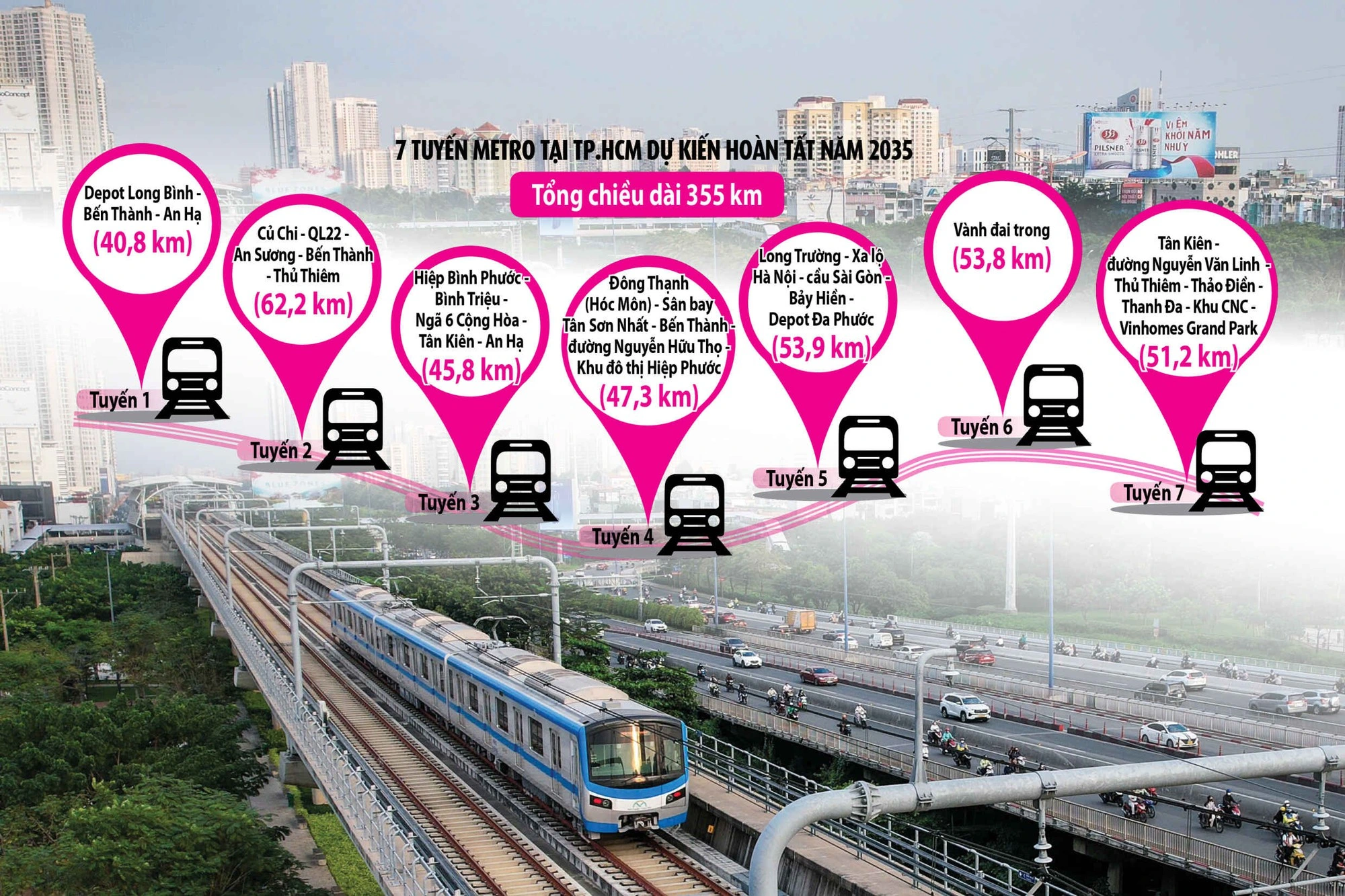
Metro Line 1 Ben Thanh – Suoi Tien started operating on December 23, 2024. By 2035, Ho Chi Minh City is expected to complete 7 metro lines with a total length of 355 km.
Photo: Nhat Thinh - Graphics: Bao Nguyen
By 2035, Ho Chi Minh City will have 355 km of metro lines.
On Monday morning (December 23rd), as usual, Mr. Nguyen Tuan Hai (resident of District 3, Ho Chi Minh City) woke up early to prepare for his more than 15 km commute from his home to the High-Tech Park (Thu Duc City). However, instead of sluggishly pushing his motorbike and bracing himself for traffic jams and dust as usual, today Mr. Hai went to work by metro.
“It was a great experience. Normally, it takes me about 45 minutes to travel by motorbike if there's no traffic, but today it only took about 20 minutes by metro, saving me half the time. The train was clean, the early hour meant fewer people, and the seats were spacious and comfortable. So from now on, I won't have to start my workday feeling tired and sluggish from driving like before,” Mr. Hai excitedly shared.
Mr. Nguyen Tuan Hai (residing in District 3, Ho Chi Minh City)
On the early morning train, there were quite a few office workers commuting from Thu Duc City to the city center, then dispersing to various locations by bus or other public transport. In the opposite direction, many people from districts such as District 8, District 3, District 1, etc., also took buses to the central station, then boarded the train to travel along Hanoi Highway to their workplaces. Notably, a significant number of students from Ho Chi Minh City used the metro to travel to universities in the Thu Duc area.
This has been the dream of many generations of students for over 10 years, and it is also the goal that Ho Chi Minh City's transportation sector is striving towards. As Vice Chairman of the Ho Chi Minh City People's Committee Bui Xuan Cuong stated at the historic moment of announcing the official operation of urban railway line No. 1 (Ben Thanh – Suoi Tien): “This project marks the realization of the process of building a sustainable public transportation system, meeting the needs of people for fast and efficient travel, contributing to reducing traffic congestion and environmental pollution. In the next phase, Ho Chi Minh City will continue to prioritize and focus on investing in and developing urban railway lines in a comprehensive manner within the planning, strongly developing according to the TOD model, aiming to build the city into a smart, modern, and sustainable city in the future, a symbol of innovation, connectivity, and civilization.”
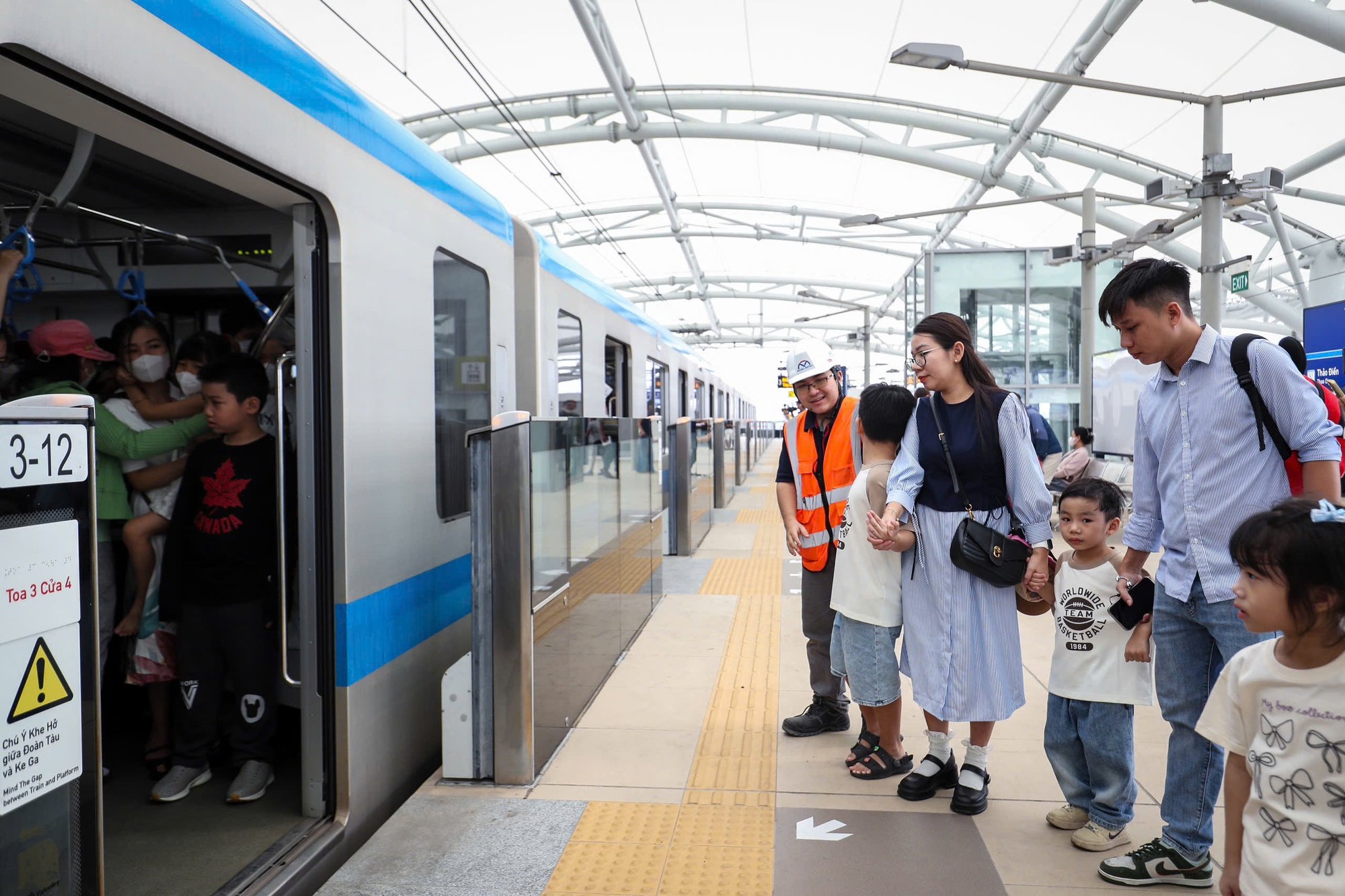
People in Ho Chi Minh City use Metro Line 1, Ben Thanh – Suoi Tien.
In the next phase mentioned by Mr. Bui Xuan Cuong, Ho Chi Minh City proposes investing in 7 metro lines totaling approximately 355 km, to be completed by 2035, with an investment of about 40.21 billion USD. By 2045, an additional 155 km will be completed, bringing the total length of urban railway to approximately 510 km.
Previously, according to Decision No. 568 issued by the Prime Minister in 2013 approving the adjustment of the Ho Chi Minh City Transport Development Plan until 2020 and beyond, the city only aimed to build 8 metro lines and 3 surface tram or monorail lines with a total length of approximately 220 km. With this adjustment to the plan, some routes have been redirected and extended.
For example, Line 1, according to the old plan, was only 19.7 km long from Ben Thanh to Suoi Tien, but it is now proposed to be extended on both sides to form the Long Binh – Ben Thanh – An Ha Depot, totaling 40.8 km. Line 4, now a combination of lines 4 and 4b according to the old plan, connects directly from Dong Thanh (Hoc Mon District) to Hiep Phuoc Urban Area and has been adjusted to run past Tan Son Nhat Airport…
The metro system aims to transport people to work, school, leisure activities, and the market…
Explaining the adjustment to the plan, Mr. Nguyen Quoc Hien, Deputy Head of the Ho Chi Minh City Urban Railway Management Board (MAUR), said that in the near future, the Ho Chi Minh City metropolitan area will include satellite cities such as Di An, Thu Dau Mot, Nhon Trach, Long Thanh, Ben Luc, etc., bringing the population to around 20 million people. Planning only 220 km of urban railway for such a megacity is too modest. Cities of similar scale around the world , such as Tokyo (Japan), Beijing (China), Seoul (Korea), etc., must have urban railway systems thousands of kilometers long to ensure that public transport accounts for about 50-70% of the daily travel needs of the people. The plan under Decision 568 aims for this rate in Ho Chi Minh City to be around 40-50% by 2035, meaning the length of the urban railway must increase two to three times compared to the original plan.
Furthermore, future metro lines will need to be extended from Ho Chi Minh City to Dong Nai, Binh Duong, Long An, and other areas, creating seamless connections to satellite urban areas. The extended metro lines will also be integrated with the national railway network, connecting to stations such as Binh Trieu and Di An; and major transportation hubs like Long Thanh Airport, Tan Kien station of the Ho Chi Minh City-Can Tho high-speed railway, Can Gio reclaimed land urban area, and Tan Son Nhat Airport.
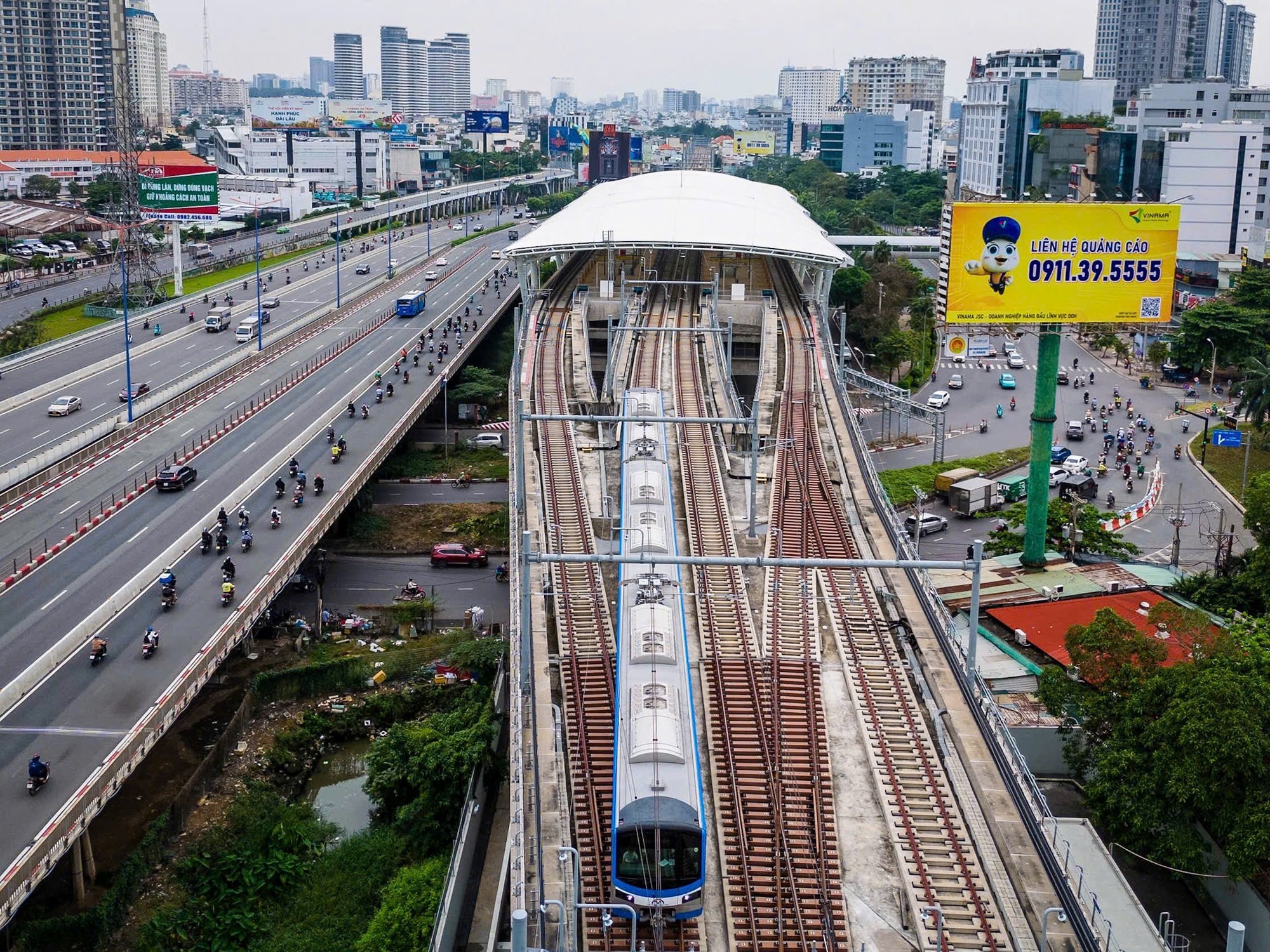
Metro Line 1 trains will run on December 23rd.
According to Mr. Nguyen Quoc Hien, the planning mindset in the years 2008-2013 was very different, always chasing after urban development. We defined residential areas first and then built connecting railways. Therefore, the project implementation process was very difficult and costly because urbanization was happening rapidly and continuously. Currently, planning is oriented to ensure it leads urban development and creates resources for urban development.
Instead of "crashing" into densely populated residential areas and spending "huge" amounts of money on land compensation, metro lines will have their station locations adjusted to public land to facilitate land acquisition and create larger land areas around the stations.
For example, lines 2 (Ben Thanh – Tham Luong), 4 (Thanh Xuan – Hiep Phuoc urban area), or 5 (Bay Hien intersection – Saigon Bridge) would incur very high land compensation costs for station construction if they only ran within urban areas. If these lines were to be extended to public land in Cu Chi, Nha Be, Hoc Mon, Binh Chanh, etc., it would easily lead to the formation of new urban areas along the route. Even within the inner city, the station locations could be adjusted with a similar approach.
Furthermore, previous planning did not adequately consider the future accessibility of these routes. Some semi-circular routes, such as routes 5 and 6 (Ba Queo – Phu Lam roundabout), are too short and will not be efficient when put into operation. Similarly, routes 3b (Cong Hoa intersection – Hiep Binh Phuoc) connecting to route 3a (Ben Thanh – Tan Kien) and 4b (Gia Dinh – Lang Cha Ca) are also not well-designed and need adjustment to increase their passenger appeal.
Overall, some areas within the city center (Tan Phu District, Binh Tan District, Thu Duc City, etc.) have a low density of railway lines. The distance from residential areas to stations is still relatively far. To ensure the most convenient access for residents, more new lines with a higher density need to be added to reduce travel distances, ensuring that people can reach a metro station within 800 meters to 1 kilometer (about a 10-minute walk). Japan and Singapore also have dense metro networks to ensure such accessibility.
“One day not too far in the future, a tourist in Bui Vien Street will easily be able to travel from the “Thai Binh Market” station on Line 2 to the city center for breakfast and Saigon coffee, then take Line 4 from Ben Thanh station to the Youth Cultural Center station, visit Notre Dame Cathedral, the Independence Palace, and the War Remnants Museum. After lunch, they will continue on Line 4 to Phu Nhuan station, transfer to Line 5 to Ba Chieu Market station, visit the Mausoleum of Ông to light incense, learn more about the formation of the Gia Dinh region, then continue to Tan Cang station, visit Landmark 81 for shopping and dinner, before taking Line 1 to Nguyen Hue pedestrian street to enjoy the city's nightlife. In general, the metro system must cover all routes, combined with a bus network reaching every corner, helping people and especially tourists easily and conveniently access historical and cultural sites, commercial centers, and services of the city,” Mr. Nguyen Quoc Hien shared.
Thanhnien.vn
Source: https://thanhnien.vn/mang-luoi-metro-tphcm-trong-tuong-lai-nhu-the-nao-185241223233032663.htm



























































Comment (0)