

During daily cooking, even a few minutes of inattention can cause the temperature to get out of control, carbonizing the food and making it stick to the bottom of the pot. This burnt layer is actually organic compounds that have been altered by high temperatures, forming an incredibly stubborn residue.
The natural reaction of most people when faced with this situation is to use steel wool or other hard objects to scrub vigorously. From a materials science perspective, this is a mistake. Using excessive physical force is not only exhausting but also damages the surface structure of the appliance. For non-stick pans, steel wool will scratch and peel off the protective Teflon coating.
For stainless steel cookware, micro-scratches will dull the shine and create small grooves that make it easier for food to stick and burn during subsequent cooking sessions.
Instead of using brute force, we can let natural chemical reactions and heat do the hard work for us. Below are some tips for cleaning burnt-on pan bottoms without scrubbing, using scientific methods to safely restore the surface of your cookware.
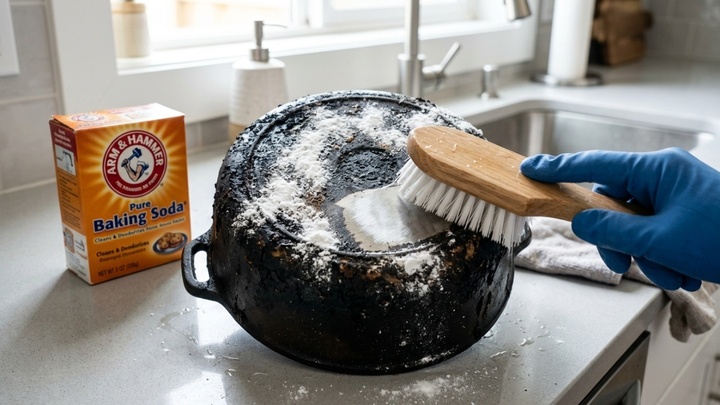
Baking soda has many applications when cleaning kitchen utensils. Photo: CM
Method 1: Using baking soda and white vinegar
Baking soda (sodium bicarbonate) is a mildly alkaline substance, while white vinegar contains acetic acid. When these two substances meet, a chemical reaction occurs immediately, releasing carbon dioxide (CO2) bubbles. Millions of these tiny bubbles act as a microscopic system, penetrating the structure of the burnt residue, breaking down chemical bonds and naturally detaching it from the metal surface.
Here's how to clean burnt-on pan bottoms without scrubbing:
- Sprinkle a layer of baking soda to completely cover the burnt bottom of the pot.
- Slowly pour white vinegar over the flour. You will immediately hear a sizzling sound and see white bubbles forming.
- Let the mixture react for about 15 to 30 minutes. For a very thick layer of burnt food, you can place the pot on the stove, gently boil the mixture for 5 minutes, then turn off the heat and let it soak for another 15 minutes.
- After soaking, the black charcoal layer has softened and peeled off. You just need to gently wipe it with a soft sponge or damp cloth, then rinse with clean water, and the pot will be shiny again.
Method 2: Using boiling water and dish soap
If you don't have vinegar or baking soda in your kitchen, you can use dish soap combined with the principle of thermal expansion. This method is especially effective for burnt-on stains containing a lot of grease.
Dishwashing liquid contains surfactants capable of breaking down fat molecules. When combined with boiling water, the high temperature causes the metal layer of the pot's bottom to expand at a microscopic level, simultaneously softening the structure of burnt organic matter. The heat and detergent work together to break down the bonds of the food residue.
How to do it:
- Pour enough water to cover the burnt bottom of the pot (about 2-3 cm of water).
- Add a few drops of dish soap to the pot and stir gently to dissolve.
- Place the pot on the stove and bring the water to a rolling boil. Once boiling, reduce the heat and simmer for about 10-15 minutes.
- Turn off the stove and leave the pot of water on the stove until it cools down (enough for you to safely touch it).
- Pour out the dirty water and gently wipe the bottom with a soft sponge. At this point, the burnt residue will have liquefied and will easily wash away with the water.
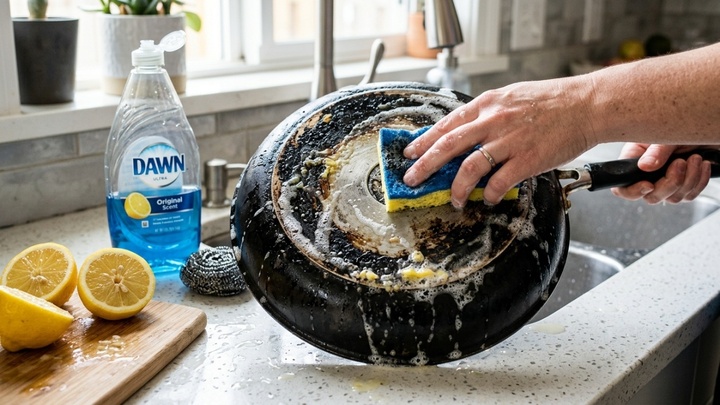
Fresh lemons and dish soap can also help you clean burnt-on pan bottoms. Photo: XHS
Method 3: Use fresh lemon to clean the burnt bottom of the pot.
Fresh lemons contain a high amount of citric acid, an excellent bio-solvent that helps dissolve organic deposits without corroding metals like industrial chemicals.
When heated, citric acid increases its activity, directly breaking down the carbon bonds in burnt food. The essential oils from the lemon peel released during heating also help neutralize the characteristic burnt smell left in the pot and kitchen.
Perform:
- Cut 2 to 3 fresh lemons into thin slices (keep the peel on).
- Arrange lemon slices to completely cover the burnt bottom of the pot, then pour in enough water to just cover the lemons.
- Boil a pot of water on the stove for about 10 minutes. The boiling process will circulate the water, carrying the acid that penetrates the plaque.
- Turn off the stove and let the pot soak overnight (or at least 2-3 hours if you're in a hurry).
The next morning, discard the lemon juice, and you'll see the burnt-on layer peeling off in chunks. Simply wipe it clean with a soft cloth and wash as usual.
Notes on cleaning burnt-out pot bottoms
To ensure that cleaning is truly effective and doesn't shorten the lifespan of the equipment, you need to remember a few basic physics principles:
- Avoid thermal shock: Never pour cold water onto a scorching hot pot. Sudden temperature differences will cause the metal to contract unevenly, leading to warping of the pot's bottom, making it unmagnetic for induction cooktops or causing poor heat transfer.
- Material classification: Acid-based methods (vinegar, lemon) are excellent for stainless steel, glass, or enamel cookware. However, for cast iron or carbon steel pans that haven't been properly seasoned, prolonged acid soaking can cause surface rust.
- Always use soft tools: Regardless of the method used, the key is patience to allow the natural chemicals time to work. Always finish the process with a sponge or microfiber cloth to protect the device's protective coating.
Cleaning your home and appliances doesn't necessarily require physical strength or harmful chemicals. By understanding and applying basic chemical principles, housework can become easier and safer, helping to maintain a clean and hygienic kitchen environment.
Source: https://vtcnews.vn/meo-lam-sach-day-noi-chay-den-ma-khong-can-cha-manh-ar1020195.html


















![[Video] Sunset at Lap An Lagoon – Where the sun sets over the fishing nets](https://vphoto.vietnam.vn/thumb/340x192/vietnam/resource/IMAGE/2026/05/31/1780192137701_beach-landscape-sea-water-nature-grass-745871-pxhere-com.jpeg)







![[Photo] The General Secretary, President and his wife lay flowers at the Ho Chi Minh Monument in Manila.](https://vphoto.vietnam.vn/thumb/1200x675/vietnam/resource/IMAGE/2026/05/31/1780219759477_anh-man-hinh-2026-05-31-luc-16-29-07.png)






























































Comment (0)