

Associate Professor Dr. Le Thi Thu Hien - Director of the Department of Cultural Heritage ( Ministry of Culture, Sports and Tourism ), Standing Member of the National Council for Cultural Heritage, believes that the new UNESCO designation opens up many opportunities for Vietnam but also leaves much work to be done.
Attending the 45th session of the World Heritage Committee in Saudi Arabia, Associate Professor Dr. Le Thi Thu Hien shared her thoughts with TG&VN regarding the recent recognition of Ha Long Bay and Cat Ba Archipelago as a World Natural Heritage site.
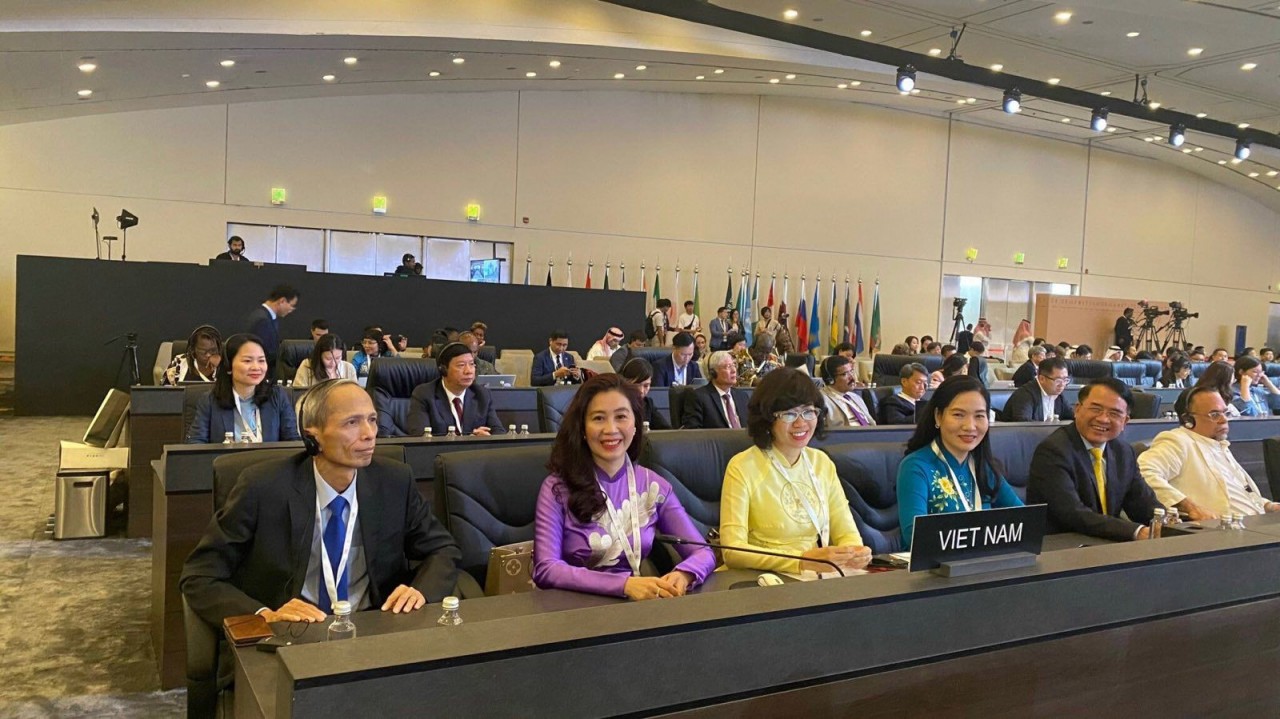 |
| Associate Professor Dr. Le Thi Thu Hien (second from the left) with the Vietnamese delegation at the 45th session of the World Heritage Committee. (Source: Provided by the interviewee) |
After eight years, Vietnam finally received the title of Natural Heritage Site again, since Phong Nha-Ke Bang National Park was recognized in 2015. According to the Director, what is the significance of this event?
Ha Long Bay has been recognized twice by UNESCO as a World Natural Heritage Site, in 1994 and 2000. To date, UNESCO's continued recognition of Ha Long Bay-Cat Ba Archipelago as a World Natural Heritage Site further strengthens and affirms the integrity of the heritage and its outstanding universal value, as well as the unique and rich cultural heritage of Vietnam, contributing to the cultural and natural heritage of humanity and the world as a whole.
This new title gives us the opportunity to promote the image of Vietnam and its people, with its rich natural resources, as well as affirm that cultural heritage is an invaluable asset and resource in socio-economic development, linked to tourism development and making a positive contribution to the development strategy of Vietnam's cultural industries.
Furthermore, Ha Long Bay-Cat Ba Archipelago is the first World Natural Heritage site in Vietnam, spanning across multiple provinces, between Quang Ninh province and Hai Phong city.
This is an important prerequisite for us to perfect the new heritage management model in areas spanning two or more provinces, while also aiming to further affirm Vietnam's role and contribute its experience and practical expertise; and towards the goal of multinational heritage management as we are assisting Laos in preparing the dossier to soon propose UNESCO recognition of Phong Nha-Ke Bang National Park in Quang Binh province as a World Natural Heritage site, expanding to include Hin-Nam-No National Park in Khammouane province.
The process of building the dossier lasted more than 10 years, with numerous difficulties and challenges. What are your observations regarding the coordination between the agencies and the two localities that led to this success?
This is the result of a very long process. It stems from the timely guidance of the Prime Minister, the close adherence to and implementation of the Prime Minister's directives, the close and effective coordination of the Ministry of Culture, Sports and Tourism, the Ministry of Foreign Affairs, the Vietnam National UNESCO Committee, the Permanent Mission of Vietnam to UNESCO in Paris, and above all, the determination of the Party Committee, government, and people of Hai Phong city and Quang Ninh province.
Honor comes with challenges, doesn't it, Madam?
It is true that UNESCO's recognition of the Ha Long Bay-Cat Ba Archipelago World Natural Heritage site opens up many opportunities for Vietnam, but it also means we have a lot of work to do. This is because it is the first World Natural Heritage site in Vietnam that spans the territory of two provinces – a problem of managing tangible heritage across provinces has never existed before.
The challenge here is how to protect and manage the heritage in a way that is unified and effective between the two localities, ensuring socio-economic development linked to tourism development, for the goal of sustainable development and environmental protection, while preserving the integrity and fully respecting the outstanding universal value of the heritage as outlined in UNESCO's recommendations alongside the recognition of Ha Long Bay - Cat Ba Archipelago as a World Heritage site.
What solutions need to be implemented to preserve and promote the value of heritage?
In my opinion, the most important solution that needs to be implemented immediately is to develop a plan and regulations for heritage management between the two localities. This will serve as a basis for jointly managing, protecting, and promoting the value of the heritage and addressing major threats such as environmental pollution (oil, noise, wastewater, waste, etc.), poaching, exploitation of marine and forest resources, overfishing, unsustainable aquaculture, settlements, development in the buffer zone, and the ecological carrying capacity of the heritage from mass tourism.
Besides destination promotion and tourism development strategies, planning the connection of points and routes into a chain of attractions to ensure increased revenue from tourism services while reducing the burden on heritage sites, respecting their outstanding universal value, is a solution but also a challenge that localities need to consider.
In the future, the recognition of the World Heritage site will create significant opportunities for the implementation of large-scale socio-economic development projects within and outside the heritage buffer zone in both localities, especially for Hai Phong city. Therefore, it is crucial to ensure a harmonious balance between socio-economic development and heritage preservation, in line with UNESCO's sustainable development goals and the perspective of cultural heritage preservation.
Overall, it is necessary to consider and research the development of a monitoring plan and indicators for effective heritage management; at the same time, create a more appropriate legal framework, especially in the roadmap for amending the Law on Cultural Heritage, which will be submitted to the Prime Minister and discussed at the 7th Session of the 15th National Assembly in 2024.
Source


















































































Comment (0)