

Pac Bo is located in Truong Ha commune, Ha Quang district, Cao Bang province, a mountainous province in northern Vietnam. Pac Bo borders China and marks the first kilometer marker of the vital Ho Chi Minh Trail. The historical site is nestled amidst the ancient forests of the Viet Bac mountains, with lush greenery and cool weather year-round. Visiting Pac Bo evokes a profound sense of sacredness in any journey.
 |
| The source of the Lenin Stream |
Pac Bo, in the local dialect, means "the source of the river." Pac Bo is also the source of the Vietnamese revolution because it is closely associated with a particularly important historical period in the revolutionary life of President Ho Chi Minh and the revolution of our entire country during the years (1941-1945) preparing for the general uprising to seize power throughout the country.
We decided to visit Pac Bo as part of our tour program in Cao Bang . Reaching this place isn't easy, and not many people get to go there.
The story of Lenin Stream and Pac Bo Cave, along with President Ho Chi Minh's verses: "Distant mountains, distant waters / It's not just vastness that defines it / Here is Lenin Stream, there is Marx Mountain / With two hands, we build a nation," is known to almost everyone. History records that after 30 years of wandering abroad to find a path to national salvation, on January 28, 1941 (the year of the Metal Snake), President Ho Chi Minh returned to his homeland to directly lead the Vietnamese revolution. The first place he set foot on his homeland was Milestone 108, and the first place he stayed upon his return to work was the Pac Bo mountain forest, in Truong Ha commune, Ha Quang district, Cao Bang province, until 1945.
 |
| The road to Coc Bo Cave |
Now this place has become a tourist spot; our car drove right up to it, and there was a fairly large parking lot. Here, on the left are small stalls selling drinks and souvenirs, each about a few square meters wide, with a long table in the middle and more than a dozen plastic chairs on either side. A clear stream flows to the right, with clearly visible rocks and fish swimming playfully against the mountain range – this is the Lenin Stream, with a sign on the cliff that reads: “Lenin Stream”. The water flows slowly and is very clear. Following the Lenin Stream, you will wind through small roads, with signposts indicating historical sites. The Pac Bo historical site is famous for its stories about President Ho Chi Minh: “In the morning, to the stream bank, in the evening, to the cave / Corn porridge and bamboo shoots are always ready / On a precarious stone table, he wrote the history of the Party / A revolutionary life is truly glorious.” (Impromptu Poem at Pac Bo - Ho Chi Minh).
The clear stream, the willow trees casting shadows along its banks, created a serene atmosphere. The guides divided the visitors into groups and provided explanations. Meanwhile, we gazed at the flowing water, filled with an indescribable feeling, for this place held a truly special place in our hearts.
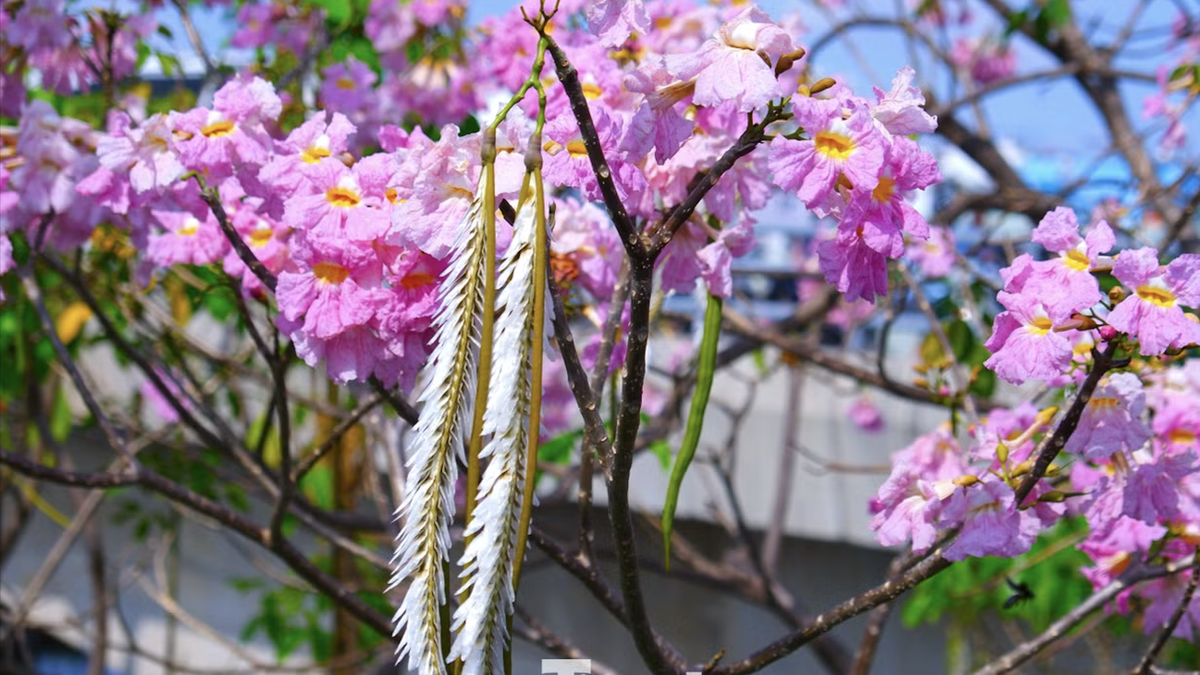
Following the directions, we crossed the iron bridge over the Lenin Stream and took a winding path. The path ran along the stream, its bed dotted with rocks and trees, and many ancient trees fell along the banks, creating a mystical scene. There were also many ancient Barringtonia trees here, their trunks clinging to the rocks, their bark gnarled. When the Barringtonia trees bloomed, it was a truly magnificent sight.
After walking about 100 meters, we reached the path leading to Coc Bo Cave. Coc Bo Cave is approximately 80 square meters in size, with an entrance only wide enough for one person to pass through. This is where Uncle Ho and his revolutionary comrades stayed from February 8, 1941, to mid-March 1941. A set of steps led us to the cave entrance. The cave opening is very small; only five people can enter at a time. It's clear that even when tourism was developed, the road to Coc Bo was difficult, so imagine how challenging it must have been during Uncle Ho's stay. Inside the cave, the lights were on, and a wooden platform rested on a rock—the place where Uncle Ho used to sleep. High above, there is a statue formed from stalactites, which Uncle Ho had placed there—a statue of Karl Marx.
The path begins by crossing rocky rapids at the headwaters of the Lenin Stream. Nearby is a guava tree, a wild guava, still only about 2 meters tall, the tree from which Uncle Ho picked leaves to make a drink in 1941. Beyond the precarious rocky outcrops is a stone path leading to the Stone Table, where Uncle Ho wrote the poem: "A precarious stone table for translating the Party's history." The stone table is a large black rock stacked on top of other rocks, with another rock next to it used as a seat by Uncle Ho. Many people have stopped here to record their experience. Continuing on, we encounter a crape myrtle tree planted by General Vo Nguyen Giap in 1975, now nearly 15 meters tall. And so the path continues along this side of the Lenin Stream, with picturesque scenery: white ducks leisurely swimming by the stream, pebbles scattered along the banks, and occasional tall trees providing shade.
A visit to Pac Bo is a journey back to our roots, filled with emotion.
Source: http://baolamdong.vn/du-lich/kham-pha/202412/mot-lan-den-pac-bo-d800acc/

![[Photo] Standing Committee member of the Party Central Committee Tran Cam Tu working with the Central Inspection Committee](https://vphoto.vietnam.vn/thumb/1200x675/vietnam/resource/IMAGE/2026/05/28/1779969579668_ndo_br_bnd-2495-jpg.webp)











































































Comment (0)