 |
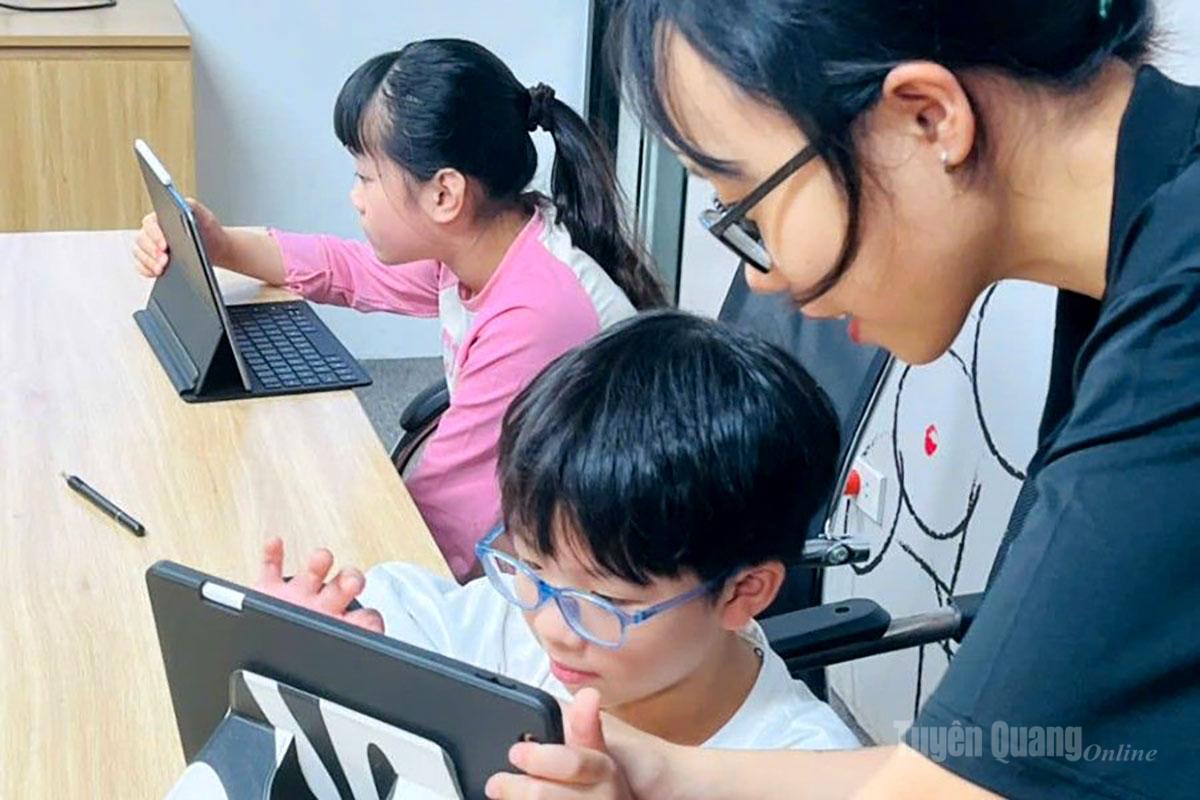
| During the summer holidays, the amount of time children spend in front of electronic devices often increases dramatically. |
The consequences of "delegating" children to technology devices.
It's not uncommon to see children as young as a few years old already proficient at opening YouTube, browsing short videos , or playing games on their phones. Many parents admit that when their children are fussy or when adults need to concentrate on work, the phone becomes the most effective "babysitter."
Notably, during summer vacation, the amount of time children spend with electronic devices often increases dramatically. With no fixed school schedule, many children spend most of their day watching videos, playing games, or using social media, "isolating" themselves in the digital world .
Another fact worth considering is the increasingly younger age at which people start using mobile phones. While previously only middle school students began using smartphones, now many children as young as 2-3 years old are regularly exposed to screens. For some parents, allowing their children to watch videos on phones is no longer a temporary solution but has become a daily habit.
Education and health experts alike affirm that in the early years of life, a child's development depends heavily on direct interaction with parents, relatives, and the surrounding environment. Excessive use of electronic devices can lead to a range of negative consequences such as delayed language development, reduced concentration, limited communication, difficulty controlling emotions, lethargy, and increased risk of technological dependence. For older children, early exposure to social media also poses many risks such as access to harmful content, being influenced by deviant trends, cyberbullying, or forming habits of isolation and disconnection from real life.
In particular, doctors and early intervention specialists have noted a remarkable phenomenon among children born during the COVID-19 pandemic, especially those born in 2019 and 2020. During social distancing, many families worked from home, children were taken outside less often, and had fewer opportunities to interact with friends, teachers, and relatives. Many parents allowed their children to spend extended periods using phones, tablets, or television.



Following the pandemic, the number of children seeking treatment for speech delays, interaction delays, social difficulties, and suspected developmental disorders increased at many healthcare facilities and intervention centers. Many experts call this the "COVID generation"—children who spent their early years in conditions of limited social interaction and excessive screen time.
While phones and social media are not the direct cause of autism spectrum disorder, prolonged screen time can lead to what many experts call "virtual autism" or autism-like syndrome, with symptoms such as delayed speech, limited eye contact, reduced interaction with others, and an overemphasis on electronic devices. This shows that the harm isn't just from the phone, but from the lack of real-life interactions between children and their families and communities during this crucial developmental stage.
 |
| When children have space to play and connect with friends, the allure of phones and social media will significantly decrease. In the photo: Children playing at Du Gia waterfall. |
To ensure children have a healthy summer
First and foremost, parents need to change their perception of phones as mere child-sitting tools. A complete ban isn't necessary, but rules for using electronic devices that are appropriate for each age group should be established. Young children should have limited screen time, content should be carefully selected, and adult supervision is essential. In particular, children should not be allowed to watch phones while eating or be soothed with electronic devices when they are fussy.
More importantly, parents need to spend quality time with their children. Parental presence and interaction create the best environment for children's language, emotional, and personality development.
During the summer, local authorities, youth organizations, schools, and social organizations should create more enriching playgrounds for children, such as talent classes, reading clubs, sports activities, life skills experiences, summer activities in residential areas, or volunteer programs for children. When children have spaces to play, explore, and connect with friends, the allure of phones and social media will significantly decrease.
In addition, it is necessary to strengthen public awareness campaigns to ensure parents are fully aware of the impact of excessive electronic device use on children. Early detection of signs of speech delays, interaction delays, or behavioral abnormalities, and timely examination and intervention for children, is also very important.



Children need technology to adapt to the digital age, but they need companionship, love, and real-life experiences even more. A meaningful summer isn't one where children spend the most time on social media, but rather one where they grow up surrounded by family, where they can run, explore, and create beautiful childhood memories.
Duy Anh
Source: https://baotuyenquang.com.vn/xa-hoi/202606/mua-he-lanh-manh-cho-tre-b2f3144/


![[Photo] "Hanoi Lotus Festival" honors the lotus flower that has been associated with Vietnam for thousands of years.](https://vphoto.vietnam.vn/thumb/1200x675/vietnam/resource/IMAGE/2026/06/27/1782516943048_sen-ha-noi-2026-minh-duy-1-jpg.webp)