

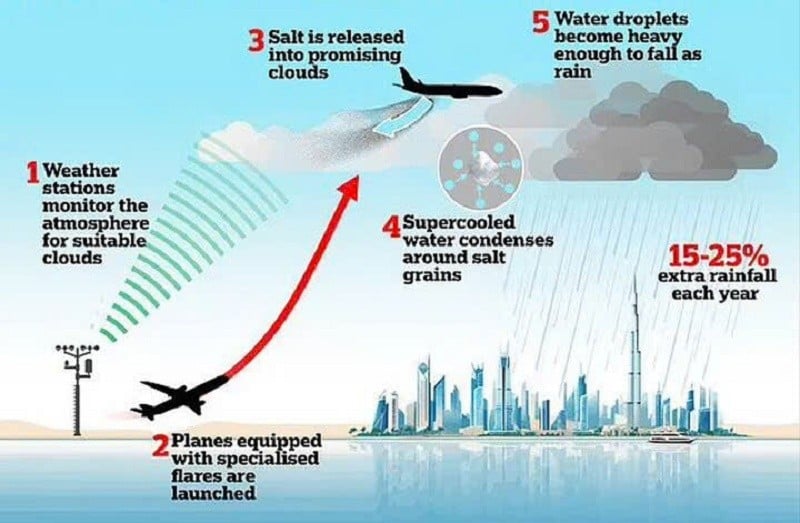
The principles of artificial rainmaking: Dream and reality
As early as the late 1940s, American and Soviet scientists conducted the first experiments on the effects of cloud seeding. They hoped that one day, humans could simply "press a button in the morning to decide whether it would rain or shine." Over half a century later, research has advanced, and many countries have invested billions of dollars, but ultimately, artificial rain remains a fragile, inconsistent, unpredictable, and even more difficult-to-scale solution.
The basic principle of artificial rainmaking, whether in Russia, the US, China, or Thailand, is the same: utilizing natural atmospheric masses containing water vapor, then intervening by introducing condensation or freezing nuclei into them, causing the water vapor in the clouds to condense into larger water droplets that fall to the ground. In theory, this sounds feasible. However, in practice, countless factors such as temperature, humidity, altitude, wind speed, air density, and the direction of air mass movement can disrupt this process. If even one of these parameters is unsuitable, the entire effort becomes futile.
China is renowned for its aggressive pursuit of artificial rainmaking technology. Prior to the 2008 and 2022 Beijing Olympics, the country spent billions of dollars building missile and anti-aircraft artillery systems to release chemicals into clouds. However, the effectiveness has been localized and short-term, difficult to prove with scientific data. Even Chinese media have admitted: If the technology were truly effective, how could the country still have suffered a severe drought in 2022, with the Yangtze River and Dongting Lake drying up, leaving tens of millions without access to clean water?
In the US, particularly in California, "cloud seeding" projects have existed for decades. The National Weather Service (NOAA) estimates that any increase in rainfall would only be about 5–15%, far too little to alleviate the prolonged drought. Numerous wildfires continue to occur, despite tens of millions of dollars invested in this technology.
The United Arab Emirates (UAE) once heavily promoted rainmaking technology using even radio-powered drones. However, in reality, many artificial rains in the UAE only caused localized flooding and urban traffic congestion, while long-term drought conditions remained unchanged. Even local media have had to admit that this technology cannot replace water resource management and sustainable solutions.
India has also implemented drought mitigation projects using artificial rain in Maharashtra state. However, subsequent assessments indicated very low effectiveness, "not sufficient to be considered a policy solution." Indian scientists recommend halting large investments and shifting towards water resource management and the development of water-saving agriculture .
These examples show that artificial rainmaking is not a "magic wand" to solve natural disasters, but only yields modest, unstable results that are difficult to prove with scientific data.
Necessary and sufficient conditions for artificial rain
From the above facts, it can be seen that artificial rain is not simply a matter of launching missiles or spraying chemicals into the air, but requires the simultaneous convergence of many stringent conditions.
First and foremost, a large mass of air containing abundant water vapor is necessary, along with the appropriate temperature, humidity, pressure, and convection for cloud formation. If the sky is clear, or the clouds are too thin and lack moisture, then all efforts to influence cloud formation are futile.
Next, a necessary condition is that the seeding system must intervene at the right time, in the right place, and with the appropriate seed density, so that the tiny water droplets in the clouds can condense, grow larger, overcome air resistance, and fall to the ground as rain. This is a very delicate process, easily disrupted by even a small change in wind direction, temperature, or humidity.
Therefore, many studies only achieve a partial fulfillment of the "necessary conditions," meaning the presence of clouds and humidity, but fail to guarantee the "sufficient conditions" for rain to fall in the desired locations. The practical effect thus only increases the probability of rain, rather than turning the dream of "commanding the wind and rain" into reality.
Vietnam: Research exists, but it cannot yet be applied.
In Vietnam, scientists have long pursued the dream of creating artificial rain. Associate Professor Vu Thanh Ca's research project in 2005 invited leading experts from Russia and the United States to collaborate on workshops and surveys. The research team also traveled to Russia, Thailand, and China to learn from their experiences. However, to date, both theory and practice have shown that this technology cannot yet be applied commercially.
Even more worrying, there was a period when a company proposed a shocking project, like "calling rain from the sky," with an emergency advance of 5 trillion VND to purchase equipment and chemicals for testing. The Government Office at the time had to consult with seven ministries, but there was no evidence to confirm that this was the right direction. In the context of a struggling economy, high public debt, and a tight budget, spending trillions of VND on a far-fetched dream was unacceptable.
No one denies humanity's desire to conquer nature. But that desire must be accompanied by a serious scientific foundation, verifiable and repeatable results, and real socio-economic benefits. Any project based solely on vague promises and lacking scientific evidence is a waste of resources and even harms public trust.
Even advanced, wealthy countries like the US, China, India, and the UAE, after decades and billions of dollars in investment, still suffer from droughts, floods, and wildfires. This proves a simple truth: humans cannot control the weather. Investing in "wind and rain control" at this time is like throwing taxpayers' money away.
Meanwhile, we have more urgent and practical things to invest in: managing water resources, developing flood control infrastructure, transforming agriculture to adapt to climate change, and modernizing the meteorological and hydrological system for early warning of natural disasters. This is the right path, both within our reach and yielding sustainable results.
The development of science demands honesty, transparency, and verification. Serious science is not magic. Artificial rain, however appealing, remains a distant dream. Instead of chasing the illusion of "chasing clouds and summoning rain," what Vietnam needs now are solutions for resource management, climate change adaptation, and building social trust through practical actions.
Source: https://nhandan.vn/mua-nhan-tao-giac-mo-va-thuc-te-post905635.html



![[Image] Nearly 125,000 Hanoi students completed the Literature exam for the 10th grade entrance exam.](https://vphoto.vietnam.vn/thumb/1200x675/vietnam/resource/IMAGE/2026/05/30/1780117233041_ndo_br_thiet-ke-chua-co-ten-2-png.webp)

















































































Comment (0)