Exactly 80 years ago today, at the call of the Viet Minh Front, the people of Hanoi took to the streets and marched towards the Grand Theatre for a rally, the entire capital resplendent with red flags bearing yellow stars. The rally turned into an armed demonstration that took place at the Residency, the Security Forces barracks, and other facilities of the puppet government.
The song "August 19th" is performed by the Vietnam Radio and Television Mixed Choir.
Composer Do Xuan Oanh, then 23 years old, led the march starting from the Giap Bat train station area to the Grand Theatre. Leading the procession, the composer clearly felt every step and the fervent atmosphere. The melody and the first lines of the song burst forth, and he sang loudly: "All Vietnamese people stand up and contribute their strength for one day / We swear to fight wholeheartedly with our blood and bones for the future."
As he composed the song, he guided the group to sing along, their voices harmonizing with their footsteps. By the time they reached Cho Mo Market (Hai Ba Trung District, Hanoi), the song was complete with 10 verses, taking the historical date of the nation as its title. The musician set the rhythm from the beginning, and the group sang as they walked until they reached the Grand Theatre, where marching groups from all over joined the crowd, singing a medley of revolutionary songs, from "Marching Song," "Destroy Fascism," "Viet Minh Flag," and ending with "August 19th."
According to the book "Do Xuan Oanh - The Nightingale of the Revolutionary Spring," from late 1943-1944, when directly participating in secret propaganda activities for the Viet Minh Front, preparing for the General Uprising in Hanoi, the musician had been nurturing the intention to compose a song about this event.
The emotions had been building up since his early days, as he recalled his difficult childhood and the hardships the war inflicted on his family. His grandfather, a patriot of the Dong Kinh Nghia Thuc movement, was persecuted by the colonial government, forced to leave his homeland, and his family was separated. His sister, the most beautiful girl in the region at the time, was abducted by a French official, tortured to death, and her body returned home. Because of poverty, Xuan Oanh only completed the fourth grade. Afterward, he struggled to make ends meet, working various jobs as a foundry worker, a miner, and then in Hai Phong as a tutor and singer, where he met composers Van Cao and Nguyen Dinh Thi and began participating in the revolution. All the resentment, hardship, and suffering from his childhood, along with the revolutionary fire burning in the artist's heart, burst forth into his melodies.
The short, rapid verses, like the rhythm of footsteps, the cries of "resentment and anger," became a powerful force of unity, urging the entire nation to "rise up" and shatter the chains of slavery. The procession marched under the "light of freedom," with "flags flying everywhere." The song concludes with a reminder: "Never forget August 19th, the day of the uprising / Happiness illuminates the Vietnamese land," expressing optimism and faith in the country's new future.
The musician "had a knack for composing on the spot, but if he didn't write it down, he'd forget it immediately." On the afternoon of August 19th, after completing the seizure of power in Hanoi, he signed the musical score of the march on a cigarette pack wrapper and took it to a friend's printing shop. The song was carved into wood and printed like leaflets, distributed throughout Hanoi.
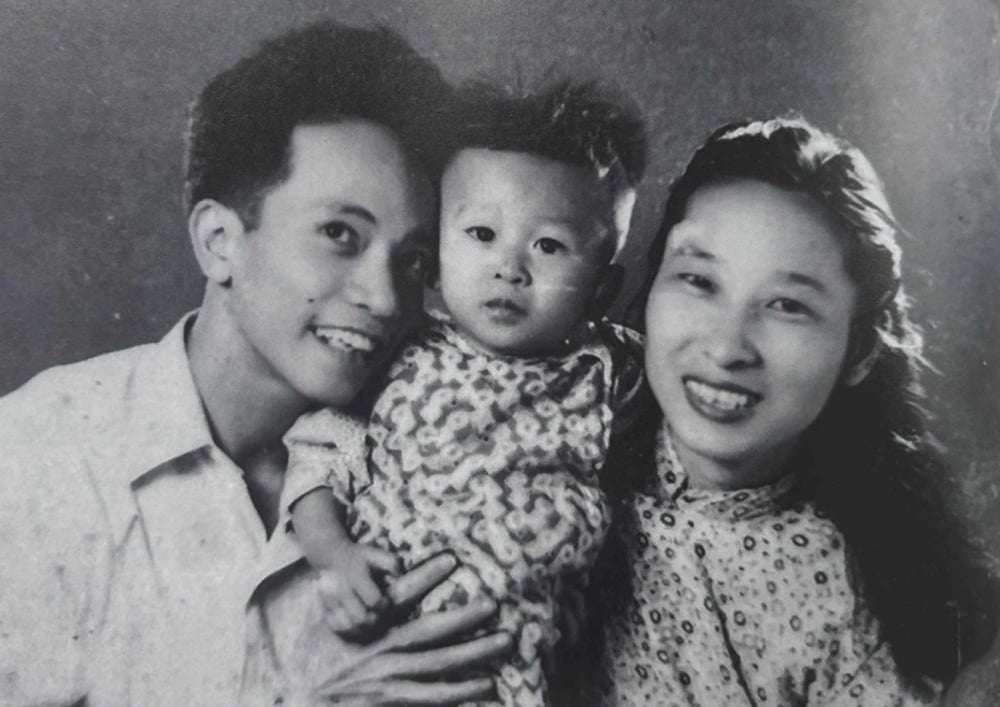
|
Composer Xuan Oanh with his wife (Mrs. Xuan Uyen) and their firstborn son, Do Le Chau, in 1957. |
Currently, the musician's family says that due to various events, the woodblock print is no longer preserved. At that time, he still kept a printed version on rough yellow A4 paper, with the red flag with a yellow star at the top. Later, this printed version was also lost due to the war.
Nevertheless, the work remains intact in the hearts of the Vietnamese people through many generations, marking the day the country turned a new page in its history, which, according to poet Nguyen Thuy Kha, was "a sudden and powerful melodic explosion at the moment of an uprising to seize power in Hanoi."
Every year, on the anniversary of the successful August Revolution, the song resounds, transporting listeners back to the heroic spirit of the past. At the "Hanoi - From the Historic Autumn of 1945" program on the evening of August 15th, the artists brought hundreds of flags onto the stage, recreating the moment when "flags flew everywhere, shining with countless golden stars."
On August 10th, at the "Homeland in My Heart" concert, Meritorious Artist Dang Duong and singer Tung Duong performed a medley of "August 19th," "The National Guard," and "The Road We Take," which was sung along to by tens of thousands of audience members. The song was well-received by the younger generation thanks to its catchy and memorable lyrics.
In "Do Xuan Oanh - The Nightingale of the Revolutionary Spring," Associate Professor-Doctor Do Le Chau - the musician's son - said that he always considered himself fortunate "to be chosen by history to record through music the earth-shattering revolutionary atmosphere of the Vietnamese people on the day of the General Uprising to seize power for the people." According to his family, during his lifetime, every August 19th, the musician received many interview requests from newspapers asking about the circumstances surrounding the creation of the song, "which was an opportunity for him to relive that historic day once again."
For Ms. Do Anh Thu, the musician's granddaughter, "August 19th" is a family song. "When I was little, I didn't understand the lyrics, but just knowing that it was composed by my grandfather made me proud. Every year on August 19th, my family gathers together. Even though he is no longer here, these days still hold sacred meaning, and the whole family still sits together to listen to the song."
Composer Do Xuan Oanh, born in 1923 and passed away in 2010, hailed from Quang Yen, Quang Ninh province. He was a cultural diplomat and musician. Before 1945, he participated in propaganda for the Viet Minh Front. After the August Revolution, he went to the Viet Bac resistance zone and worked for the newspaper Cuu Quoc. He was one of the first English-language broadcasters of the Voice of Vietnam Radio and an interpreter for high-ranking Party and State leaders. For many years, he served as the Secretary-General of the Vietnamese Committee for World Peace, participating in the Paris Peace Conference and many other historical events. He also wrote songs such as "Ho Chi Minh - He is a myriad of stars" and "Homeland of the soldier". The musician received the Third-Class Independence Medal in 1998 and the State Prize for Literature and Arts in 2009. |
According to VnExpress
• See source link: https://vnexpress.net/muoi-chin-thang-tam-ban-toc-ky-thanh-khuc-ca-bat-hu-4928378.html
Source: https://baobacninhtv.vn/muoi-chin-thang-tam-ban-toc-ky-thanh-khuc-ca-bat-hu-postid424499.bbg


![[Image] Hanoi's urban life under the challenge of a "scorching hot" environment](https://vphoto.vietnam.vn/thumb/1200x675/vietnam/resource/IMAGE/2026/05/25/1779706979265_nang-nong-t5-2026-minh-duy-7-4636-jpg.webp)

![[Image] Close-up view of the interchange connecting the two expressways and Long Thanh Airport.](https://vphoto.vietnam.vn/thumb/1200x675/vietnam/resource/IMAGE/2026/05/25/1779703378210_ndo_br_z7863716673926-224453a31600126cce10622af6290afd-4549-jpg.webp)














































































Comment (0)