

Many pivotal changes
The 2026 Women's National Football Championship officially kicked off on June 20th, with the participation of 7 teams: Hanoi I, Hanoi II, Thai Nguyen T&T, Vietnam Coal and Mineral Corporation, Phong Phu Ha Nam, Ho Chi Minh City I, and Ho Chi Minh City II. The first leg of the tournament took place from June 20th to July 19th, and the second leg was held from July 23rd to August 21st.
Unlike previous seasons where matches were played locally, this year's tournament will alternate between home and away games, similar to men's football; each club is allowed to register one foreign player. The winning team will receive a prize of 500 million VND and represent Vietnam in the 2027-2028 AFC Women's Club Championship. Notably, the Vietnam Football Federation (VFF) is piloting a professional licensing program, aiming for clubs to meet professional criteria by 2028.
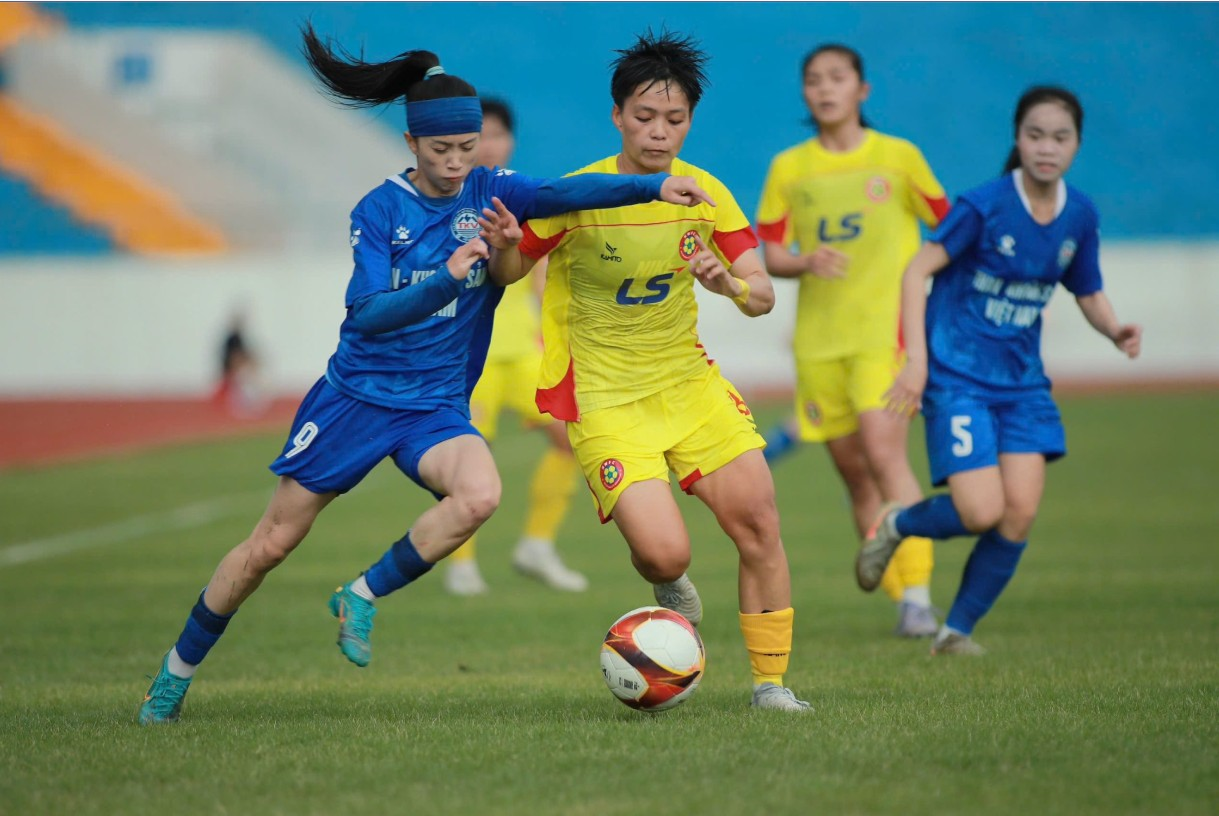 |
Matches in the 2026 Women's National Football Championship promise to be exciting with a home-and-away format (illustrative photo). Photo: VFF |
Overall, these changes are the first step in the process of professionalizing women's football and complying with the mandatory regulations of the Asian Football Confederation. Mr. Nguyen Van Phu, General Secretary of the VFF, emphasized: “The 2026 season holds special significance as it marks a professional transition in Vietnamese women's football. Playing in a home-and-away format will contribute to a shift for local communities and fans. The VFF is committed to continuing to cooperate closely with clubs to organize a successful tournament, meeting the expectations of fans and partners.”
Finances remain a burden.
The home-and-away format is expected to help women's clubs attract more viewers, create more room for development, and increase revenue. However, the biggest challenge for many clubs is the professional licensing criteria, which require improved quality in areas such as expertise, facilities, management, legal compliance, and finance.
Sharing his thoughts on this matter, Mr. Doan Viet Trieu, team leader of Thai Nguyen T&T Women's Club, said: “The home-and-away format brings a new spirit and determination to the players of Thai Nguyen T&T Club. Playing at the newly inaugurated Thai Nguyen Stadium, in the enthusiastic atmosphere of the home crowd, will give the players more motivation to strive for good results. However, the pilot program for professional licensing faces many difficulties as it requires the club to operate its own football company, as well as ensure operating costs from socialized sources.”
Sharing the same view, Mr. Nguyen Trong Hong, Head of the Football Department at the Hanoi Sports Training and Competition Center, explained: “The biggest difficulty for us is the reactive approach; the repair of Ha Dong Stadium was not included in the annual plan. However, thanks to the attention of leaders at all levels and the decisive joint efforts of all levels and sectors, the repairs are being urgently implemented to ensure the stadium meets the standards for hosting matches.”
However, what worries Mr. Nguyen Trong Hong and other team leaders, department managers, and local women's football officials is the difficulty in implementing the pilot program for professional licensing. Mr. Nguyen Trong Hong affirmed: “Not only Hanoi women's football but many other women's football clubs also face many difficulties in implementing professional licensing. Many women's clubs in Vietnam have 100% of their operating costs from the state budget, with very limited sponsorship sources. The regulation requiring each women's club to have an operating company and funding from social sources is very difficult. I believe that for women's clubs to meet the licensing criteria, a liberalization of mechanisms is needed, along with the participation and support of communities and businesses.”
The Vietnam National Football Championship (V-League) has been professional for 26 years, but each season, some clubs still fail to meet the criteria regarding facilities and finances. Many clubs are still facing the challenge of attracting fans and increasing revenue. Women's football, with its limited resources and less fan interest, faces many difficult challenges. From goals to true professionalism, women's clubs desperately need leverage to escape their precarious situation as new regulations become a burden.
Source: https://www.qdnd.vn/the-thao/trong-nuoc/nan-giai-chuyen-nghiep-bong-da-nu-1040843
![[Image] Hanoi's urban life under the challenge of a "scorching hot" environment](https://vphoto.vietnam.vn/thumb/1200x675/vietnam/resource/IMAGE/2026/05/25/1779706979265_nang-nong-t5-2026-minh-duy-7-4636-jpg.webp)

![[Image] Close-up view of the interchange connecting the two expressways and Long Thanh Airport.](https://vphoto.vietnam.vn/thumb/1200x675/vietnam/resource/IMAGE/2026/05/25/1779703378210_ndo_br_z7863716673926-224453a31600126cce10622af6290afd-4549-jpg.webp)




























































































Comment (0)