

In recent years, generally speaking, the units directly involved in training soldiers have closely followed the training guidelines, principles, and methods; the officers' qualifications and capabilities have met the unit's requirements and the soldiers' level of understanding quite well. However, surveys show that in some grassroots units, newly graduated platoon officers still exhibit limitations in methods, skills, and experience in training and guiding soldiers in their review sessions. The main reasons are that young officers lack practical experience in the unit, and partly due to their limited initiative and self-study.
Therefore, in order to overcome the aforementioned limitations in the future, the relevant parties need to effectively implement the following key measures:
Further strengthen the leadership and guidance of Party committees and commanders at all levels regarding training and combat readiness tasks in the units.
Party committees and battalion/company commanders need to strengthen the dissemination of information to cadres, party members, non-commissioned officers, and soldiers to ensure a deep understanding of the Party and State's military and national defense viewpoints and guidelines, especially Resolution No. 44-NQ/TW, dated November 24, 2023, of the Central Committee of the Party (13th term) on the Strategy for National Defense in the New Situation; Resolution No. 1659-NQ/QUTW, dated December 20, 2022, of the Central Military Commission on improving the quality of training in the period 2023-2030 and beyond; and the directives, orders, and training and combat readiness tasks of higher levels.
Based on this, review and supplement the targets, content, and measures in your unit's programs and plans, ensuring they are consistent with the practical requirements and tasks of the unit and the capabilities of the troops; focusing on breakthroughs in new issues, weak points, and shortcomings. At the same time, strengthen political education and ideological guidance, creating a strong and profound transformation in the thinking, awareness, attitude, and responsibility of officers and soldiers towards this important task.
At the same time, we must resolutely overcome manifestations of lax leadership, direction, and management by unit leaders; combat complacency, conservatism, reluctance to innovate, fear of difficulties and hardships, and the "achievement-oriented" mentality in training and combat readiness.
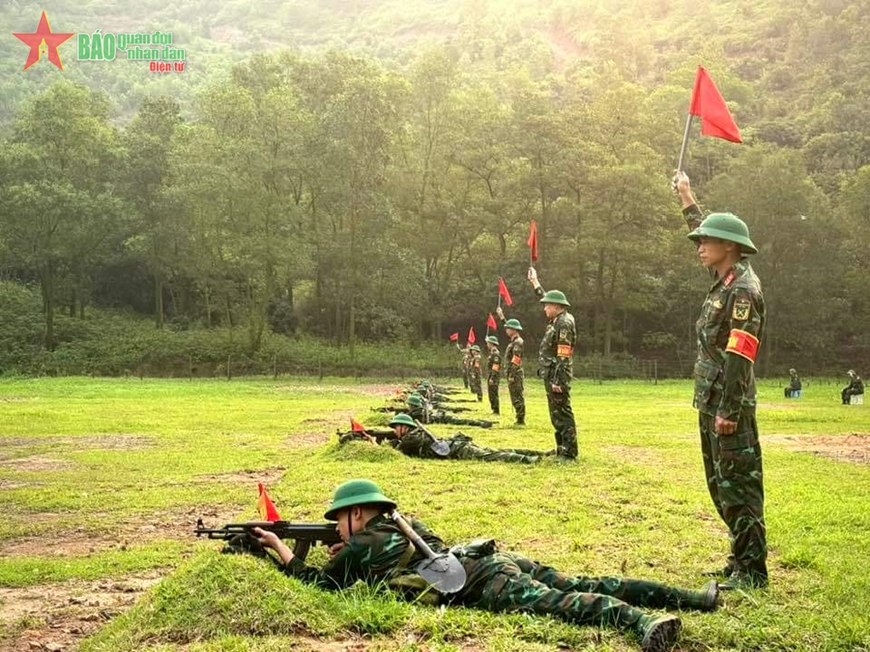 |
| Organizing the AK submachine gun shooting test (lesson 1) for new recruits at the Military School of the 12th Army Corps, 2024. |
,
Based on the principle that "cadres are the foundation of the work," at the beginning of each training phase, agencies and units conduct thorough training and development for platoon and company-level officers. Following the motto "superiors teach subordinates, commanders teach units," it is necessary to select exemplary officers in terms of character, ability, skills, and experience, and to establish a model framework for training content.
The training and refresher courses focus on improving the level, skills, and methods of military training; individual, squad, and platoon tactical movements; practical skills in drill and ceremony; physical training; content and methods of political education (basic and regular); skills in understanding, resolving, and motivating the thoughts and providing psychological counseling for non-commissioned officers and soldiers...
Provide guidance on innovating the organizational forms and methods of training inspection and review; strengthen surprise inspections and cross-inspections between units, realistically assess training and combat readiness results, and promptly draw common lessons; do a good job of commending and rewarding individuals and collectives with high achievements in the training and development process; propose measures to overcome limitations and shortcomings in the preparation of training content (if any).
Actively innovate the content, organization, and methods of training and combat readiness to suit the characteristics of the unit and the conditions of modern technological warfare.
This is the most important content and solution, directly determining the quality of training, combat readiness, and fighting at the grassroots level; at the same time, it is a prerequisite for units to successfully complete their central political tasks and avoid being caught off guard in any situation.
The content of combat readiness training must be appropriate to the level of understanding of the officers and soldiers; the organizational structure, weapons, and equipment of the unit; and the combat environment under current conditions. During training, units and officers directly involved in training must thoroughly understand and effectively implement the motto "basic, practical, and solid," "emphasize comprehensive and in-depth training," and "connect the training ground with the battlefield"; flexibly applying the "3 viewpoints, 8 principles, and 6 combinations" in training. Strengthen mobile training, long-term field training, night training, high-intensity training, and training based on missions and situations, bringing troops closer to real combat conditions; focus on improving the ability of forces to coordinate operations, avoiding passivity and surprise.
Every year, the results of troop training and development are used as a measure and criterion for evaluating, rewarding, and promoting officers.
Innovate and improve the effectiveness of competitions and sports events in the direction of being "fundamental, practical, solid, in-depth, professional, and achieving high results".
It is an objective requirement for units to organize competitions and training exercises effectively, aiming to assess the level, capabilities, and responsibilities of officers and soldiers, as well as the results of training, combat readiness, and the operational and tactical coordination skills of platoons after each training phase. This helps Party committees, leaders, and commanders at all levels, from company to regiment, to understand the strength of their officers and soldiers, thereby making appropriate and timely decisions regarding personnel deployment and different tasks, ultimately achieving the best possible results for the unit.
The implementation of this task must be rigorous, scientific, substantive, objective, and fair, aiming to encourage, motivate, and maximize the spirit, responsibility, activeness, initiative, and creativity of the troops in training; promptly identify officers with effective training methods and units with good models to encourage, commend, reward, and replicate them, contributing to improving the quality of training throughout the regiment. Based on these results, the regiment will organize the selection and training of coaches and athletes in knowledge, skills, and character; and form teams to participate in military and military sports competitions... according to the military and national defense requirements of higher levels.
In light of the demands and tasks of building the Army and defending the Fatherland in the new situation, improving the quality of training and combat readiness is of even greater importance. This requires Party committees, commanders at all levels, and officers and soldiers at the grassroots level to strengthen their resolve and determination, and to implement more decisively and comprehensively measures to ensure that units are always combat-ready, fight victoriously, firmly protect the independence, sovereignty, unity, and territorial integrity of the Fatherland, and maintain a peaceful and stable environment for national construction and development.
Lieutenant Colonel, MSc Phan Huy Hung; Colonel, PhD Ha Thanh Tung; Major, MSc Le Hai Ninh (Political Academy, Ministry of National Defence)
Source: https://www.qdnd.vn/quoc-phong-an-ninh/xay-dung-quan-doi/nang-cao-trinh-do-huan-luyen-cho-can-bo-cap-phan-doi-trong-giai-doan-hien-nay-821044




































































Comment (0)