

In the context of digital transformation, international economic integration, and the strong development of e-commerce, logistics is playing an increasingly important role in the competitiveness of the economy.
The current situation creates an urgent need for high-quality logistics human resources who are adaptable to technology, capable of managing modern supply chains, and meeting the sustainable development needs of businesses.
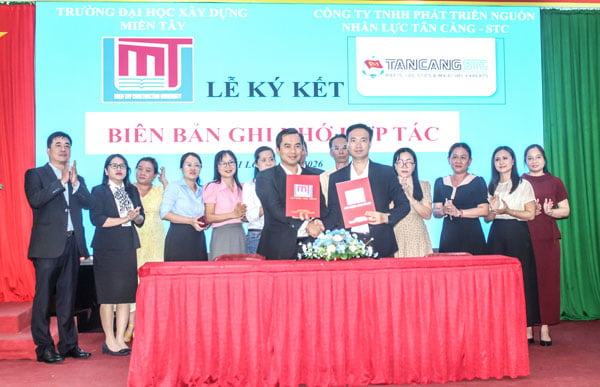 |
| Representatives from the Western University of Construction signed a memorandum of cooperation with Tan Cang Human Resources Development Co., Ltd. |
"Thirst" for high-quality logistics human resources.
Logistics is the management and coordination of activities related to transportation, including storage, packaging, and handling of goods from origin to destination. The goal of logistics is to optimize time and reduce production costs, thereby ensuring that goods are transported safely and quickly to customers.
According to Dr. Vo Thi Van Na from the Faculty of Economics (Western University of Construction), in the context of international economic integration and the boom in e-commerce, logistics has become a core service sector that determines national competitiveness.
According to the Ministry of Industry and Trade 's 2025 logistics report, it is projected that 2.2 million logistics personnel will be needed by 2030. In reality, there is a significant gap between university training programs and the practical skills required by businesses. Newly graduated students often lack the skills to operate modern management systems and the ability to handle real-world supply chain risks.
According to Dr. Ngo Anh Tuan, Vice President of the Vietnam Association of Maritime Agents, Brokers and Services, the Mekong Delta has long been positioned as a key economic region for agricultural and aquatic product production, contributing a large portion to the country's total export volume of rice, fruits, and seafood.
However, despite its enormous advantages in scale of production and extensive natural river network (accounting for up to 70% of the country's inland waterways), the agricultural sector here is being hampered by the bottleneck of "logistics costs". Recent statistics and research show that logistics costs in the Mekong Delta are very high, accounting for 20-30% (and even nearly 40% for some perishable agricultural products) of the product cost structure.
The biggest paradox of the region is that despite possessing enormous inland waterway transport potential, currently up to 70% of the country's annual exports still have to be transported by road to Ho Chi Minh City or deep-water port clusters such as Cai Mep-Thi Vai for export.
This fragmentation of the transportation chain, coupled with the lack of integrated regional logistics centers and modern, standardized cold chain systems, not only drives up costs but also causes significant post-harvest losses of agricultural products, severely reducing competitiveness in the international market.
Dr. Ngo Anh Tuan shared that the Mekong Delta region still faces a shortage of "soft infrastructure," specifically the business ecosystem and human resources. The local logistics service market is currently fragmented, with most businesses operating independently, lacking trust in cooperation to share resources, thus failing to form a comprehensive supply chain management ecosystem.
The quality of the local workforce reveals alarming gaps. The current workforce largely fails to meet the requirements for process digitalization (such as the ability to operate core software systems and perform big data analytics), and struggles with handling and managing multimodal transport risks. Furthermore, knowledge of "green logistics" and sustainable development (ESG) standards – which are becoming mandatory technical barriers in European and American markets – has not been adequately updated.
 |
| Representatives from the Western University of Construction received a certificate of membership in the Vietnam Logistics Human Resources Development Association. |
Based on the above practices, considering the restructuring and innovation of training models and programs in logistics and supply chain management is not simply a task of improving educational quality. It is a pivotal solution to create a generation of personnel with sufficient technological capabilities and systems thinking to overcome supply chain bottlenecks, contributing to enhancing the value of agricultural and aquatic products and promoting sustainable development for the entire Mekong Delta region.
Improving the quality of human resources.
Mr. Nguyen Thanh Nha, General Director of Tan Cang Human Resources Development Co., Ltd., shared that from a business perspective, in the era of developing artificial intelligence, AI-generated tools—notably Google Gemini, ChatGPT, or Claude—can be fully developed into personal guides.
Students can build a foundational knowledge of logistics by using AI to personalize and simplify technical concepts; transforming AI into a partner for English language skills training, work exchange, negotiation, etc. Simultaneously, they can utilize AI's comprehensive capabilities to create scenarios, develop problem-solving skills, respond to risks, and enhance multi-dimensional assessment and decision-making abilities.
Dr. Ha Minh Hieu, Deputy Head of the External Relations Department of the Vietnam Logistics Human Resources Development Association, stated that the solutions for developing logistics human resources and supply chain management from the university's perspective include strengthening cooperation with businesses in training, participating in guiding and evaluating students; enhancing career counseling and guidance; and simultaneously developing infrastructure, curricula, and simulation practice rooms; and increasing the number of well-trained teachers in the relevant fields and specialties.
From the business perspective, companies participate in and commission research and human resource training projects from training institutions, develop internship programs, and build recruitment and compensation policies that are appropriate for each job position.
 |
| High-quality human resources are becoming a decisive factor in the competitiveness of logistics businesses. |
The Western University of Construction has recently developed a training program in Logistics and Supply Chain Management. According to Dr. Vo Thi Van Na, a highlight is that the program has designed 38 credits for practical training, internships, and a thesis. The shift from traditional training methods to a model that is organically linked with businesses is a pressing requirement, affirming the practical relevance of the university's training program.
By flexibly applying the experiential learning model, the school will create a symbiotic ecosystem: Students increase their competitiveness, businesses optimize recruitment costs—eliminating retraining expenses—and the school affirms the quality of its graduates, meeting the stringent requirements of the current logistics market.
In the context of globalization and rapid digital transformation, the professional qualifications and skills of the logistics workforce need to be continuously improved. Prioritizing human resource development is essential for the sustainable growth and competitiveness of the logistics industry.
Text and photos: PHUONG THU
Source: https://baovinhlong.com.vn/kinh-te/202605/nang-chat-luong-nguon-nhan-luc-nganh-logistics-d123ad8/


![[Image] A brilliant symphony and explosive power in the skies of Da Nang.](https://vphoto.vietnam.vn/thumb/1200x675/vietnam/resource/IMAGE/2026/05/31/1780193150738_anh-bia-copy-jpg.webp)
![[Video] Sunset at Lap An Lagoon – Where the sun sets over the fishing nets](https://vphoto.vietnam.vn/thumb/1200x675/vietnam/resource/IMAGE/2026/05/31/1780192137701_beach-landscape-sea-water-nature-grass-745871-pxhere-com.jpeg)






![[Video] Sunset at Lap An Lagoon – Where the sun sets over the fishing nets](https://vphoto.vietnam.vn/thumb/800x450/vietnam/resource/IMAGE/2026/05/31/1780192137701_beach-landscape-sea-water-nature-grass-745871-pxhere-com.jpeg)







































![[Video] Sunset at Lap An Lagoon – Where the sun sets over the fishing nets](https://vphoto.vietnam.vn/thumb/402x226/vietnam/resource/IMAGE/2026/05/31/1780192137701_beach-landscape-sea-water-nature-grass-745871-pxhere-com.jpeg)


































Comment (0)