

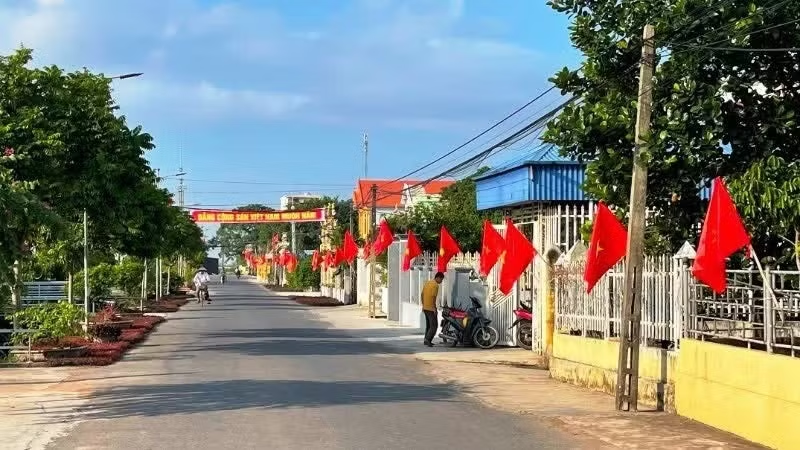
A model new rural residential area in Giao Thuy commune, Ninh Binh province. (Photo: Nhan Dan Newspaper)
The Ministry of Construction has issued Circular No. 10/2026/TT-BXD guiding the implementation of national criteria for new rural communes and the conditions for completing the task of building new rural areas at the provincial level for the period 2026-2030 under the authority of the Ministry of Construction. This is a concrete step in implementing the policy of developing synchronous infrastructure, improving the quality of planning, and contributing to gradually changing the face of rural areas towards modernity and sustainability.
According to the Circular, the planning criteria have been raised to focus on quality, transparency, and the ability to organize implementation. Localities must not only ensure that the general planning of the commune is approved but also develop specific implementation plans that comply with the legal regulations on urban and rural planning. In particular, the requirement to resettle and stabilize the population in areas frequently affected by natural disasters, border regions, and difficult areas is clearly stated, in order to ensure safety and long-term development.
The circular also categorizes communes into groups to apply appropriate criteria. For communes adjacent to urban areas or those with urban development orientations (Group 1), a detailed plan is required to concretize the general plan or zoning plan. Along with this, rural architectural management is strengthened through the issuance or integration of architectural management regulations into general plans, contributing to preserving rural cultural identity and landscape.
In the infrastructure sector, transportation continues to be a key focus. Rural roads must meet planning standards and be regularly maintained. A notable new requirement is to enhance the "green" element in infrastructure development, with at least 50% of rural roads having trees planted along their length.
At the provincial and city levels, fulfilling the task of building new rural areas requires a transportation system that seamlessly connects all communes. Specifically, at least 70% of the length of provincial roads must be lined with trees, contributing to the improvement of the ecological environment and landscape of the area.
Furthermore, criteria for residential housing continue to be refined to improve quality. Solid housing must meet the "three sturdy" standard: foundation, frame, and roof, constructed with durable materials, ensuring a lifespan of 20 years or more. This regulation aims to improve living standards while increasing resilience to the impacts of climate change.
Rural environmental protection efforts have been set with more specific requirements. Communes must develop plans for surface water drainage, collection, and treatment of domestic wastewater that are appropriate to their actual conditions. The percentage of domestic wastewater collected and treated must reach 50% or more; specifically, communes in Group 1 are required to have at least one centralized wastewater treatment facility that meets technical standards.
In the Circular, the Ministry of Construction requests the People's Committees of provinces and cities to specify and implement the criteria based on actual conditions, ensuring that they are not lower than the general standard framework, thereby contributing to the goal of building a comprehensively and sustainably developed rural Vietnam in the new phase.
According to Nhan Dan newspaper
Source: https://baoangiang.com.vn/nang-chuan-nong-thon-moi-giai-doan-2026-2030-a484772.html


![[Image] Hanoi's urban life under the challenge of a "scorching hot" environment](https://vphoto.vietnam.vn/thumb/1200x675/vietnam/resource/IMAGE/2026/05/25/1779706979265_nang-nong-t5-2026-minh-duy-7-4636-jpg.webp)

![[Image] Close-up view of the interchange connecting the two expressways and Long Thanh Airport.](https://vphoto.vietnam.vn/thumb/1200x675/vietnam/resource/IMAGE/2026/05/25/1779703378210_ndo_br_z7863716673926-224453a31600126cce10622af6290afd-4549-jpg.webp)




















































































Comment (0)