

NASA's Jet Propulsion Laboratory (JPL) has developed the Self-Propelled Miniature Underwater Probe (SWIM), aimed at detecting chemical and thermal signals of extraterrestrial life in the saltwater ocean beneath the icy crust of Jupiter's moon Europa. Recently, the probe's maneuverability was also tested in a swimming pool at Caltech.
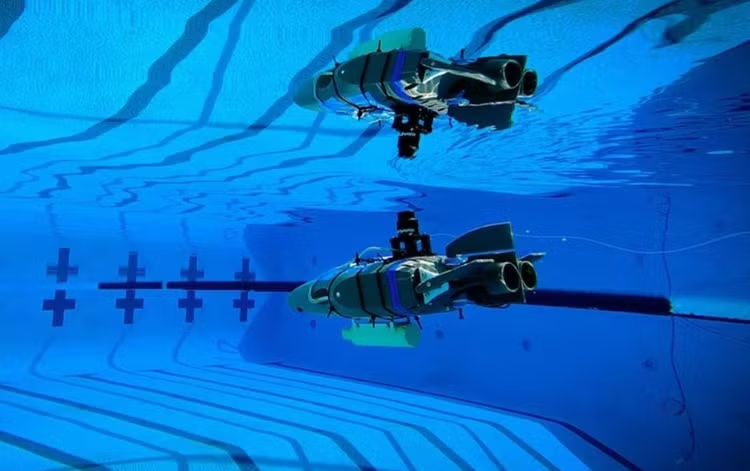
According to reports, the latest prototype uses inexpensive commercial engines and 3D-printed electronic components. The SWIM miniature probe is expected to eventually be equipped with an underwater wireless communication system to pinpoint its location and provide data collected during its exploration of the oceans surrounding distant icy moons.
Ethan Schaler, head of the JPL project research team, said that NASA developed underwater robots for space exploration because they believe that life needs water to survive.
The probe used in this underwater experiment is approximately 42 cm long, and the research team hopes to eventually shrink it down to 12 cm, smaller than even a mobile phone. According to Ethan Schaler, developing this mini-underwater probe has been incredibly difficult; this is just the first design in a series of designs aimed at exploring the far reaches of the ocean .
Next, they need to understand the challenges they will face in underwater dive missions. At the same time, engineers will simulate the pressure and gravity that the probe will encounter on Europa.
Engineers have developed a crucial technology for this mini-probe. It includes a miniature multi-sensor chip capable of measuring temperature, pressure, acidity, conductivity, and chemical composition—all vital factors in the search for life, although it may take several years before such a mini-probe can operate in the ocean on Europa.
Source: https://khoahocdoisong.vn/nasa-phat-trien-tau-tham-do-mini-kham-pha-mat-trang-europa-post2149101965.html

![[Image] Nearly 125,000 Hanoi students completed the Literature exam for the 10th grade entrance exam.](https://vphoto.vietnam.vn/thumb/1200x675/vietnam/resource/IMAGE/2026/05/30/1780117233041_ndo_br_thiet-ke-chua-co-ten-2-png.webp)























![[GALLERY] Vietnamese people spend 302 billion VND watching 60-second films; Netflix is worried.](https://vphoto.vietnam.vn/thumb/402x226/vietnam/resource/IMAGE/2026/05/29/1780031393099_ve-5-png.webp)












































































Comment (0)