

According to Vo Hai Son, Deputy Director of the Department of Disease Prevention ( Ministry of Health ), the latest update from the World Health Organization (WHO) Africa region indicates that the Ebola outbreak caused by the Bundibugyo strain in the Democratic Republic of Congo and Uganda continues to be complex, with a rapid increase in the number of cases, an expanding scope of the outbreak, and the emergence of a risk of cross-border transmission.
On May 17, 2026, the WHO declared the Ebola outbreak caused by the Bundibugyo strain in these two countries as a "Public health event of international concern." However, the WHO stated that the outbreak did not yet meet the criteria to be classified as a global pandemic emergency.
Notably, this is a strain of Ebola virus for which there is currently no approved vaccine or specific treatment.
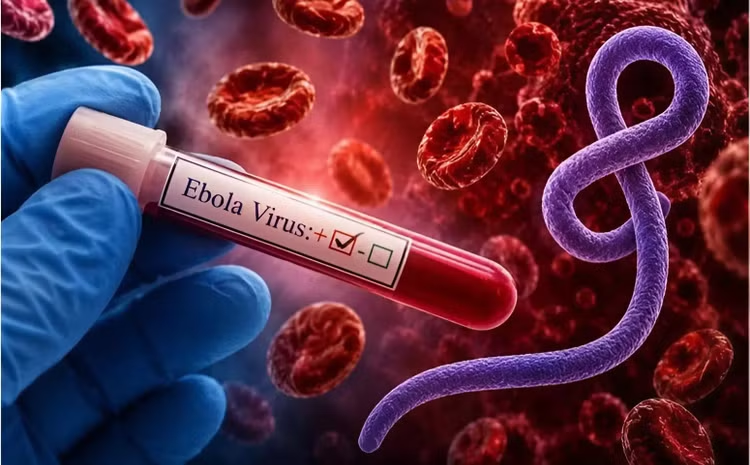
As of May 27, 2026, Congo had recorded 1,077 suspected cases, including 238 suspected deaths. The country also confirmed 121 cases of Ebola, including 17 deaths. In Uganda, health officials recorded 7 confirmed cases, including 1 death.
In total, the two countries have recorded 128 confirmed cases of Ebola caused by the Bundibugyo strain and 18 deaths. The WHO notes that these figures may continue to change as epidemiological investigations and testing are ongoing.
According to the WHO, the outbreak in the Democratic Republic of Congo is currently present in 14 health areas across three provinces, primarily concentrated in Ituri province. Several hotspots with a high number of cases include Rwampara, Bunia, Mongbwalu, and Nyankunde. Controlling the outbreak is challenging due to the complex security situation, high population mobility, particularly in mining areas and border regions.
In Uganda, cases have been identified as imported cases from Congo to the capital, Kampala. Some cases are linked to travel, transportation, and medical care.
The WHO assessed the risk of an outbreak in the Democratic Republic of Congo as “very high,” while the regional risk, including Uganda, was rated as “high” due to continued community transmission, the risk of missed infection chains, and the expanding network of contacts.
On a global scale, the WHO currently assesses the risk as low.
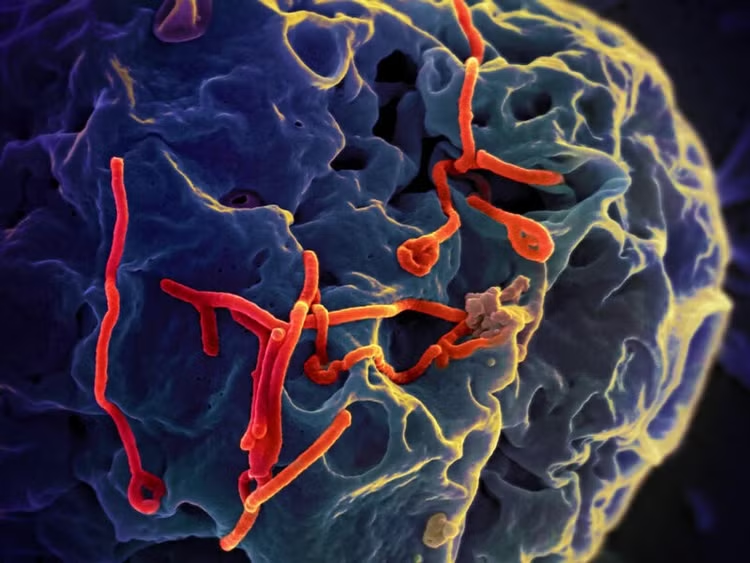
In response to the evolving epidemic situation, on May 22, 2026, the Department of Disease Prevention (Ministry of Health) collaborated with the WHO, the US Centers for Disease Control and Prevention (US.CDC), relevant ministries and agencies, and experts to assess the risk of Ebola entering Vietnam.
According to the assessment results, Vietnam has not recorded any cases and the risk of importation is currently low. However, the health sector acknowledges that the possibility of imported cases cannot be ruled out given the continued increase in international travel and interaction.
The Ministry of Health stated that it has proactively implemented many disease prevention and control measures from an early stage and from afar; at the same time, it has updated professional and technical guidelines on surveillance, testing, early detection, epidemiological investigation, contact tracing, and management of suspected cases.
Local authorities are required to strengthen surveillance at border crossings, healthcare facilities, and in the community; review response plans, and prepare personnel, supplies, chemicals, equipment, isolation areas, and treatment facilities in case of outbreaks.
Simultaneously, the health sector is also stepping up infection prevention and control practices, risk communication, and community engagement to maintain readiness for response.
Given the risk of the disease developing in a complex manner, the Department of Disease Prevention advises people not to panic but to proactively implement preventive measures.
People need to get information from official sources and limit unnecessary travel to areas experiencing the Ebola outbreak.
For those who must travel to an affected area, the Ministry of Health recommends avoiding contact with people who show suspicious symptoms such as fever, vomiting, or diarrhea.
People returning from areas with outbreaks or who have been in contact with suspected cases should proactively monitor their health. If any unusual symptoms appear, they should immediately contact the nearest medical facility for advice, examination, and timely treatment.
The Department of Disease Prevention and Control stated that it will continue to coordinate closely with the WHO, US CDC, and other international organizations to update the epidemic situation, regularly assess risks, and implement appropriate prevention and control measures in accordance with the actual developments.
>>> We invite our readers to watch the video : The Ministry of Health updates the signs of Ebola infection, with a mortality rate of up to 50%:
Source: https://khoahocdoisong.vn/who-canh-bao-khan-ve-ebola-bundibugyo-tai-chau-phi-post2149102232.html
![[Image] Nearly 125,000 Hanoi students completed the Literature exam for the 10th grade entrance exam.](https://vphoto.vietnam.vn/thumb/1200x675/vietnam/resource/IMAGE/2026/05/30/1780117233041_ndo_br_thiet-ke-chua-co-ten-2-png.webp)















![[INFOGRAPHIC] Canon EOS R6: A new breakthrough in 7K Open Gate video recording.](https://vphoto.vietnam.vn/thumb/402x226/vietnam/resource/IMAGE/2026/05/30/1780114528841_info-mayanh-a-thumb-jpg.webp)

































































Comment (0)