

anniversary of death
The most important aspect of ancestor worship is the commemoration of death anniversaries. So what is a death anniversary? A death anniversary is the day commemorating the passing of a deceased person, often referred to as a memorial day.
After the deceased are buried according to customs and rituals, they rest peacefully in their graves. Their descendants must set aside their grief and longing to return to their daily lives. However, every year on the anniversary of their death, even if busy, their descendants must remember to hold a memorial service. It's called a memorial service, not a traditional offering, because only those who follow certain religions and accept ancestor worship perform this ritual. For deceased relatives, only a memorial service is held, not an offering.
On the anniversary of a death, people prepare a feast to invite relatives and friends. In the countryside, the anniversary of a death is an occasion for the host to reciprocate the hospitality of those who have previously invited them to meals. This is called "repaying a debt of gratitude."
Ancestor worship ceremonies can be large or small, depending on the family's circumstances, the number of descendants, and often the level of connection between the living and the deceased.
The anniversaries of parents and grandparents are usually celebrated with large ceremonies, while the anniversaries of siblings, uncles, aunts, and great-grandparents are often simply marked by a humble meal to avoid neglecting the occasion. These smaller anniversaries are called "small" anniversaries, where close friends and relatives are not invited; the ceremony is held at home, followed by a meal shared among family members.
In short, a death anniversary is a day to remember the deceased, with offerings and meals depending on the family's customs.
On the anniversary of a death, there is a distinction between the first anniversary and the final anniversary, as well as other commemorative days, which are called auspicious days.
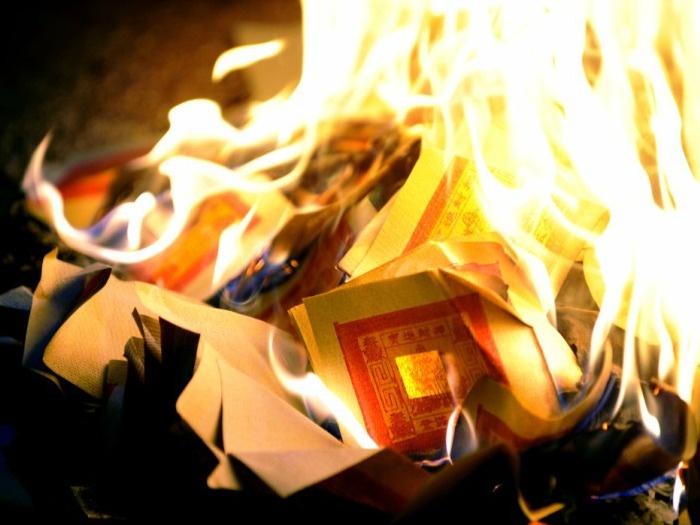 |
Burning paper offerings is a long-standing custom. Photo: Chinese American Family. |
First anniversary of death or first death anniversary
The first anniversary of a death is the first commemoration of the deceased, exactly one year later.
This day is also known as the first anniversary of death. The descendants are still grieving; the pain lingers in the hearts of the living, and children still mourn their parents, wives mourn their husbands, and parents mourn their children, etc.
Yes, a year may seem like a long time, but it's not enough to heal the wounds, not enough to erase all the memories between the living and the dead, not enough to alleviate the grief of losing a loved one for the living.
On the first anniversary of the death, when offering sacrifices to the deceased, the living wear mourning clothes as they did on the day of the funeral, especially the children and grandchildren, to show the departed soul that their grief and longing have not yet subsided. And the children and grandchildren, during the ceremony, also cry as they did on the day of the funeral.
In wealthier families, on the first anniversary of a death, a brass band is invited to play music from the first meal until the end of the anniversary day.
The coarse linen clothes, hats, and staffs worn at funerals are then worn by descendants on the first anniversary of their parents' death. They must wear coarse linen clothes and banana-leaf hats and use staffs to perform rituals and reciprocate the greetings of guests who come to the memorial service before their parents' altar.
For people in the past, traditional clothing was very important; it demonstrated the filial piety of children towards their parents. On the first anniversary of a child's death, wealthy families would often hold a grand ceremony to invite relatives and neighbors from the village.
During this memorial service, the living usually prepare all sorts of items to burn for the deceased: clothes, bedding, dishes, chickens and ducks. Sometimes even vehicles and boats. In short, all the everyday necessities that people need. "As in the earthly realm, so in the afterlife," whatever exists in the earthly realm must also be needed in the afterlife.
During this ritual of burning paper effigies, there are also effigies. It is believed that when these paper effigies are burned and sent to the underworld by a sorcerer, they will "transform" into servants for the deceased.
[...]
The custom of burning effigies has very ancient origins. Originally, during the feudal era, when a man died, both his first and second wives would commit suicide at the grave. The servants, who were essentially slaves, were also killed and buried with him. Later, the instinct for self-preservation led people to think of using effigies as substitutes.
The belief of descendants in the immortality of their ancestors' souls leads people to think of burning paper offerings to provide the deceased with everything they need for daily "life" in the afterlife.
In today's civilized society, some people consider burning paper offerings unreasonable, but they don't want to go against the wishes of their relatives, so they still burn them on death anniversaries with the belief that even if it's wrong, it's not a big deal, and if it's right, abandoning it would be a sin.
Source: https://znews.vn/nhung-tuc-it-nguoi-biet-ve-ngay-gio-dau-post1650348.html
![[Photo] General Secretary and President To Lam presides over a working session with the Central Policy and Strategy Committee on the development of the materials industry.](https://vphoto.vietnam.vn/thumb/1200x675/vietnam/resource/IMAGE/2026/05/21/1779359935432_a3-bnd-3129-1412-jpg.webp)




































































Comment (0)