

On November 16th, Nikkei Asia reported that China's CSI Semiconductor Index (CSI931865) has risen for six consecutive sessions since the US presidential election results on November 5th. This index assesses the performance of semiconductor companies on the Chinese stock market.
Using challenges as motivation?
Since the beginning of the year, CSI931865 has risen 26%, outperforming the 12% increase of the Shanghai Stock Exchange's general stock index. This increase is also higher than the 20% increase of the SOX – a similar index on the NASDAQ (USA).
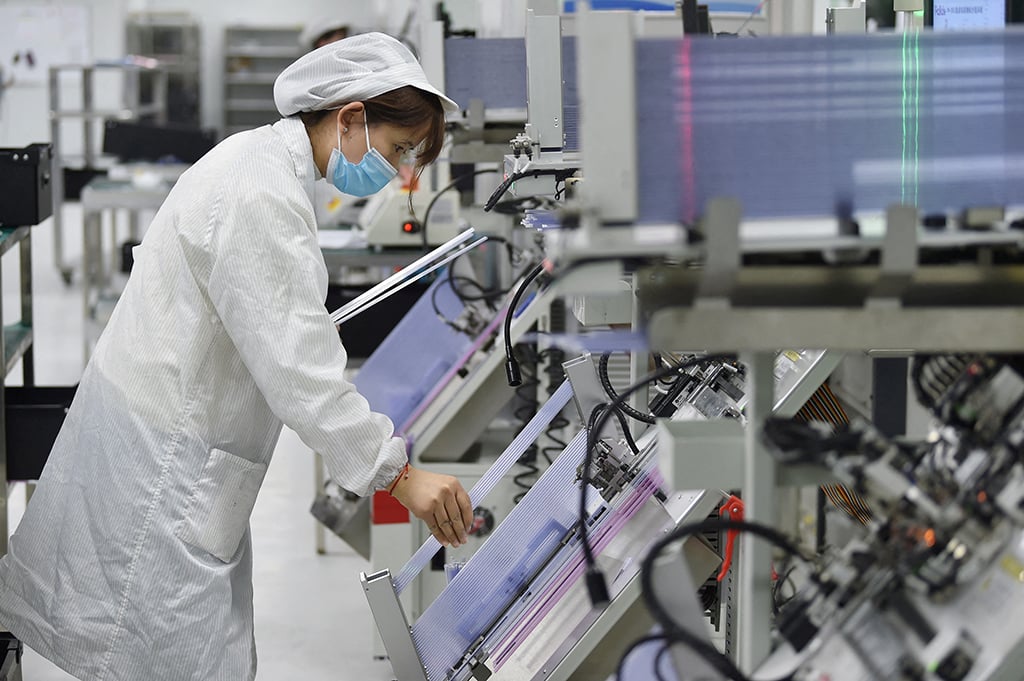
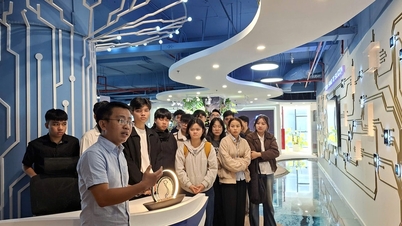
Inside a semiconductor chip manufacturing plant in Jiangsu province (China)
The surge in CSI931865 is believed to be due to the growth opportunities for Chinese semiconductor companies as they play an increasingly larger role in the domestic market, amidst the country's limited access to advanced semiconductor technology, supplies, and products.
Typically, Empyrean Technology (a manufacturer of automation tools for chip design) has seen the third-highest gain overall on the Chinese stock market recently. This is because the company is expected to soon dominate the Chinese market as competitors from the US, such as Synopsys and Cadence Design Systems, face restrictions on accessing the mainland market. Ranked fourth in terms of price increase on the Chinese stock market is Nexchip Semiconductor, which has risen more than 20% since its initial public offering (IPO) in 2023.
Preparations are thorough, but the challenges are significant.
Perhaps, having learned from facing sanctions during Trump's first term (2017-2021) and the subsequent term of US President Joe Biden (from 2021), Chinese semiconductor companies are diligently preparing for the anticipated further escalation of the US-China trade war under Trump.
According to Reuters, citing data from Chinese customs, China has increased its purchases of semiconductor equipment from abroad. From January to September 2024, China's semiconductor equipment imports increased by more than 30% year-on-year, reaching $24.12 billion. Of this amount, $7.9 billion was spent on lithography machines, which are essential for producing the most advanced chips. China's investment in lithography machines increased by 35.44% year-on-year. Most of the lithography machines purchased by China came from ASML (Netherlands) – valued at $7 billion, accounting for more than 88% of the total $7.9 billion.
However, ASML Holding has supplied its most advanced deep ultraviolet (DUV) lithography machines to China this year. According to a US requirement imposed in 2023, ASML was only allowed to supply some older generation DUVs to China. Since 2019, the US has also required ASML to cease selling ultra-extreme ultraviolet (EUV) lithography machines to China. This restricted access to advanced lithography machines is causing difficulties for China's semiconductor chip industry. It also represents a major challenge for China in its pursuit of semiconductor self-sufficiency. Despite years of development, China has only recently launched lithography machines operating at a wavelength of 193 nm, achieving resolutions below 65 nm, and thin coatings with accuracy below 8 nm.
Meanwhile, ASML's DUV lithography can achieve resolutions below 38 nm and thin-layer coatings with precision down to 1.3 nm. ASML's EUV lithography machines offer even higher resolutions. And without lithography machines of the same caliber as ASML's equipment, China would find it difficult to produce advanced semiconductor chips domestically.
Moreover, even before Trump took office, Reuters, citing its own sources, revealed that on November 11th, the US Department of Commerce banned TSMC (Taiwan) – the world's largest manufacturer of advanced semiconductor chips – from supplying advanced semiconductor chips to mainland China. This poses significant challenges for the Chinese technology industry, which still needs considerable time to increase its self-reliance.
The US is providing $6.6 billion in funding to TSMC.
The U.S. Commerce Department announced yesterday that the government has decided to provide $6.6 billion in funding to the U.S. unit of Taiwan Semiconductor Manufacturing Company (TSMC) to manufacture semiconductors in Phoenix, Arizona, according to Reuters. In April, TSMC agreed to expand its investment in the U.S. and build a third factory in Arizona by 2030.
Faculty of Literature
Source: https://thanhnien.vn/nganh-chip-trung-quoc-doc-suc-truc-thuong-chien-leo-thang-185241116215734498.htm




























![[Photo] Reception to welcome General Secretary and President To Lam and his wife on their State visit to the Philippines](https://vphoto.vietnam.vn/thumb/1200x675/vietnam/resource/IMAGE/2026/06/01/1780295488620_vna-potal-chieu-dai-chao-mung-tong-bi-thu-chu-tich-nuoc-to-lam-va-phu-nhan-tham-cap-nha-nuoc-toi-philippines-8798060-7855-jpg.webp)
























































Comment (0)