

- Cai Chanh Base National Special Monument
- The Lung Lá Provincial Party Committee Base - The Thể House historical site
- Visiting the old base
- Spring rejoices in the revolutionary base area.
- Warmth and camaraderie in the revolutionary base area.
The countryside brightens up.
I remember a time when Ninh Thanh Loi was a quiet, saline, acidic land with a sparse population, a desolate "dog-yawning field." The soil was infertile, there were few rice paddies, and most of it consisted of swamps, mangrove forests, water coconut trees, and reeds.
However, after 50 years of reform, this place has completely transformed. Smooth concrete roads connect hamlets and villages; colorful ornamental flowers line the roadsides; sturdy brick houses stand close together... the countryside seems to brighten up amidst a vibrant picture.
 Ninh Thanh Loi rice field. Photo: PHAN THANH CUONG
Mr. Nguyen Van Thiet, from Chom Cao hamlet, nearly 80 years old, is a farmer who has spent his entire life in the wetlands. He shared that in the past, land was abundant and population sparse, with every family reclaiming barren land for cultivation. His family alone owned about 10 hectares. In the past, growing pineapples and melaleuca trees wasn't very profitable, but now they've switched to growing rice and raising shrimp, increasing their income several times over. Roads are now convenient, making buying and selling shrimp and rice much easier.
For generations, the people of Ninh Thanh Loi have been hardworking, never submitting to enemies in the past, and refusing to accept poverty today. Over 12,100 hectares of aquaculture land in the commune are being effectively utilized by the local people. To optimize income per unit area, farmers apply a model of integrated farming of shrimp, crabs, fish, and rice, with the main species being: tiger shrimp, freshwater prawn, crab, snakehead fish, and catfish...
Mr. Thai Van Quich's family in Kor Thum hamlet owns 1.4 hectares of farmland. Each year, he raises shrimp, crabs, and fish while also cultivating one rice crop. Mr. Quich stated that this year's rice harvest yielded 7.5-8 tons per hectare, and with stable rice prices, the profit was quite good. He added that agricultural production is now much easier thanks to mechanization; from land preparation, sowing, fertilizing, spraying pesticides to harvesting, all are assisted by machinery, significantly reducing the labor burden for farmers.
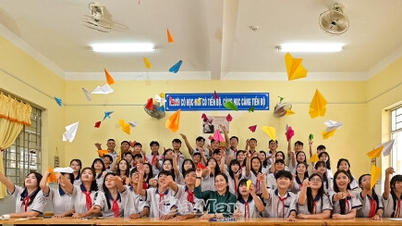
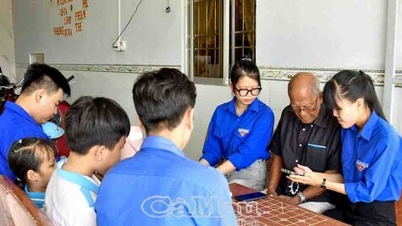
 The joy of youth union members under the national flag in Ninh Thanh Loi.
In Ninh Thanh Loi today, the rice fields not only bring prosperity to farmers but also create the renowned brand of "fragrant rice - clean shrimp" known far and wide, such as ST24, ST25, Mot Bui Do, Dai Thom 8...
Stepping confidently into the future
Following the merger of Ninh Thanh Loi and Ninh Thanh Loi A communes, the commune has met 13 out of 19 criteria in the national set of criteria for advanced new rural areas. With strong determination, the commune People's Committee has mobilized all resources to improve the material and spiritual lives of the people.
Mr. Phan Thanh Sung, Vice Chairman of the People's Committee of Ninh Thanh Loi commune, said: "The people in the area are very diligent and hardworking. When new economic models are transferred, people seriously learn and actively participate to access advanced farming processes. This year, the rice-shrimp farming plan has been implemented 100%; shrimp production and rice yield have both exceeded the set targets. In addition, there are other models of crop cultivation and livestock farming, thanks to which not only is food security ensured, but people's incomes are constantly increasing."
 The rural roads of Ninh Thanh Loi are brilliantly decorated to welcome spring.
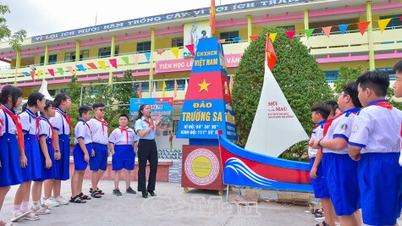
Besides economic development, a prominent achievement in the commune's new rural development is the comprehensive electricity supply system covering the entire commune, ensuring 100% of households have access to safe electricity. The education system has also been comprehensively invested in, with 7 schools from kindergarten to junior high school, all meeting national standards, creating a modern learning environment for the younger generation. The rate of universal health insurance coverage has reached 93.46%, approaching the maximum target. These results contribute to creating an increasingly modern and prosperous appearance for Ninh Thanh Loi.
Adding new vitality to the rural landscape is the comprehensively invested and smooth transportation infrastructure, creating favorable conditions for people's travel and trade. In particular, the DT980 road – a project connecting the Ganh Hao estuary with the Can Tho expressway, passing through Ninh Thanh Loi commune – is entering its final phase. Once this road is officially put into use, Ninh Thanh Loi will be directly connected to the region's vital transportation network, expanding its economic development potential and facilitating access to key economic zones.
In every bountiful shrimp and rice field, along every well-maintained, green road, and under the roofs of schools filled with the sounds of laughter and conversation, one can clearly see a rural area making a strong breakthrough in a new phase of development. That is the vitality of Ninh Thanh Loi.
Thuy Lien - Thanh Hai
Source: https://baocamau.vn/ngay-moi-can-cu-cai-chanh-a126431.html
![[Photo] Secretary of the National Assembly Party Committee, Chairman of the National Assembly presides over the meeting of the Standing Committee and Executive Committee of the National Assembly Party Committee.](https://vphoto.vietnam.vn/thumb/1200x675/vietnam/resource/IMAGE/2026/06/03/1780480353201_ndo_br_bnd-2585-jpg.webp)
![[Photo] General Secretary and President To Lam presides over a meeting with the Central Organizing Committee.](https://vphoto.vietnam.vn/thumb/1200x675/vietnam/resource/IMAGE/2026/06/03/1780482764658_a1-bnd-4741-3342-jpg.webp)


















![[Photo] General Secretary and President To Lam attends the 14th Congress of the Vietnam Trade Union](https://vphoto.vietnam.vn/thumb/1200x675/vietnam/resource/IMAGE/2026/06/04/1780543339765_anh-man-hinh-2026-06-04-luc-10-22-07.png)




















![[Video] Sunset at Lap An Lagoon – Where the sun sets over the fishing nets](https://vphoto.vietnam.vn/thumb/1200x675/vietnam/resource/IMAGE/2026/05/31/1780192137701_beach-landscape-sea-water-nature-grass-745871-pxhere-com.jpeg)




![[Photo] General Secretary and President To Lam attends the 14th Congress of the Vietnam Trade Union](https://vphoto.vietnam.vn/thumb/402x226/vietnam/resource/IMAGE/2026/06/04/1780543339765_anh-man-hinh-2026-06-04-luc-10-22-07.png)























Comment (0)