

Preserving the salt-making craft
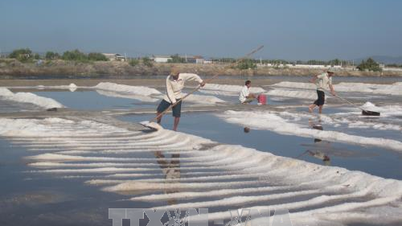
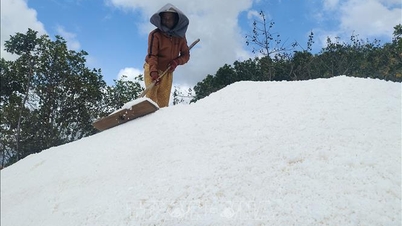
Welcoming us under the scorching midday sun, Mr. Ngo Minh Chien, a salt farmer in An Thoi Dong commune, happily said that the price of salt sold by the quintal currently ranges from 105,000 to 110,000 VND/quintal. His family cultivates 2 hectares of salt fields, and this season's yield is approximately 2,200 quintals, meaning each hectare can produce more than 1,000 quintals of salt.
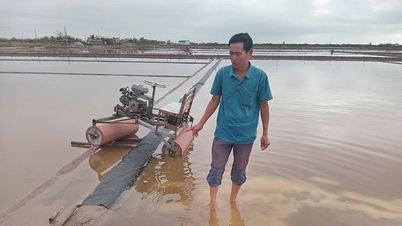
This year, strong consumer demand has helped salt production sell quickly, eliminating the problem of salt piling up and being difficult to sell, as seen in previous seasons. According to elderly farmer Le Quy, born and raised in An Thoi Dong commune and still practicing the salt-making craft passed down from his ancestors, besides market factors, the investment by some households in storage tanks and improvements to crystallization yards has also contributed to raising salt quality, allowing it to be sold at a better price.
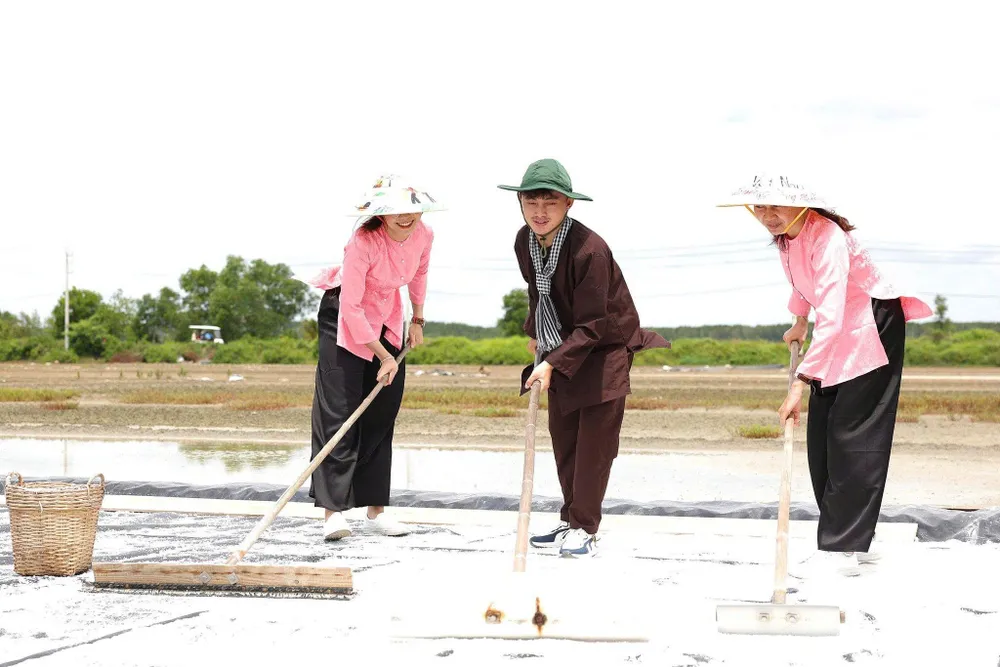
According to long-time salt farmers in the area, salt production in An Thoi Dong commune originated in the late 1960s. People in the commune would go to the edge of the forest to collect concentrated brine accumulated in ponds and ditches, then mix it with river water and allow it to settle naturally. Afterward, they would use the concentrated brine to make salt. By 1977, salt production progressed to granular salt production on salt fields. From 2007 to the present, people have begun to shift from producing salt on earthen floors to using tarpaulins for salt production.
Salt production is a traditional occupation, identified as one of the two main industries of An Thoi Dong commune, after aquaculture. To preserve traditional cultural values in the suburban communes of Ho Chi Minh City, on October 14, 2024, the People's Committee of Ho Chi Minh City issued a Decision recognizing An Thoi Dong commune as a traditional salt production village.
This is not only a recognition of the hard work of salt farmers, but also a stepping stone to enhance the value of the product, promoting the development of the salt industry in a modern, sustainable direction and closely linked to the market.
Profit from tourism
Heading towards the sea, Thieng Lieng is a small island hamlet belonging to Thanh An commune, with nearly 13,000 hectares of mangrove forest. Salt production originated in the 1970s when residents came to reclaim land and expand salt fields. The salt industry developed, and today Thanh An island commune has approximately 400 hectares of salt fields.
Salt production is arduous work and dependent on the weather. Production costs, especially fuel and transportation costs to the mainland, are high, making salt farmers' incomes unstable. However, in recent years, the development of community tourism on Thieng Lieng island hamlet has helped salt farmers not only increase their income but also preserve their traditional craft.
Since Thiềng Liềng adopted the community-based tourism model, the income of the people on the island hamlet has become more diverse and prosperous. Besides producing raw salt, farmers have also expanded the production of processed salts such as shrimp salt, chili salt, pepper salt, and herbal salt… Most of these salt products have been recognized as OCOP 3-star. The development of community-based tourism has also become an effective sales channel for local salt farmers.
In the trend of developing green and sustainable tourism, Thieng Lieng Island not only welcomes tourists but also tells the story of salt farmers who have endured countless seasons of rain and sunshine, working day and night, enduring hardships but persistently preserving the traditional craft of their ancestors. Ms. Nguyen Thi Bach Tuyet, Director of the Thieng Lieng Agricultural - Commercial - Service - Tourism Cooperative, said that since implementing the community tourism model, Thieng Lieng has welcomed tens of thousands of visitors.
Currently, the community-based tourism model on the island involves 18 households, 16 of which still maintain the traditional salt-making craft. "Combining tourism with preserving the age-old salt-making craft is a way for island residents to increase their income and maintain their traditional occupation. Income from tourism provides people with additional resources to invest in production, and conversely, salt production becomes a unique highlight, creating a distinct identity for tourism in the island hamlet," Ms. Tuyet shared.
Thieng Lieng hamlet currently has 243 households, of which more than 150 are still involved in salt production, which serves as their main source of livelihood. Here, tourists can not only breathe in the fresh air from the "green lung" of the mangrove forest but also have the opportunity to stroll through the salt fields and learn about the traditional salt-making craft of the island's inhabitants.
Source: https://www.sggp.org.vn/nghe-muoi-chuyen-minh-post844362.html



















































































Comment (0)