Following feedback from National Assembly representatives that the policy to build Vietnam's first semiconductor chip manufacturing plant was not attractive enough, government representatives stated that they would study, incorporate the feedback, and finalize the resolution for submission to the National Assembly for approval.
Following feedback from National Assembly representatives that the policy to build Vietnam's first semiconductor chip manufacturing plant was not attractive enough, government representatives stated that they would study, incorporate the feedback, and finalize the resolution for submission to the National Assembly for approval.
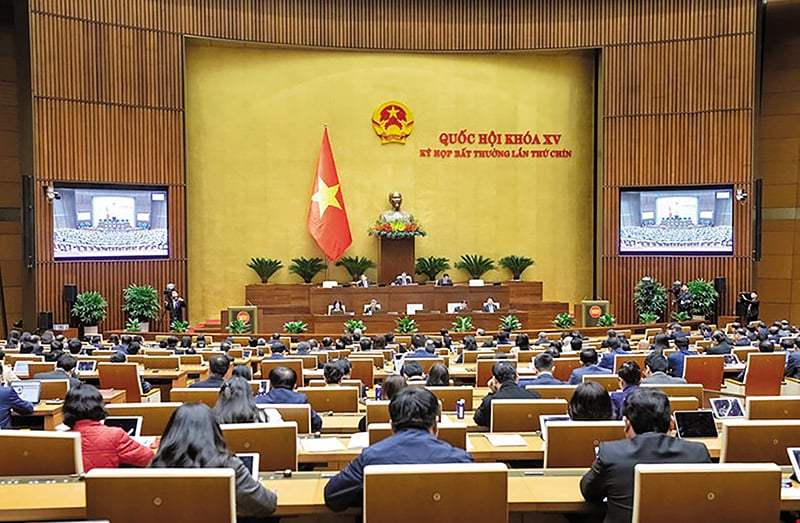 |
| The National Assembly held a plenary discussion on the Draft Resolution of the National Assembly on piloting a number of policies to remove obstacles in science , technology and innovation activities. |
The first factory is very important.
This morning (February 19th), the National Assembly will pass a resolution piloting several policies to remove obstacles in science, technology, and innovation activities.
This was the initial draft resolution title submitted by the Government. Later, after incorporating feedback from National Assembly deputies, at the end of the plenary session on the morning of February 17th, the representative of the Drafting Committee (then Minister of Information and Communications Nguyen Manh Hung) proposed a new title: Resolution on piloting a number of special policies and mechanisms to create breakthroughs in the development of science, technology, innovation and digital transformation.
"The pilot resolution does not aim to remove all bottlenecks, especially since it was prepared in a short time, but focuses on piloting a few special policies and mechanisms under the authority of the National Assembly that are basically clear and can be implemented immediately, addressing long-standing bottlenecks and urgent issues to create breakthrough development and implement Resolution 57 of the Politburo immediately," Minister Nguyen Manh Hung explained.
Previously, one of the issues raised by delegates was the draft resolution stipulating that the central budget would support no more than 30% of the total investment of the project and no more than 12,800 billion VND for the construction of small-scale, high-tech semiconductor chip manufacturing plants to serve the needs of research, design, production, packaging, and testing of semiconductor chips.
Representative Nguyen Duy Minh (Da Nang) analyzed that, according to Article 17 of the Draft Resolution, the policy of supporting 30% of the total investment only applies if the semiconductor manufacturing plant starts production before December 31, 2028. This aims to create pressure and motivation for businesses to reach the target two years early, which is a good idea. “However, building Vietnam’s first semiconductor manufacturing plant with such a deadline is quite difficult to implement, and the 30% support level is not attractive enough,” Representative Minh commented.
Therefore, Mr. Minh suggested that Vietnamese businesses be allowed to choose one of two options.
Firstly, businesses using investment capital to invest in projects will be allowed to extend the support period until December 31, 2030, and will receive support according to the following timelines: 30% in 2030, increasing by an additional 10% if the project is shortened by one year; 40% in 2029; and 50% in 2028.
Secondly, businesses are allowed to use their Science and Technology Development Fund to invest in projects and are permitted to allocate more than 10% of the fund (according to current regulations) for a number of years to invest in factories, with the factories expected to begin production before December 31, 2030.
In response, Minister Nguyen Manh Hung affirmed that the semiconductor industry is a strategic industry. Vietnam aims to fully develop all stages of this industry, with the most challenging being the manufacturing plants, especially the first production plant which is crucial for research and testing of chips designed in Vietnam.


"This factory is crucial for the production of specialized chips for Vietnam, especially for defense and security, and is very important for human resource training," Mr. Hung emphasized.
Minister Nguyen Manh Hung also provided additional information, stating that this small-scale factory is worth less than $1 billion, similar to a lab.
According to Mr. Hung, the State should invest entirely, but to attract businesses to participate in the operation, the Resolution proposes supporting 30% of the total investment value.
“Some National Assembly deputies have suggested a higher support level, up to 50% if the project is completed faster, and a minimum of 30%, allowing businesses to use the science and technology fund for investment because this is a research and development project, not purely a business venture; allowing businesses to allocate more than 10% of the Science and Technology Fund over a number of years to invest in this factory and lab, and also suggesting that the names of the supported businesses should not be specified. We will study and consider these suggestions,” Minister Nguyen Manh Hung reported to the National Assembly.
A breakthrough policy is needed for the development of nuclear power.
Also this morning, the National Assembly voted to approve the Resolution on specific mechanisms and policies for investment and construction of the Ninh Thuan Nuclear Power Project.
Earlier, during discussions in committees and the plenary session, many delegates unanimously agreed on the need for breakthrough policies to develop nuclear power and nuclear energy for peaceful purposes and development in Vietnam, as presented by the Government. Some opinions also noted that, alongside potential benefits and positive aspects, the project also faces many risks and challenges. Therefore, careful and specific consideration is needed regarding financial, technological, and environmental, social, and geopolitical safety issues.
Regarding specific details, the selection of the investor and contractor is one of the issues of concern to the delegates. According to the proposal, the Prime Minister assigned the investor to implement projects using the turnkey contract form and direct contracting for the turnkey package for the construction of the main plant with the contractor in an intergovernmental agreement or treaty; applying direct contracting/simplified direct contracting for important consulting packages to prepare, verify, appraise, and assist the investor in managing and implementing the project; purchasing fuel, and hiring partners for operation and maintenance in the initial period.
During the group discussion, some delegates expressed concerns about this regulation, arguing that if not strictly controlled, it could affect the transparency, progress, and quality of the Project.
Speaking in the assembly hall, delegate Trinh Thi Tu Anh (Lam Dong) argued that the "turnkey" contract is suitable for Vietnam's current conditions. She explained that South Korea – a country possessing nuclear power technology – also chose this model for its first plant between 1972 and 1978.
Thanks to strong research support policies, by 1998, South Korea had completely mastered the technology, exporting a "Made in Korea" nuclear power plant to the United Arab Emirates in 2009. Several other countries also chose the "turnkey" contract model when building their first nuclear power plants, such as Egypt, Türkiye, Bangladesh, Belarus, the United Arab Emirates, and Poland.
Regarding nuclear safety and security, delegate Tú Anh stated that, conventionally, suppliers adhere to the principles of the International Atomic Energy Agency (IAEA), so regardless of which technology partner is chosen, the standards and regulations used in the design of nuclear power plants are consistent with IAEA standards.
According to delegate Tú Anh, designs that take into account Vietnam's topography and climate should be approved according to Vietnamese safety standards and regulations, and can be assessed through a simplified process.
Another issue that received attention and discussion was the regulation exempting investors from reporting to the owner's representative agency for review and approval of investment projects and capital mobilization plans.



Representative Nguyen Quang Huan (Binh Duong) argued that large-scale projects often involve unforeseen circumstances. "Suppose later, the equity capital is insufficient and requires increased funding. If the state-owned entity is not involved in supervision, will the investor have the authority to increase capital, or will they have to seek approval from the National Assembly?" Mr. Huan questioned.
According to the representative from Binh Duong, the state-owned agency's oversight allows for faster decision-making than requesting adjustments from the National Assembly. Therefore, consideration should be given to ensuring the project is implemented quickly but stably.
In his explanatory report, Minister of Industry and Trade Nguyen Hong Dien stated: “With a spirit of openness, urgency, and a commitment to avoiding perfectionism, but also not being hasty or subjective, after today's discussion, we pledge to continue working with the lead agency to thoroughly research and incorporate as many valid opinions from delegates as possible to finalize the Draft Resolution, which will be submitted to the National Assembly for consideration and approval at the end of this session. This will serve as the basis for the prompt implementation of the Project, ensuring quality and progress as required.”
This morning (February 19th), the 15th National Assembly concluded its ninth extraordinary session, passing resolutions on adjusting the growth target to 8% or higher, on the investment policy for the Lao Cai - Hanoi - Hai Phong railway construction project, and on piloting some specific mechanisms and policies to develop the urban railway network in Hanoi and Ho Chi Minh City.
The resolutions that were voted on also included those on piloting certain special policies and mechanisms to create breakthroughs in the development of science, technology, innovation, and digital transformation; on specific mechanisms and policies for investing in and constructing the Ninh Thuan Nuclear Power Project; and on addressing certain issues related to the reorganization of the state apparatus.
The Law on Promulgation of Legal Normative Documents (amended) and the Law on Organization of Local Government (amended) were also passed at this session.
Source: https://baodautu.vn/nghien-cuu-ho-tro-cao-hon-cho-cong-nghiep-ban-dan-d247625.html


![[Photo] Prime Minister Le Minh Hung presides over the thematic session on promoting science and technology development and innovation.](https://vphoto.vietnam.vn/thumb/1200x675/vietnam/resource/IMAGE/2026/06/23/1782207872934_ndo_br_dsc-1724-jpg.webp)