

 |
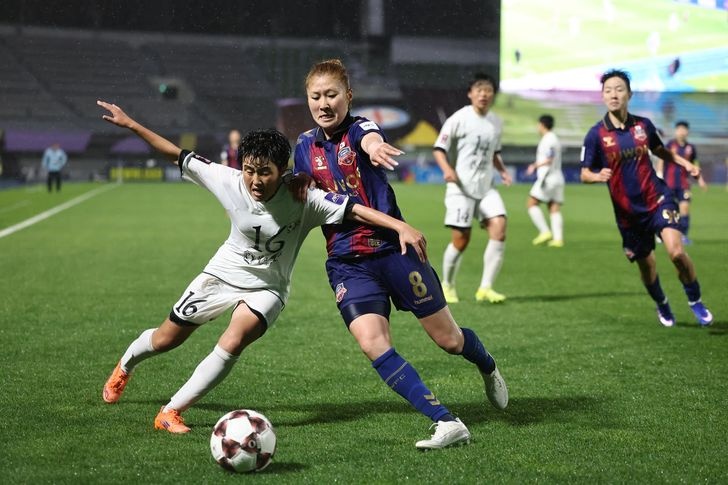
The female players displayed fierce determination in the semi-final match of the 2026 AFC Women's Club Championship. Photo: Yonhap |
On the evening of May 20th, it rained heavily in Suwon, South Korea, but thousands of people still packed a corner of the stands, wearing raincoats, to watch the semi-final match of the Asian Women's Club Championship between South Korea's Suwon team and North Korea's Naegohyang team.
Beyond its sporting significance, the match was also seen as a new test for a more conciliatory atmosphere on the Korean Peninsula, marking the first time a North Korean women's football club had traveled to South Korea to compete in a continental tournament.
The appearance of the North Korean team attracted particular attention from the South Korean media and public opinion, as exchanges between the two Koreas in many fields, including sports, have been almost frozen for many years.
Speaking on the same day, South Korean Unification Minister Chung Dong Young suggested that the semi-final match between South Korea's Suwon FC Women's club and North Korea's Naegohyang Women's FC could set a positive precedent for improving inter-Korean relations.
Minister Chung Dong Young also emphasized that the South Korean government has instructed the police and relevant agencies to ensure the security, logistics, and safe and convenient transportation of the North Korean delegation.
The Minister of Culture and Sports represented the South Korean government in watching the match live.
Sports diplomacy carries a message of hope.
For many years, sports was almost the only area where Seoul and Pyongyang maintained contact, even as political dialogue channels stalled.
The 2018 Winter Olympics ushered in a rare period of détente on the Korean Peninsula when Pyongyang sent a delegation of athletes to South Korea along with Kim Yo Jong, the sister of leader Kim Jong Un. The two Koreas then marched under a single flag and formed the first joint Korean women's ice hockey team in Olympic history.
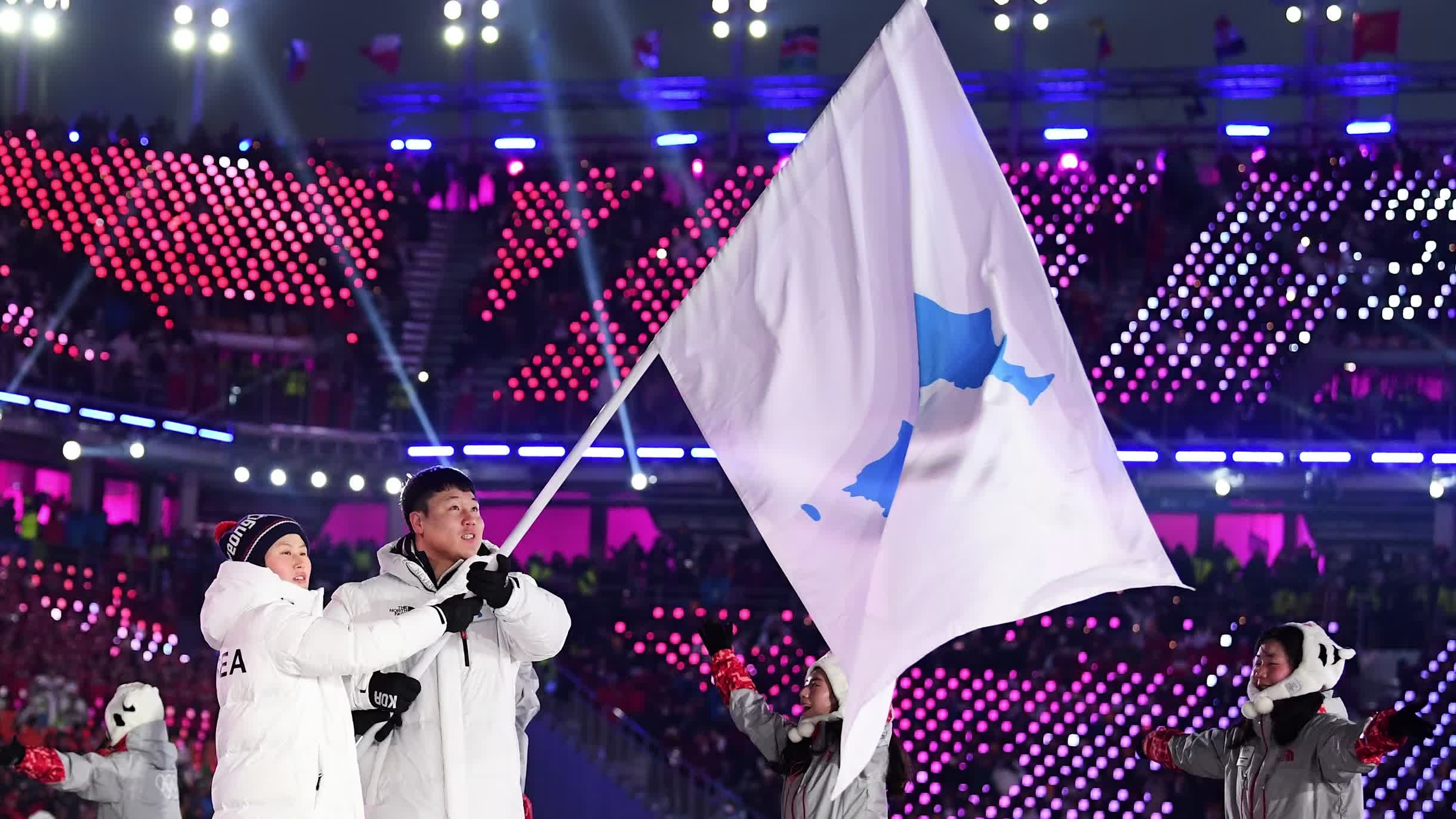 |
The image shows South Korean and North Korean athletes marching under a shared flag that reads "Unified Korean Peninsula" at the opening ceremony of the 2018 Winter Olympics. Photo: International Olympic Committee. |
The conciliatory atmosphere from the 2018 Winter Olympics subsequently paved the way for a series of high-level meetings, including the inter-Korean summit and meetings between US President Donald Trump and leader Kim Jong Un in Singapore and Hanoi.
Previously, football had also served as a special diplomatic tool on the peninsula on several occasions. In 1990, the South Korean national team visited Pyongyang for a friendly match against the North Korean team. In 2002, North Korea sent a delegation of supporters to South Korea to cheer at the 2002 Busan Asian Games. In 2005, Pyongyang and Seoul marched together under one flag at the opening ceremony of the East Asian Games in Macau.
Experts at the Center for Strategic and International Studies (CSIS) suggest that sports diplomacy has the potential to create a "political buffer zone," where both sides can send conciliatory signals without formal concessions at the negotiating table.
Symbolic meaning
Yonhap quoted Kim Yong, a spectator at the match, as saying that he had long believed that if relations between the two Koreas were to change, it would have to come from peace-building efforts involving the people.
"If we can show them, even in small ways, that we are one people with one heart, then perhaps ordinary people in North Korea will realize that we feel the same way," he said.
“Then, from there, people will gradually build it up. Melting the ice little by little. The ice will melt if it’s warm enough for long enough, right?” he said before turning back into the rain to continue watching the match.
Many experts believe it is too early to see the match as a sign of a turning point in inter-Korean relations. “The likelihood of this football game immediately becoming a ‘breakthrough’ in inter-Korean relations is quite limited,” said Hyobin Lee, a professor at Sogang University in Seoul.
However, she argued that a North Korean women's soccer team visiting South Korea still holds symbolic significance and could become "an opportunity to ease tensions in a frozen relationship."
Meanwhile, some other experts are more cautious, arguing that inter-Korean sporting events and cultural exchanges have taken place fairly frequently in the past but have not produced any significant diplomatic breakthroughs.
"Therefore, I don't see any reason to view this development as a signal of anything truly new," said Erwin Tan, a professor of international politics at Hankuk University of Foreign Studies.
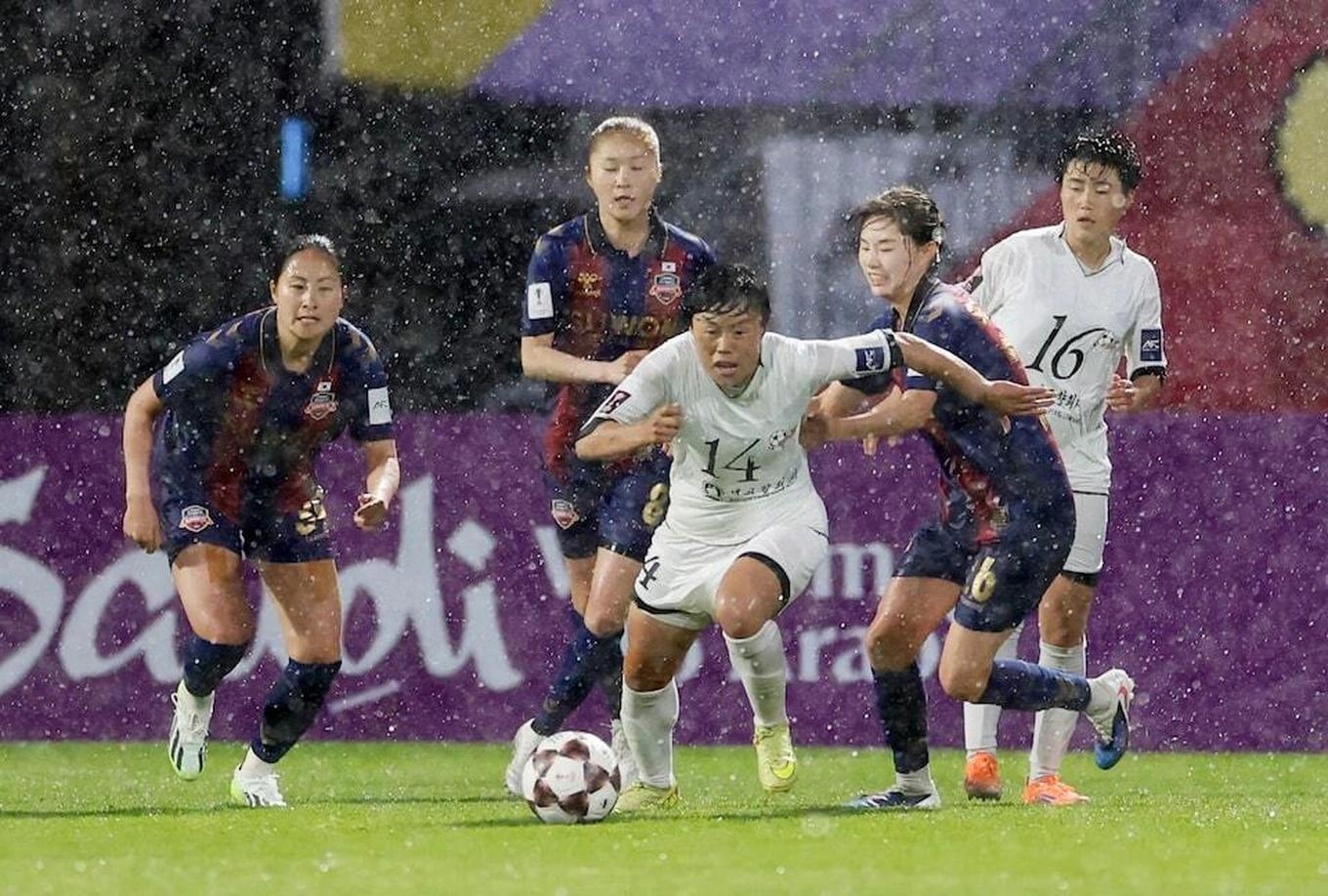 |
The match took place in heavy rain. Photo: Reuters |
Meanwhile, North Korea maintains its hardline stance by amending its constitution, removing provisions related to unification while strengthening its southern border. This suggests that any conciliatory signals through sports, if any, are unlikely to bring about significant political change in the short term.
Nevertheless, sports continue to be used and serve as a channel of soft diplomacy on the Korean Peninsula as Seoul seeks to restart dialogue with Pyongyang.
Source: https://znews.vn/ngoai-giao-bong-da-cua-han-quoc-post1653574.html






















































































Comment (0)