

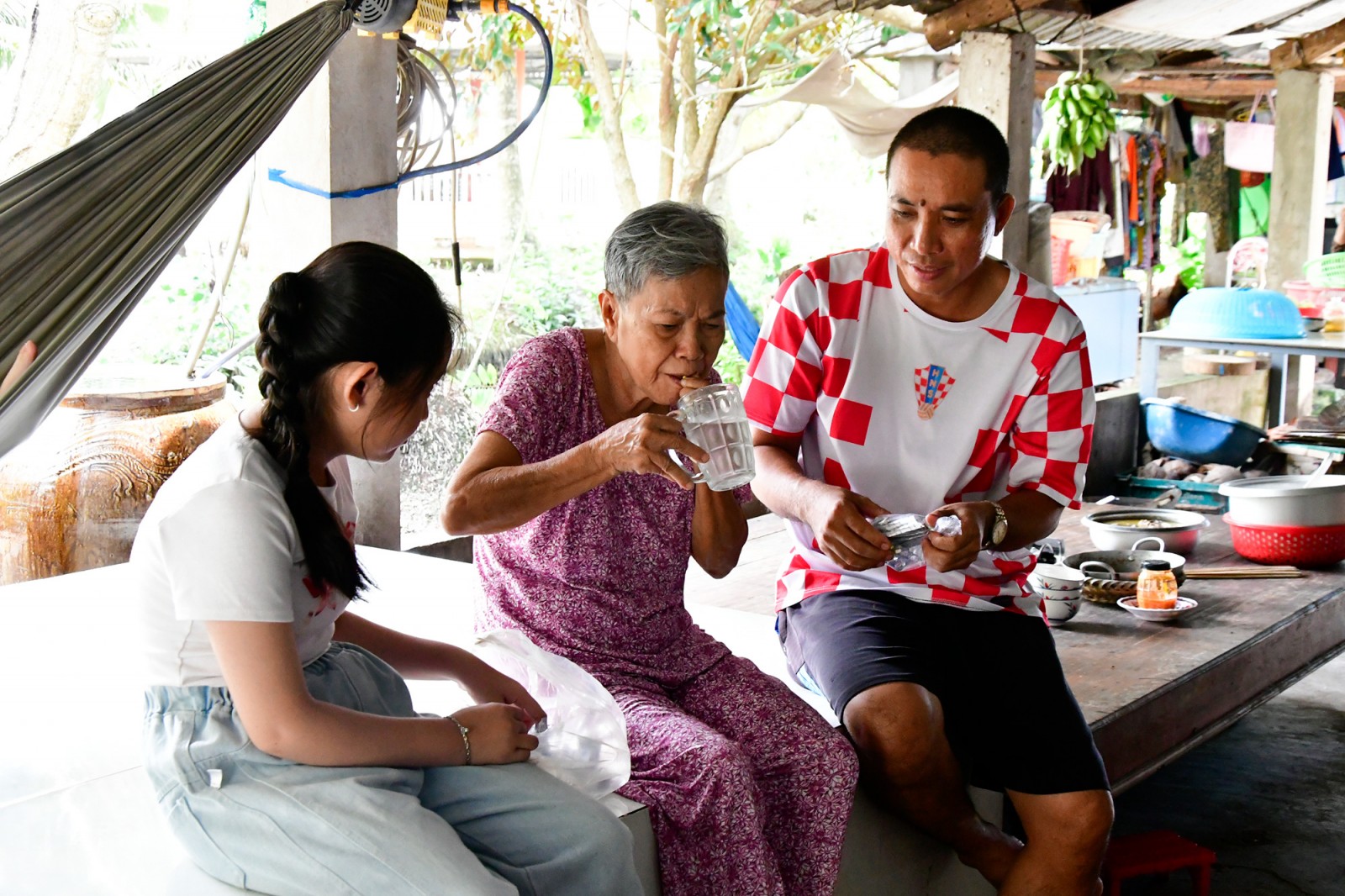
Ms. Ma Thi San, residing in Tay Son 1 hamlet, An Bien commune, enjoys time with her children and grandchildren in her rural home. Photo: Bao Tran
Heartwarming moments surrounded by children and grandchildren.
On a weekend afternoon, the house of Mrs. Ma Thi San, residing in Tay Son 1 hamlet, An Bien commune, was filled with the joyful sounds of her grandchildren running and playing in the yard. Sitting on an old hammock, she watched her children and grandchildren come and go, a gentle smile playing on her lips. At 72, her joy was no longer about eating well or dressing well, but about seeing her children and grandchildren gathered under her roof each day. Mrs. San said: “I just need to hear the familiar sound of the car pulling into the yard, hear the children call out ‘Mom!’, ‘Grandma!’, and that makes me happy. At my age, seeing my children and grandchildren live in harmony is the greatest happiness.”
Mrs. San has five children. In the past, her small house was always filled with laughter and chatter. Then, as her children grew up, got married, and each went their own way, she found solace in her own life. Her husband passed away a few years ago due to old age, leaving her alone in her house. On ordinary days, the only sounds in the house are the sweeping of the yard and her hurried comings and goings. Only on weekends or holidays does the house become lively again.
People in the Mekong Delta often say, "The youngest child enjoys the wealth, the youngest child bears the burden of poverty." In many rural families, the youngest child is usually the one who stays to care for their elderly parents, and Mrs. San's family is no exception. Her youngest son, Le Quoc Dat, is a farmer, and during the off-season, he stays at home to take care of his mother. His wife works as a factory worker in Tac Cau, leaving early in the morning and returning late in the evening, but everything at home is still well taken care of. Every morning before going to the fields, Mr. Dat reminds his mother to take her medicine and prepares meals. On days when she has difficulty walking due to leg pain, he helps her out to the porch to get some fresh air and quietly takes care of her meals and sleep.
Not long ago, Mrs. San unexpectedly suffered a stroke. Her daughter-in-law was preparing to go to work when she found her mother-in-law lying motionless, her mouth distorted, unable to speak. As soon as the news broke, her siblings immediately dropped everything and rushed to the hospital. Mrs. San recalled, "When I opened my eyes and saw them all gathered around my bed, I wanted to live on. During my days in the hospital, my children took turns watching over me, some feeding me spoonfuls of porridge, others changing my diapers, and some staying up all night to watch over me."
Rely on each other
In many other homes, the elderly sometimes find themselves alone, relying on each other in quiet solitude. The house of Mrs. Thi Huong (78 years old), in Kinh Lang hamlet, Dong Thai commune, is often filled with the sound of intermittent coughing. Mr. Danh Lap, Mrs. Huong's husband, lies on his side on a wooden bed. Sciatica makes it increasingly difficult for him to walk. Mrs. Huong also suffers from a variety of ailments common in old age, from herniated discs and a weak heart to high blood pressure… Their three daughters have all married and moved far away. Their youngest son and his wife have been working as factory workers in another province for 16 years, sending back 3 million dong each month to help their parents cover living expenses and raise their grandchild in first grade.
The couple's old age is now tied to medicine and caring for each other during changes in weather. Mrs. Huong recounted that when her husband's leg ached and he couldn't walk, she would cook meals and get medicine for him. One day, her blood pressure spiked, and she lay delirious, so he would use his cane to call neighbors for help. Mr. Lap sat beside her, occasionally wincing from the pain radiating down his spine and leg, and added, "Even getting an injection requires waiting for someone free to take me. Some days the pain is so intense, I just lie curled up in one place until evening."
Their lives were once spent traveling far and wide, following the seasons. When they were healthy, they worked as hired rice harvesters from Hon Dat, Tan Hiep, and even up to Ha Tien. When there was no work, they would pack their bags and go elsewhere to make a living. When rice harvesting machines became increasingly common, and hired work dwindled, they returned to their hometown to make a living by setting traps and growing vegetables. Now, every morning, Mrs. Huong still slowly goes to the garden to water the small rows of vegetables in front of her house. As evening falls, the house falls silent, waiting for a phone call from afar. Mrs. Huong says, "All my children love their parents, but they have their own lives to worry about, so they only come home once in a while. My youngest son often calls and says, 'Please wait a few more years, when he has a little more money, he'll come back to me, because now, if he comes back to the countryside, he doesn't know what he can do.'"
Source: https://baoangiang.com.vn/ngong-con-duoi-mai-nha-que-a485377.html
![[Image] Hanoi's urban life under the challenge of a "scorching hot" environment](https://vphoto.vietnam.vn/thumb/1200x675/vietnam/resource/IMAGE/2026/05/25/1779706979265_nang-nong-t5-2026-minh-duy-7-4636-jpg.webp)


![[Image] Close-up view of the interchange connecting the two expressways and Long Thanh Airport.](https://vphoto.vietnam.vn/thumb/1200x675/vietnam/resource/IMAGE/2026/05/25/1779703378210_ndo_br_z7863716673926-224453a31600126cce10622af6290afd-4549-jpg.webp)












































































Comment (0)