

Delegate Truong Trong Nghia (from Ho Chi Minh City delegation) expressed his agreement with the proposal of the People's Procuracy. “It relates to many things, including waste when so many projects are stalled, houses are sealed and cannot be transferred, and then there are stocks, money, gold... The Party's resolution is already in place, the policy is already established, we must ensure that trials and cases are handled correctly, without wrongful convictions or escaping punishment; especially regarding economic issues, the handling of assets must be highly effective and avoid waste,” he said.
Another important point, according to the delegates, is to avoid disrupting commercial and civil relations, many of which involve foreign countries. In particular, it must not affect human rights or civil rights…
However, after studying the draft resolution, Mr. Truong Trong Nghia was still not comfortable with the regulations concerning real estate, money, physical assets, shares, stocks, bonds, and other areas related to banking.
"I'm afraid that if we don't do it carefully, it will lead to violations. The intention may be good, but ultimately it will violate the law and infringe on the rights of all parties involved, including victims, suspects, and defendants, whose legitimate rights could be affected," Mr. Nghia expressed.
Referring to the principle of presumption of innocence, the representative from Ho Chi Minh City stated that the resolution proposes applying it from the stage of handling reports of wrongdoing, but the general principle is that until there is a final judgment from the court, the person is still treated as innocent. It might not be entirely appropriate to seize assets immediately upon receiving a complaint from the investigating agency.
“The number of denunciations is overwhelming; people denounce each other out of hatred, competition, or misunderstandings. There are cases of wrongful convictions resulting from mishandling of denunciations, requiring apologies years later, by which time all the assets have been lost. Therefore, the resolution needs to clearly define measures for handling assets that are consistent with the principle of presumption of innocence and consistent with the right to dispose of assets at different stages of the criminal process,” Mr. Truong Trong Nghia stated.
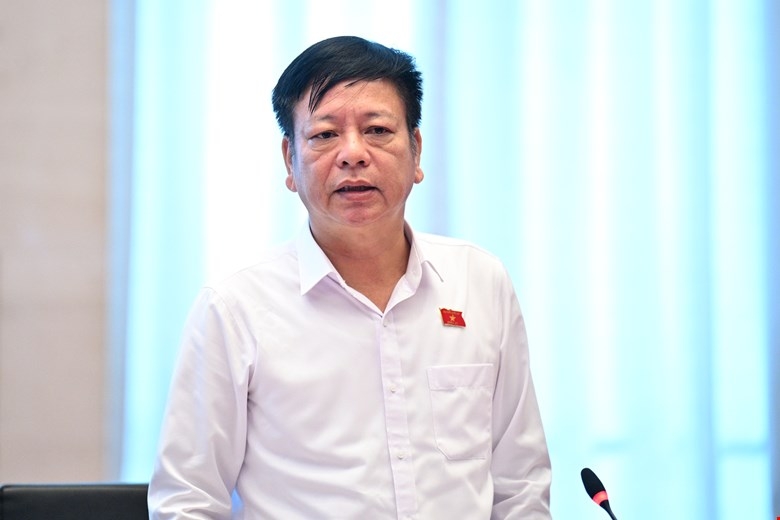
Representative Nguyen Truong Giang – Vice Chairman of the Law Committee – also expressed concerns about the regulation allowing the deposit of security money to cancel seizure, temporary detention, confiscation, or freezing of assets, provided that the amount is not lower than the value of the evidence or assets as determined by the asset valuation report.
Firstly, he argued that appraisal in the judicial system is difficult because prices can vary at different times, and some assets may even fetch higher prices at auction after a judgment takes effect than before. Therefore, such regulations are very difficult to implement, and appraisal becomes very problematic.
Secondly, after the seizure, temporary detention, freezing, or confiscation of the evidence and assets is lifted, the individual or organization receiving them back is responsible for preserving the evidence and assets during the process of management, exploitation, and use.
“If a house is worth 10 billion VND, and they pay 11-12 billion VND, then when they get it back, they can't sell it? Once the seizure is lifted, they can conduct normal transactions, so can that property be sold? If they're told to hold onto it after paying, nobody will put down money because it won't be effective. In the case of allowing the sale, if the evidence is lost, how can they later go back and verify the evidence?” Mr. Giang questioned.
Representative Duong Van Thang – Deputy Chief Justice of the Supreme People's Court, Chief Justice of the Central Military Court – suggested caution regarding the scope of the draft resolution, especially the pre-trial stage, as it is not yet known whether a case will be initiated or whether suspects will be charged. Handling evidence and assets of those not yet charged could lead to violations of property rights as stipulated in the Constitution.
Emphasizing the principle that the resolution stipulates new content not yet regulated by current law, Mr. Thang argued that, in addition to ensuring the timely implementation of remedial measures, it is necessary to minimize the occurrence of disputes, exploitation, abuse, corruption, and negative practices.
Therefore, the delegates proposed adding the following principle: Firstly, ensuring that no disputes arise with other cases, and ensuring a balance between the interests of the State and the legitimate rights and interests of agencies, organizations, and individuals.
Secondly, regarding physical evidence bearing traces of a crime, the basis for determining the crime and criminal responsibility requires that the investigative agency, the prosecutor's office, and the court must demonstrate the evidence's validity so that the court can adjudicate the case, avoiding wrongful convictions of innocent people and preventing the escape of criminals.
Source: https://vov.vn/chinh-polit/nop-tien-de-nhan-lai-tai-san-ke-bien-phong-toa-nguoi-dan-co-duoc-ban-khong-post1131982.vov


































































































Comment (0)