


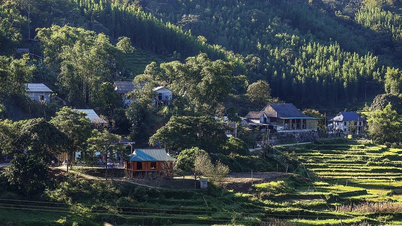
For many years, dozens of households in Tieu Khu hamlet, Tan Hoa commune, Phu Tho province have been living without access to clean water, despite residing right next to the Hoa Binh hydroelectric reservoir, considered one of the most abundant water sources in the northern mountainous region. What's more, the residents "live next to the reservoir but still lack clean water" because the clean water supply project lacked water and was subsequently abandoned.
According to observations by a Vietnam News Agency (VNA) reporter in Tieu Khu hamlet, there are currently more than 50 households living along the lake. Although a clean water supply project was implemented and completed by the former Hoa Binh City People's Committee in 2019, the natural water source does not meet the needs of the people. The water system has been damaged over a long period and has not been renovated or repaired, leading to an inability to ensure water supply for the people. To date, this project is almost abandoned. In addition, part of the water storage tank system has been buried under soil and rocks, and many sections of the water pipes are broken, cracked, and severely degraded over time.
Mr. Bui Van Quang, residing in Tieu Khu hamlet, Tan Hoa ward, stated that after the project was completed, residents hoped to soon have access to a stable and hygienic source of clean water. However, their hopes quickly turned into disappointment when the project was not put into operation. Meanwhile, daily life remains dependent on unstable natural water sources, posing many potential safety risks.

To obtain water, residents of Tieu Khu hamlet are forced to fend for themselves by investing in plastic pipes and drawing water from natural springs located kilometers away. This manual water supply is not only costly but also carries many risks. The pipelines are frequently damaged due to the complex hilly terrain, landslides, or construction activities involving blasting for road building in the area.
Residents of Tieu Khu hamlet said that every time the water pipes break, they have to spend millions of dong to repair or replace them. This is a significant expense for people in rural areas who still face many difficulties. In particular, there are times when the water system is interrupted for many days, causing significant disruption to the daily lives of families.
Faced with this situation, a "spontaneous water supply station" was built by the family of Ms. Dinh Thi Binh in Tieu Khu hamlet, with a reservoir and a water pipe system to supply water to households in the area. The water is drawn from natural springs and then distributed to each household on a scheduled basis.

According to Ms. Dinh Thi Binh, to maintain the system, each household contributes a small monthly fee. Specifically, the fee is about 100,000 VND/month for large households and about 50,000 VND/month for smaller households. Although the cost is not large, this system is only temporary and does not fully guarantee clean drinking water standards.
Besides facing a shortage of clean water, residents of Tieu Khu hamlet are also concerned about health risks associated with using unsanitary water sources over a long period. Many households have to boil water for drinking, but this still cannot completely eliminate the potential risks from bacteria and impurities.

Ms. Dinh Thi Binh emphasized: "We are only doing this as a temporary solution to ensure people have water for daily use. However, this water source is untreated and heavily dependent on natural conditions, so it cannot be guaranteed to be absolutely safe."
Mr. Nguyen Van Vui, Secretary of the Party cell of Tieu Khu hamlet, Tan Hoa ward, said that during meetings with voters, residents have repeatedly petitioned the authorities at all levels to promptly restore and put into operation the clean water supply project that has already been invested in. They also requested solutions to support and upgrade the water supply system to ensure the essential needs of the people are met.
Leaving a completed water supply project unused for many years represents a significant waste of investment resources. Not only does this result in budget losses, but it also directly impacts the lives and health of local residents.

According to representatives from the Tan Hoa Ward People's Committee (Phu Tho province), implementing infrastructure projects in remote areas often faces numerous difficulties related to terrain, resources, and management. However, for essential projects such as clean water supply, delays in commissioning or prolonged deterioration are unacceptable. The local government hopes that the State will consider investing in the construction of a new domestic water supply system to ensure a stable life for the people in the hamlet.
Addressing this situation promptly will not only resolve immediate difficulties but also demonstrate the responsibility of all levels of government in caring for the people's lives, aiming for sustainable development and equitable access to essential services.
Source: https://baotintuc.vn/van-de-quan-tam/nguoi-dan-ven-ho-hoa-binh-khat-nuoc-sach-20260422115547158.htm


![[Photo] General Secretary and President To Lam receives Amazon's Senior Vice President David Zapolsky](https://vphoto.vietnam.vn/thumb/1200x675/vietnam/resource/IMAGE/2026/05/22/1779466547770_a1-bnd-3513-6601-jpg.webp)









































































Comment (0)