

Gaps in child protection
After every shocking case of child abuse, society often asks a nagging question: Why did these children have to endure such pain for so long without it being discovered early?
According to Dr. Ananya Manmathabhai Mehta, Deputy Head of Professional Communication at RMIT University Vietnam, in many cases, neighbors, relatives, or schools may notice unusual signs but hesitate to intervene because they consider it a "private family matter."

This silence inadvertently creates a vacuum that allows violence to continue behind closed doors. Psychologists believe this is not just a personal issue but also reflects long-standing cultural barriers in society. The notion of "spare the rod and spoil the child" or the reluctance to confront abuse prevents many from speaking out when they witness signs of violence.
Meanwhile, the pressures of making a living in large cities are increasing the risk of children being neglected or living in unsafe environments. In fact, in many industrial zones in Dong Nai, Ho Chi Minh City, and other localities with a high concentration of migrant workers, many parents work long hours, lack family support networks, and are forced to send their children to informal daycare centers or leave them without the necessary care and supervision.
Dr. Nguyen Ngoc Quynh Anh, Head of the Psychology Department at RMIT University Vietnam, believes that many abusive parents are actually facing psychological stress, financial pressure, or unhealed trauma. When unable to control their anger and helplessness, they easily resort to physical punishment on their children as a way to release negative emotions.
In this context, social media is increasingly influencing how communities perceive and react to child abuse cases. According to Dr. Ananya Manmathabhai Mehta, Facebook, TikTok, and other digital platforms have the positive aspects of spreading information very quickly, creating social pressure on authorities to take action, and helping many people access knowledge about children's rights and how to identify signs of abuse.
“However, social media is also a ‘double-edged sword.’ Many discussions easily become extreme and emotional, focusing on personal attacks or spreading unverified information. More worryingly, images and private information of children are widely shared online, causing victims to suffer further psychological trauma after the tragedy,” Dr. Ananya Manmathabhai Mehta stated.
According to statistics for the first quarter of 2026, the country recorded 57 cases of child abuse in the online environment. Authorities have also repeatedly warned about the increasing number of individuals using social media to approach, manipulate, entice, or threaten minors, with increasingly sophisticated methods.
In light of this situation, the Ministry of Public Security is coordinating with relevant agencies to develop a program to protect children in the online environment for the period 2026-2030. This program will propose solutions to strengthen monitoring and prevention of high-tech crimes related to children, while also improving digital safety skills for young people.
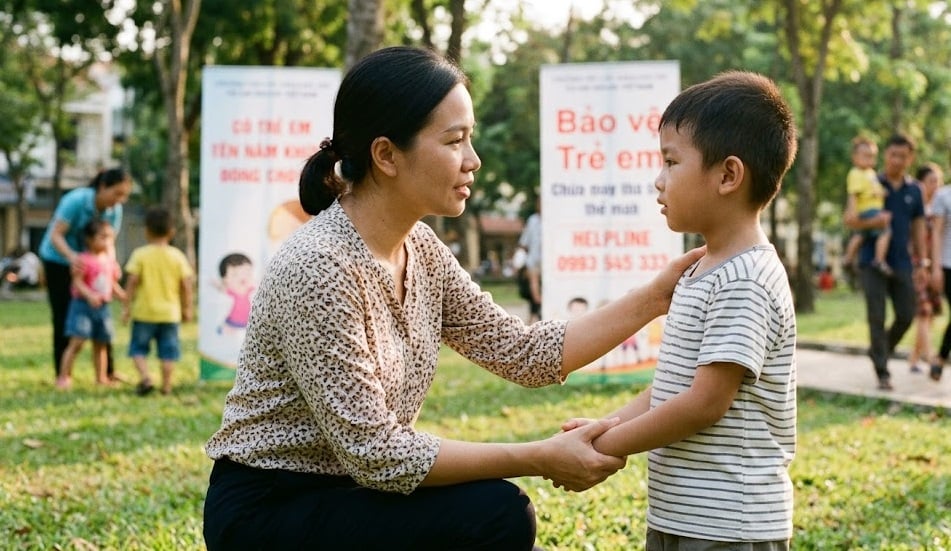
According to media experts, reporting on child abuse should prioritize the safety and dignity of children over sensationalism. The media has a responsibility not only to reflect the tragedy but also to help the community understand how to identify risks, how to report safely, and where to find necessary support.
"We need to shift the focus from the question 'what happened' to 'what can we do to prevent it from happening again'," emphasized Dr. Ananya Manmathabhai Mehta.
Building a protective "shield" for children from an early age.
After every shocking case of child abuse, the question often arises: why weren't the warning signs detected sooner? According to many psychologists and social workers, current child protection efforts still primarily focus on dealing with the consequences, while early detection and intervention remain significant gaps.
The case of the over 2-year-old boy being abused in Hoa Hiep commune, formerly Ba Ria - Vung Tau province, is considered one of the rare instances where inter-agency coordination was activated promptly. Immediately after receiving the information, the National Child Protection Hotline 111 connected with local authorities, the police, and medical facilities to take the child for emergency treatment.
The Ministry of Health also requested Children's Hospital 1 (Ho Chi Minh City) to focus its maximum professional resources on treating the child patient, while the investigating agency quickly apprehended those involved.
According to psychology experts, coordinated efforts between child protection systems, healthcare, the police, and local authorities are key to shortening intervention times in emergency situations. However, not all incidents are detected early enough for children to receive timely protection.
Currently, the 111 hotline remains a crucial point of contact for receiving information related to child abuse, violence, or urgent assistance. According to specialized reports, the hotline receives approximately 300,000 calls annually. Between June 2021 and June 2025 alone, it recorded over 1.55 million calls from people nationwide.

However, in many residential and industrial areas, a significant number of people still do not know how to report incidents or are hesitant to provide information due to concerns about confidentiality. Meanwhile, according to social workers, many families only seek support when conflicts and pressures have become uncontrollable.
Experts believe that to prevent child abuse from an early age, the first and most important step is to create a safe reporting mechanism that encourages people to speak up, children to seek help, and neighbors and relatives to overcome the mindset that "it's a private family matter."
In addition to community support systems, schools also need to become the first line of defense for children. According to Dr. Ananya Manmathabhai Mehta, teachers and school staff need to be properly trained to recognize signs of both physical and psychological abnormalities. Schools should not only be places for teaching knowledge but also safe spaces where children can seek help when in danger.
Many education experts believe that homeroom teachers and school psychologists are often the first to notice changes in children's behavior, from withdrawal, fear, and lack of concentration to unusual emotional reactions. With timely intervention, much harm can be prevented before it becomes serious.
At the community level, organizations such as the Women's Union, the Youth Union, or local trade unions are also considered important support networks, especially for migrant worker families who are facing significant economic pressure and lack parenting skills.
According to Dr. Nguyen Ngoc Quynh Anh, supporting parents in managing stress, caring for their mental health, and accessing non-violent parenting methods is key to prevention. Many cases of abuse stem from a prolonged lack of self-control on the part of adults, coupled with a lack of caregiving and psychological support skills.
Citing international research, an RMIT expert stated that many countries such as Norway, Sweden, and Finland are prioritizing an "early prevention" model, meaning supporting families from the moment a risk emerges, rather than only intervening after the child has become a victim. These countries invest heavily in school-based psychological services, community social work, and programs to support parents during the early stages of raising young children.
Experts believe that protecting children will not be effective if it remains solely the responsibility of each family. Only when schools, communities, authorities, and everyone around them speak up against unusual signs will children truly have a chance to be protected.
It's impossible to completely erase the deep scars left in the childhoods of many abused children. But society can absolutely prevent similar tragedies from repeating themselves if every cry for help is heard sooner, every abnormal sign is detected more promptly, and every child has a sufficiently safe "shield" to protect them.
Source: https://baotintuc.vn/van-de-quan-tam/bao-hanh-tre-em-bai-cuoi-va-lo-hong-bao-ve-tre-20260520173309910.htm

![[Photo] General Secretary and President To Lam presides over a meeting on preparations for the review of one year of operation of the three-tiered government system.](https://vphoto.vietnam.vn/thumb/1200x675/vietnam/resource/IMAGE/2026/06/02/1780391821195_a1-bnd-4595-9717-jpg.webp)




























![[Image] Affirming the aspirations and new standards of the Vietnamese real estate market in the new era.](https://vphoto.vietnam.vn/thumb/1200x675/vietnam/resource/IMAGE/2026/06/03/1780441948766_giai-thuong-bat-dong-san-2026-minh-duy-6-7364-jpg.webp)
































































Comment (0)