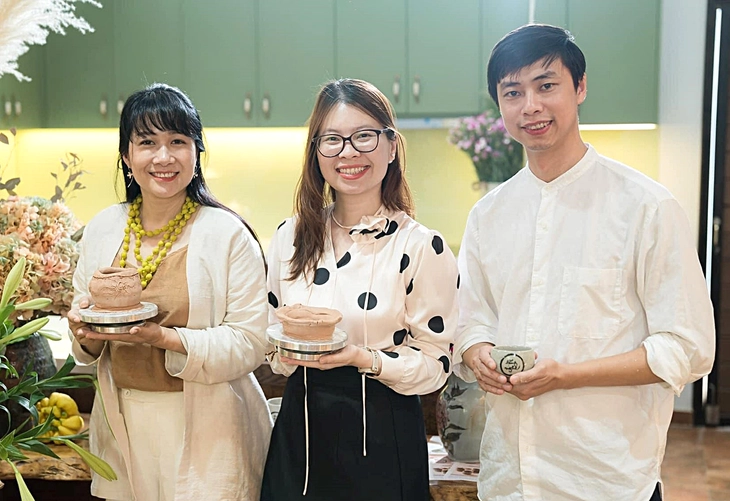
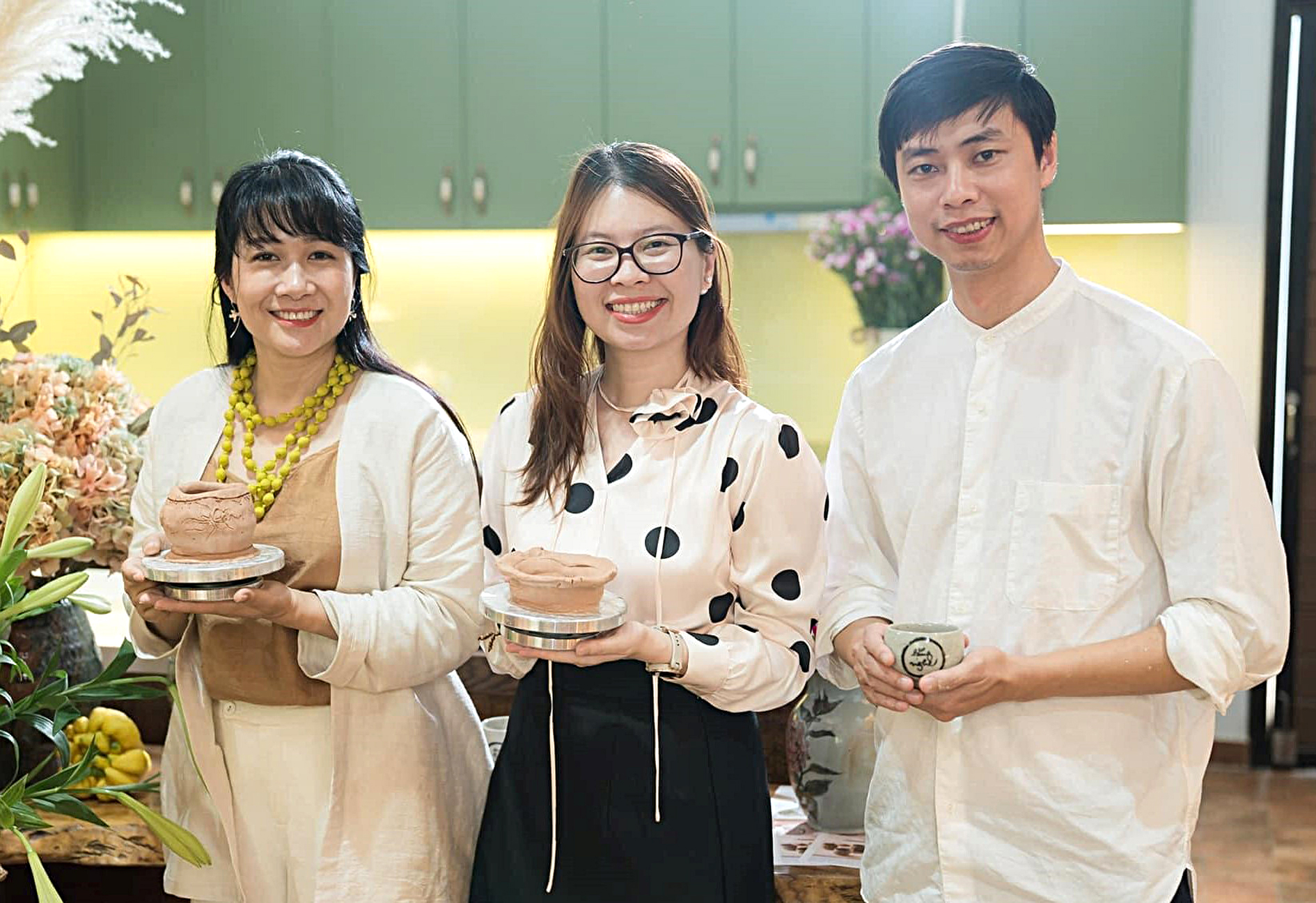
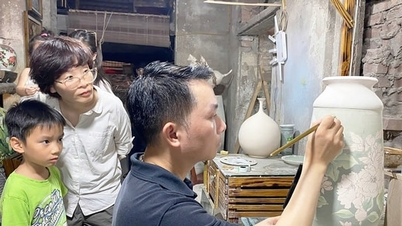
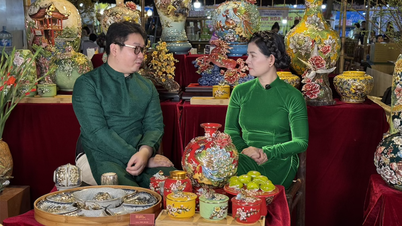
Besides being a pottery maker, Nguyen Truong Son (right) is also a speaker sharing his knowledge about pottery - Photo: Provided by the interviewee.
For Son, every finished or broken piece is a part of the creative journey. "Pottery taught me patience, taught me how to accept both success and failure," Son said.
Growing up in a pottery village.
Born and raised in Bat Trang pottery village (Gia Lam, Hanoi ), artisan Nguyen Truong Son, born in the 1980s, came to pottery as naturally as breathing. Clay is not just a material, but also a memory, a living environment, and a familiar rhythm of life for the entire craft village.
His childhood was filled with small tasks in the family workshop. "From a young age, my parents had us children share the work. There were many steps in the pottery-making process that I could help with, such as shaping the pottery and making the glaze... My love for pottery and clay probably started back then," he recalled.
But Son didn't choose the path of repeating what had already been done. He believed that pottery making is a process of continuous change because if it only stopped at reproducing, pottery would die. It was from this thought that, at the end of 2021, he and a group of young friends founded the BUT pottery brand. The project was born from the hope that young people in the craft village would continue the story of Bat Trang pottery using contemporary language, where tradition and creativity go hand in hand.
In its early days, BUT pottery focused on unique, one-of-a-kind vases. Each vase had a different shape, glaze color, and surface texture; no two were alike. Pottery enthusiasts quickly recognized its distinctive character: rustic yet refined, free-spirited yet profound.
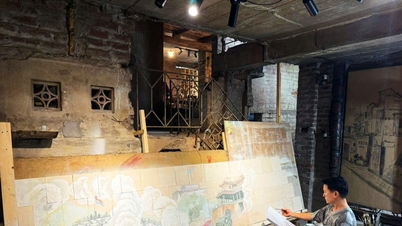
When this product line was well-received, Son continued to expand his creative scope into ceramic painting – a more challenging field requiring a combination of ceramic techniques, painting, and emotion. In the workshop, the ceramic paintings are handcrafted, dried, and then fired in the kiln.
Some works were successful, others cracked after days of waiting. Son didn't shy away from those failures. "There were times when two-thirds of the works were ruined in the kiln," he recounted, then continued, "Everyone was disappointed, but I simply thought it was okay, it was all just a challenge, and the next time would surely be a success." That calmness must come from his long experience with clay, fire, and the limitations of human capabilities.
I want pottery to become a bridge that brings people closer to Vietnamese values. That is when clay is no longer inanimate but becomes a material that can tell stories about memories, traditional crafts, and even love for the land.
NGUYEN TRUONG SON
Gain life experience to deepen your career.
After many years in the profession, Nguyen Truong Son chose to travel to reinvent himself. He once undertook a walking journey across Vietnam, giving himself the necessary respite from the fast-paced life. He said he wanted space and time to slow down, to detach himself from projects and work in order to have new experiences.
The trip allowed him to gain deeper exposure to the cultural life of many regions, but what resonated most deeply with him was the human connection. The nights sheltering from the rain under the school's eaves, the simple meals shared by the mountain people... all became vivid material for Son's later creative work.
In his collections of BUT ceramics, Son openly expresses his desire to tell the story of Vietnamese culture through the language of pottery. The Phu Cau collection, inspired by the jewelry of Hmong women, is one example. The vases, shaped like highland earrings, evoke the image of women walking amidst the mountains and forests of Northwest Vietnam.
The path Son chose wasn't easy. Starting a business in a long-established craft village meant finding his own way without straying from his roots. There were difficulties in building a team, experimenting with materials, choosing glazes, and firing in the kiln; each step was a lesson.
What keeps him going is constantly asking himself, "Why did I start?" because that very question brings him back to his initial love for the earth, for pottery, and for the cultural story he wants to tell.
There, people often call those who have been involved in the craft for a long time "artisans." But Truong Son only dares to call himself a ceramic artist. He wants ceramics to be more imaginative, not confined within a framework. This doesn't mean he makes ceramics detached from reality, but rather that he gives himself the right to experiment, to fail, and to tell the story of the era he lives in through each work.
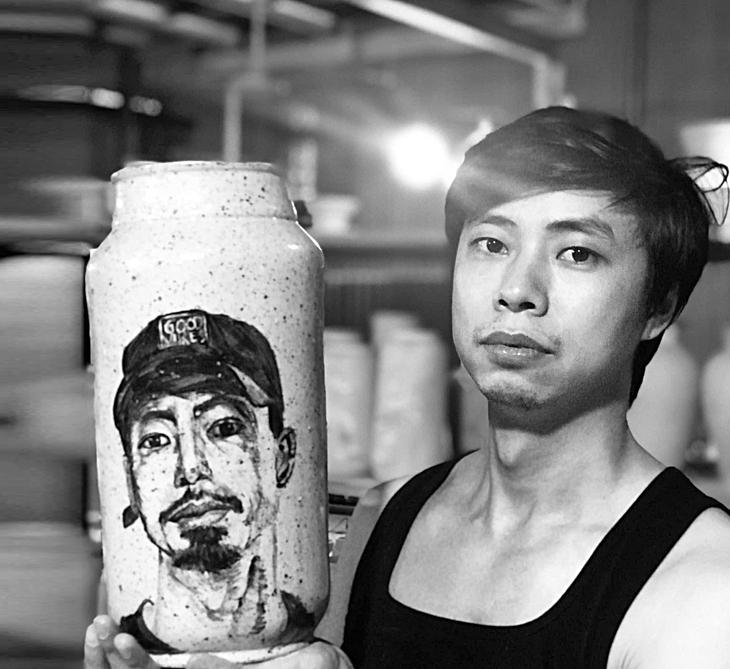
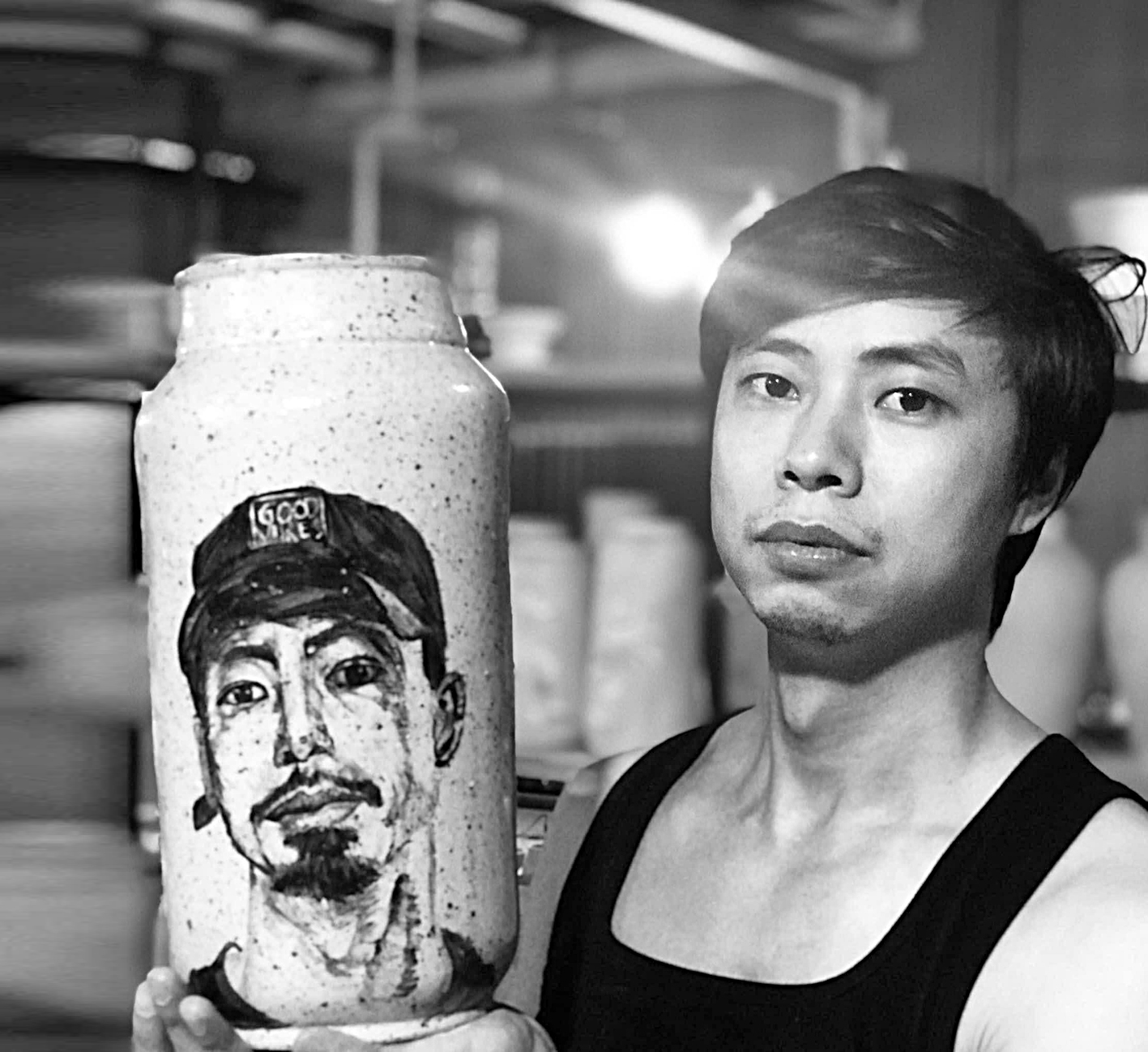
Nguyen Truong Son with one of his unique artworks - Photo: Provided by the artist.
Unique eel-shaped pottery
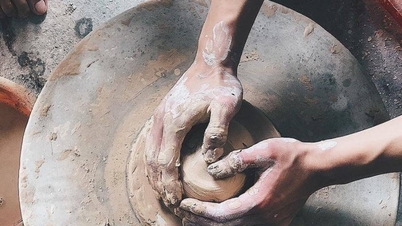
One of Nguyen Truong Son's most distinctive works is his "be chach" pottery. This pottery-making method, inspired by ancient techniques, has been developed by him to preserve the original handprints of the craftsman. As a result, the pottery surface has a natural, uneven texture, creating a unique light effect.
"With hand-molded pottery, you can make dozens of pieces a day, but with clay eels, you can only make three to five pieces a day. Each product is unique. Even the person who makes it can't replicate it exactly," Son said.
It is precisely this unique quality that makes him less worried about copying. Son admits that in the craft village, being learned from or imitated is unavoidable. But he believes that the core value of handcrafted pottery lies in the handprint, the emotions, and the time that the craftsman invests.
"To be a pioneer, you have to accept being copied. But with unique ceramics, copying only goes as far as the form; it can't touch the soul," Son confidently stated.
Slow down, do less, do things differently.
Looking at Nguyen Truong Son's ceramic works, bearing the rough yet meaningful imprint of his hand, viewers can sense a slow-paced spirit, contrasting with the hurried rhythm of life outside. This is not mere nostalgia, but a way of engaging in dialogue with the present.
His ceramics are not just for display; they are meant to prompt people to stop, touch, and listen. In the contemporary world, where many products are created quickly and are similar, Nguyen Truong Son chooses the opposite path: to work slowly, to work less, and to work differently.
He not only wants to contribute to keeping the Bat Trang pottery village alive but also hopes to breathe new life into it. His story includes memories of the village, personal experiences, journeys, and even the unhidden cracks in the pottery. For Son, it is these things that create the enduring beauty of Vietnamese pottery today.
Source: https://tuoitre.vn/nguoi-ke-chuyen-bang-dat-tu-lang-gom-bat-trang-20260409112114496.htm



![[Photo] The heat at the fireworks display site on the opening night of the Da Nang International Fireworks Festival 2026](https://vphoto.vietnam.vn/thumb/1200x675/vietnam/resource/IMAGE/2026/05/27/1779889741485_ndo_br_z7872039145157-fecaba5112f39e8352544099d7ef4738-5140-jpg.webp)
![[Photo] The courage of new recruits of Brigade 144 on the training ground.](https://vphoto.vietnam.vn/thumb/1200x675/vietnam/resource/IMAGE/2026/05/27/1779881651341_anh-man-hinh-2026-05-27-luc-18-32-52.png)





































![[Photo] The courage of new recruits of Brigade 144 on the training ground.](https://vphoto.vietnam.vn/thumb/402x226/vietnam/resource/IMAGE/2026/05/27/1779881651341_anh-man-hinh-2026-05-27-luc-18-32-52.png)


















Comment (0)