

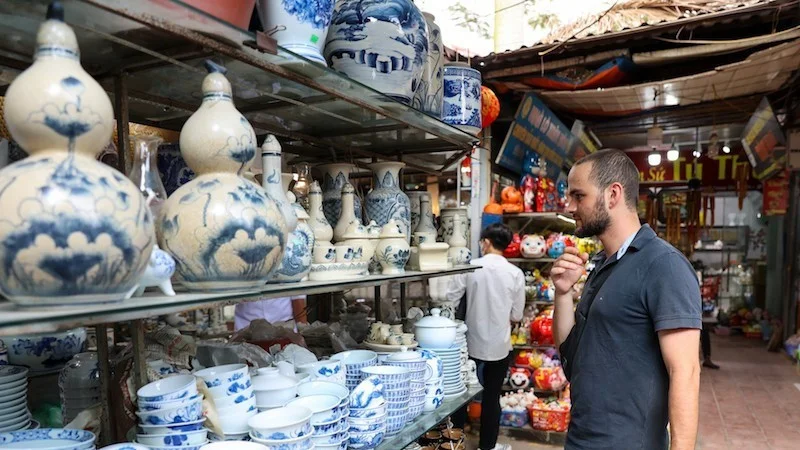
Foreign tourists visit Bat Trang pottery village (Hanoi). (Photo: Dang Anh)
These two resolutions demonstrate a significant shift in thinking, creating a legal framework, mechanisms, and groundbreaking policies that unlock resources and creative potential in society, contributing to breakthrough development in the cultural sector.
Building for development
Resolution 66 marks a significant turning point in the development and implementation of legislation, shifting from traditional management thinking to a modern approach that places citizens and businesses at the center.
The resolution emphasizes improving the effectiveness of law enforcement, stating that laws should not simply be "management tools" but rather "civilized standards," helping to remove bottlenecks, unleash social resources for development, and create competitive advantages.
Resolution 66 demands a decisive abandonment of the "if you can't manage it, ban it" mentality, the promotion of democracy, encouragement of creativity, and the liberation of all productive forces for development.
Culture is a unique field that demands creativity and continuous innovation; therefore, this new directive in the Resolution helps to quickly remove invisible barriers, unleash resources in society, open up new opportunities for artists, and encourage them to boldly experiment with new things, meeting the demands and trends of the times.
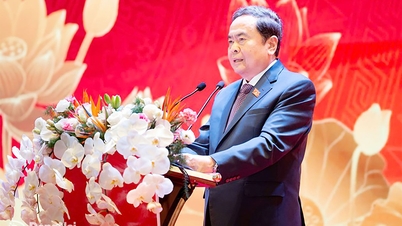
Associate Professor, Dr. Bui Hoai Son, a full-time member of the National Assembly 's Committee on Culture and Society, assessed: "Renewing thinking in legislation is not only necessary, but also the 'key' to unlocking the 'door' to national development."
Simultaneously, Resolution 66 clearly states the requirement to "strengthen the application of digital technology and artificial intelligence in legal work," and identifies the goal of lawmaking as "creating momentum for innovation, digital transformation, and the development of the digital economy ."
The cast of three blockbuster films of 2025: "Red Rain", "Tunnel: The Sun in the Darkness", and "Battle in the Air". (Thai Hoa starred in two of them)
In the cultural sector, the application of digital technology will make administrative procedures such as licensing and copyright registration faster and more transparent. On the other hand, the development of the cultural industry is closely linked to the digital economy; the use of technology to manage and protect intellectual property rights will be a significant step forward, creating a civilized environment and promoting the integration of Vietnamese culture into the international community.
A notable new aspect of the Resolution is its focus on building a culture of law compliance, ensuring that the supremacy of the Constitution and laws becomes the standard of conduct for all entities in society.
Accordingly, the culture of law compliance is defined as a system of values, norms, and habits of respecting the law. This regulation will contribute to raising legal awareness in the community, thereby forming a healthy cultural environment.
Ms. Le Thuong, President of the Vietnam Association in the Kansai region of Japan, shared: “A clear, transparent, stable, and investor-friendly legal framework will open up opportunities for the global Vietnamese community to bring capital, intellectual resources, technology, and experience back to serve the nation-building process. A favorable legal environment is also an indicator of the level of institutional development of the country, thereby enhancing Vietnam's position on the international stage.”
The private sector provides a boost to a culture of innovation.
Along with the favorable legal framework from Resolution 66, Resolution 68 opens up new opportunities and prospects for the private economic sector. The Resolution facilitates the extensive participation of private enterprises in key areas, including culture.
Specifically, the Resolution outlines several new points: Firstly, it shifts from a public administration system primarily focused on management to one that prioritizes service and development, placing citizens and businesses at the center; modernizing public governance and data-driven governance. It reduces interference and eliminates administrative barriers, the "request-and-grant" mechanism, and the "if you can't manage it, ban it" mentality; and shifts from pre-auditing to post-auditing coupled with enhanced inspection and supervision.
In cultural and artistic events, exhibitions, and performances, this regulation will help private businesses proactively create richer and more distinctive cultural values to meet societal needs.
Secondly, we need to develop breakthrough mechanisms and policies to encourage the development of the private sector in priority areas, including innovation. This will facilitate the private sector's access to resources such as land, capital, and high-quality human resources.
Typical examples include preferential tax support policies, such as exemption from corporate income tax for the first 3-5 years for small and medium-sized enterprises in the cultural sector; support for renting public housing and land at low, stable prices, helping to reduce operating costs, build community cultural spaces, attract audiences and promote local cultural life...
Thirdly, expand the participation of private enterprises in national projects, while simultaneously developing solutions to encourage private enterprises to invest in expanding and developing the cultural and entertainment industries; diversify and improve the effectiveness of cooperation between the State and the private sector through public-private partnership (PPP) models, public leadership - private management, public investment - private management, and private investment - public use, in the fields of economic infrastructure and socio-cultural infrastructure.

The private sector is the driving force behind Vietnam's sustainable growth goals. (Photo: THANH DAT)
Deputy Prime Minister Nguyen Chi Dung commented: Previously, we considered the private sector as a part of the economy, an important part of the economy. Now, with Resolution 68, we have shifted to considering it the most important driving force of the national economy. We boldly empower them to ensure rights such as: the right to property ownership, the right to freedom of business, the right to equal competition, access to the country's resources, and fair treatment.
National Assembly representative Phan Duc Hieu, Standing Member of the National Assembly's Economic Committee, noted that Resolution 68 marked a "qualitative change," shifting from the mindset of "only being allowed to do business in sectors permitted by the State" to the mindset of "being allowed to do business in all sectors not prohibited by law."
This marks a major turning point in guaranteeing the business rights of citizens and enterprises, while also creating a strong impetus for the development of the private sector, with the cultural sector witnessing vibrant participation from the private sector, playing an increasingly important role.
Resolution 68 marked a "qualitative shift," from the mindset of "only being allowed to do business in sectors permitted by the State" to the mindset of "being allowed to do business in all sectors not prohibited by law."
National Assembly representative Phan Duc Hieu, Standing Member of the National Assembly's Economic Committee.
At the same time, Resolution 68 takes a new step forward by ensuring diverse business rights, strengthening the protection of the private economic sector, and establishing specific mechanisms for protection, encouragement, and support, such as allowing businesses to "proactively remedy the consequences first, before considering any action."
Dr. Mac Quoc Anh, Director of the Institute of Economics and Business Development, Vice President and General Secretary of the Hanoi Small and Medium Enterprises Association (HanoiSME), assessed: "Resolution 68 not only unlocks institutional 'locks' but also places a great responsibility on entrepreneurs to become the architects of a new growth model."
To ensure that Resolutions 66 and 68 truly become powerful driving forces for cultural development, experts suggest that relevant agencies should promptly issue a comprehensive set of unified implementing guidelines to avoid legal gaps and inconsistent approaches among localities and agencies.
In reality, the important guidelines from the newly issued resolutions have quickly been implemented, creating a golden opportunity for the private sector in developing the cultural industry.
Many creative cultural startups in major cities have had the opportunity to access preferential funding, proactively participate in meaningful cultural events such as political art concerts, contemporary art projects, etc., contributing to elevating the cultural industry.
The "launchpad" provided by the newly issued resolutions will not only help mobilize financial resources but also ignite the entrepreneurial spirit, promote the elevation of national culture, and position the Vietnamese cultural brand on the international stage.
This aligns with the Party's policy of promoting the role of culture as an endogenous resource and making it a key economic sector, contributing to the country's development in the new era.
Reporters (Nhan Dan Newspaper)
Source: https://baocantho.com.vn/bai-3-dot-pha-tu-tu-duy-den-hanh-dong-a191576.html
![[Photo] Life on both banks of the river returns to its bustling pace on the day the Long Bien Bridge opens to traffic.](https://vphoto.vietnam.vn/thumb/1200x675/vietnam/resource/IMAGE/2026/05/28/1779949763708_cau-long-bien-minh-duy-7-3610-jpg.webp)
![[Image] Checking the security conditions at the exam site, ready for the 10th grade exam.](https://vphoto.vietnam.vn/thumb/1200x675/vietnam/resource/IMAGE/2026/05/28/1779943458889_z7872507660648-d764421a26e8cd7b61d70d142a48a685-jpg.webp)
![[Photo] The heat at the fireworks display site on the opening night of the Da Nang International Fireworks Festival 2026](https://vphoto.vietnam.vn/thumb/1200x675/vietnam/resource/IMAGE/2026/05/27/1779889741485_ndo_br_z7872039145157-fecaba5112f39e8352544099d7ef4738-5140-jpg.webp)























![[INFOGRAPHICS] Termination of activities for part-time community-level workers before May 31, 2026](https://vphoto.vietnam.vn/thumb/402x226/vietnam/resource/IMAGE/2026/05/28/1779955167483_1779955042.webp)



































































Comment (0)