

During excavations at a site in the Al-Subiyah desert in West Asia, Kuwaiti and Polish experts discovered traces of a still-mysterious civilization: a "strange" clay head belonging to a "snake-man".
Decoding ancient artifacts
Archaeologists have discovered traces of a mysterious civilization that existed in the Al-Subiyah desert, northern Kuwait, from approximately 5500 BC to 4900 BC. Among the remains, they have identified a clay head that they call the "snake man".
Experts call the clay head the "snake man" because the artifact has a long skull, a flat nose, no mouth, and narrow, squinting eyes.
The clay head bears a striking resemblance to the "snake-man" figure in Ubaid culture. Therefore, experts have spent considerable time studying and deciphering this ancient artifact.
According to the research team, the discovery of the "snake man" is a unique finding at the Bahra 1 site. It is also important evidence of the influence of the customs and beliefs of the Ubaid civilization across West Asia.
"The presence of the clay head raises interesting questions about its purpose, symbolic value, or ritual significance for the people of ancient times," said archaeologist Piotr Bieliński.
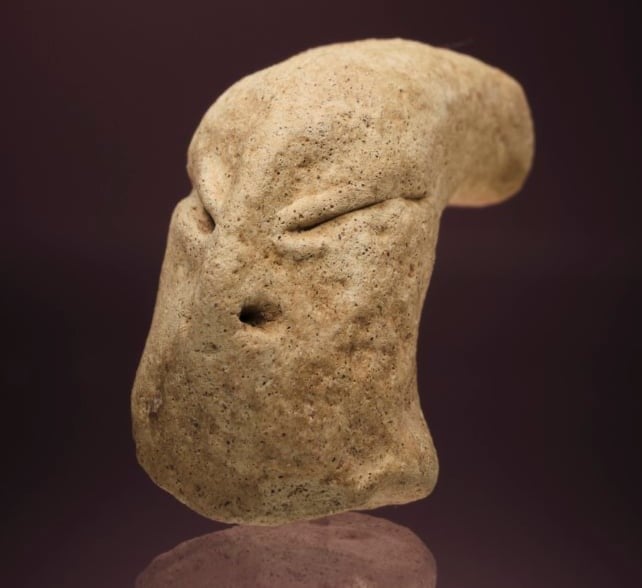 |
The "snake head" of the Ubaid people was found in Bahra 1. Photo: Adam Oleksiak/CAŚ UW. |
Laying the foundation for many cultures
Besides snake-like human faces, Ubaid artisans also often create unusually slender female figures with bird or lizard heads.
Long before the Sumerians established one of the world's oldest civilizations, the Ubaid people laid the foundation for many other cultures.
Evidence of the Ubaid culture has been found in trade networks, irrigation systems, and even temples in areas that are now Iraq and Kuwait. The unique pottery style of the Ubaid people distinguishes them from other cultures.
Since 2009, the early Ubaid period site known as Bahra 1 has attracted the attention of archaeologists due to its unique features, including a structure described as a "shrine" and an architectural layout unexpected for its age.
The discovery of Ubaid pottery and handicrafts reveals that they were often made from dried plant matter dipped in clay. Beyond deciphering the Ubaid cultural network, researchers have also gained insight into the region's ecosystem more than seven millennia ago.
Archaeologist Roman Hovsepyan from the National Institute of Archaeology and Ethnology (NAS RA) in France, a member of the research team, said that initial analyses showed traces of plants in the clay, especially reeds, in locally produced pottery. Meanwhile, remnants of cultivated plants, including cereals such as barley and wheat, were also found.
Source: https://khoahocdoisong.vn/nguoi-ran-he-lo-nen-van-minh-7500-nam-truoc-post256514.html



















![[GALLERY] Amazon shocked by $200 billion AI scam, employees rush to build bots.](https://vphoto.vietnam.vn/thumb/402x226/vietnam/resource/IMAGE/2026/06/01/1780307801611_am-1-png.webp)



![[Photo] Reception to welcome General Secretary and President To Lam and his wife on their State visit to the Philippines](https://vphoto.vietnam.vn/thumb/1200x675/vietnam/resource/IMAGE/2026/06/01/1780295488620_vna-potal-chieu-dai-chao-mung-tong-bi-thu-chu-tich-nuoc-to-lam-va-phu-nhan-tham-cap-nha-nuoc-toi-philippines-8798060-7855-jpg.webp)






























































Comment (0)