

From detached houses to houses facing the street.
The essence of "urban housing" and "rural housing" is the same. It's a familiar and endearing image, so much so that people call their spouse "my home," their family "my home," their hometown "homeland," and their country "home."
Urban housing is currently increasing rapidly in line with the growing urban population. This architecture is evolving in two ways, with two different directions.
First, let's call it a "bottom-up" approach, meaning that "urban housing" develops from "rural housing." This process happens gradually.
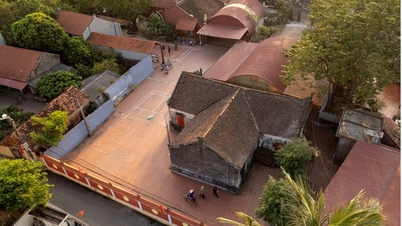
In the old days in the countryside, it was common to see three-room houses used as the main house for worship, receiving guests, and as the sleeping quarters for the eldest son of the family. Next to it, there was usually an additional side room for storing agricultural products, tools, and for production.
The entire modest "L"-shaped structure sits within a large plot of land, with ancillary facilities such as a drying yard, kitchen, toilet, vegetable garden, fish pond, vegetable patch, poultry and livestock pens…
Gradually, as socio -economic conditions developed and occupational structures changed rapidly, people adapted by allocating a front yard space for shops or workshops. Therefore, the house moved towards the street.
Furthermore, the traditional model of four generations living together under one roof seems to be fading away these days. As time passes, the children grow up, move out, and parents begin to consider dividing a piece of land among each child.
So, the house, which was originally horizontal, will soon be rotated to a vertical position. At some point, with the level of urbanization, these houses will become... "urban housing".
Houses according to the plan.
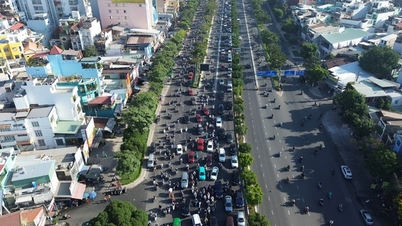
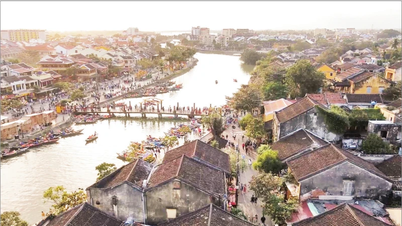
The journey of "urban housing" has witnessed the strong development of residential areas and urban zones. At this point, urban housing architecture has taken shape with specific forms: villas (with a frontage of approximately 9-10m), terraced houses (with a frontage of approximately 7-8m), and townhouses (with a frontage of approximately 5-6m). These are regulated differently in terms of building setbacks, building boundaries, number of floors, and height.
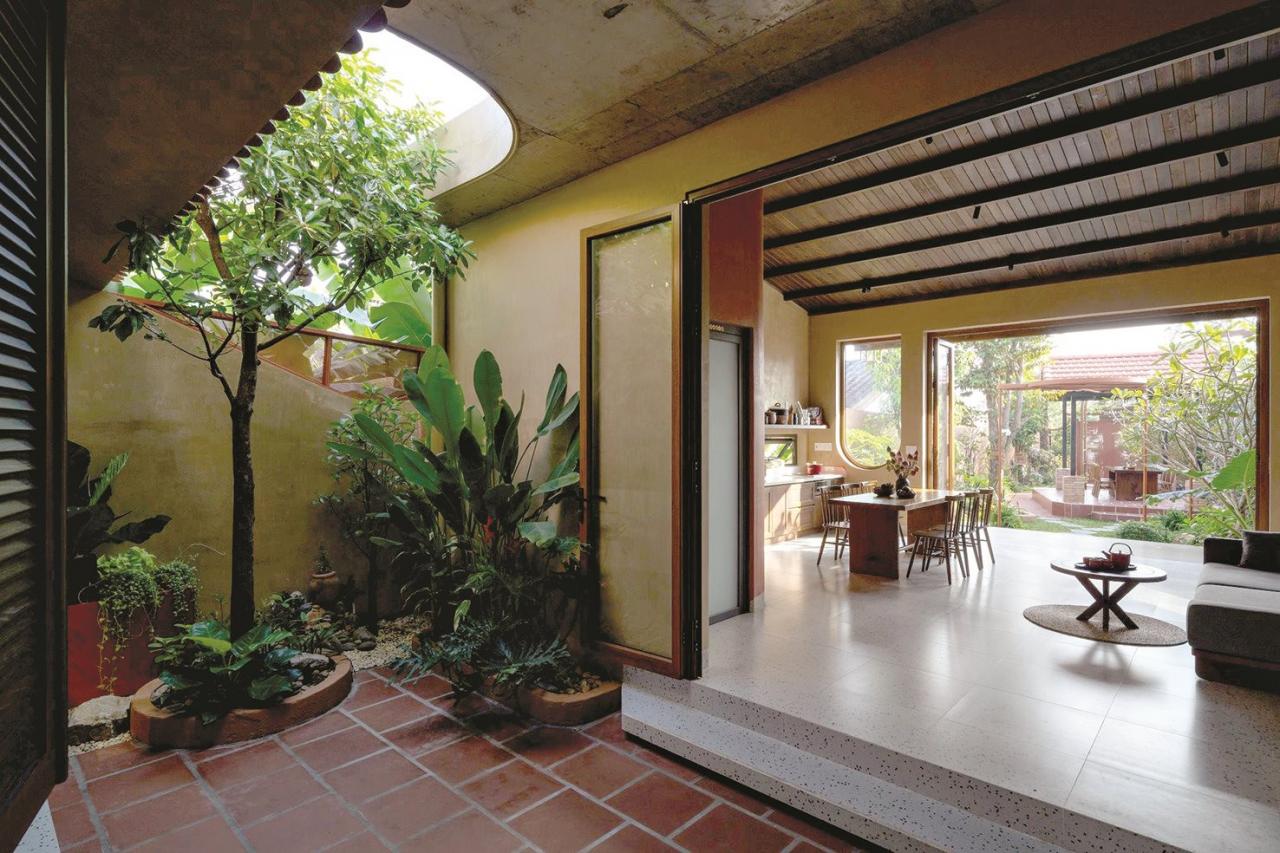
Although varying in shape, the spaces within "urban homes" share a common pattern. Starting with the living room, people today often choose an airy space that can connect to other areas such as the kitchen, atrium, and outdoor garden.

The kitchen has become a vital space – an open space. From the kitchen, one can observe all areas of the house, even the garden. Many families also arrange a separate dining area, which is also a space for communication and family bonding. Nowadays, bedrooms in modern architecture tend to be moderately sized and solely for… sleeping.
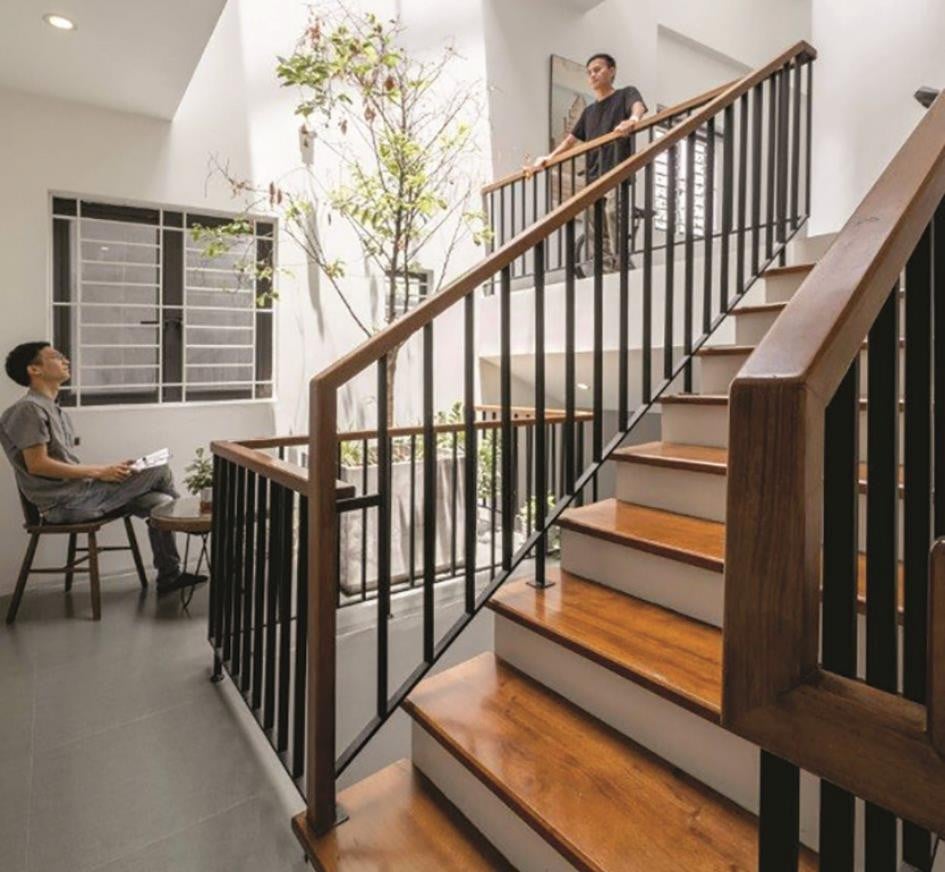
The void - a special space
Depending on specific needs and conditions, the house may also include other spaces: a prayer room, a common living area, a reading room, a tea corner, etc. Among these, open spaces are also special areas that help enhance natural light and ventilation.
The open space is also a "communication space." From there, children on the upper floor can see and call their mother downstairs, or simply by opening the window on the second floor, they can observe all the way to the gate. The open space, seemingly insignificant, actually enhances the value of other spaces in the house.
The open space could be the front yard, backyard, and atrium. Given the limited space in a house, it's advisable to leave a spacious front yard (for gardening, parking, or future use).
The spacious yard also helps to set the building back, making it more visually appealing. The backyard is also essential for drying clothes, growing vegetables, or creating a landscaped garden. Thus, even in an urban setting, the house evokes the features of a traditional agricultural house.
A beautiful home is a warm haven nestled within the host's hospitality, the hostess's skillful tea-making, the obedient children's greetings, and the sincere and tolerant conversations between host and guest.
All these elements combine to create the overall impression, like the soul of the house. The house is beautiful in its portrayal of the family's lifestyle and reflects the vibrant and colorful essence of life.
It could be a book the homeowner hastily left on the table after reading, children's toys scattered on the floor, or vegetables and fruits displayed on the kitchen counter in preparation for a family meal...
Most importantly, a home should provide freedom for its inhabitants and a sense of nostalgia when they are away. So that everyone has the right to be proud of their home...
Source




![[Photo] General Secretary and President To Lam receives Amazon's Senior Vice President David Zapolsky](https://vphoto.vietnam.vn/thumb/1200x675/vietnam/resource/IMAGE/2026/05/22/1779466547770_a1-bnd-3513-6601-jpg.webp)







































































Comment (0)