

 |
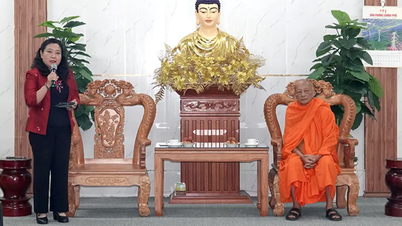
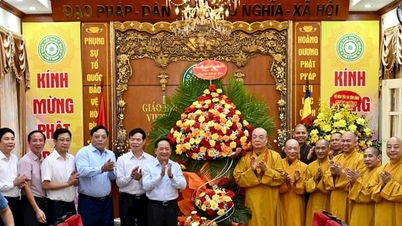
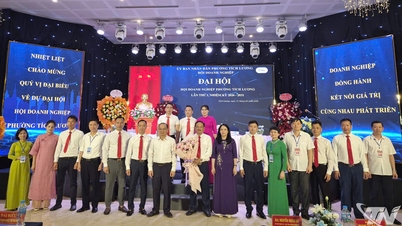
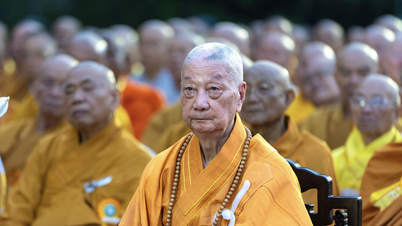
| Comrade Trinh Xuan Truong, Secretary of the Thai Nguyen Provincial Party Committee, and the delegation congratulated the Executive Board of the Vietnam Buddhist Association of Thai Nguyen Province. (Photo: Provided) |
In fact, the roots of many current crises, whether environmental pollution or war, stem from what Buddhism calls the three poisons: greed, hatred, and delusion. Greed fuels excessive consumerism, depletes natural resources, and disregards the lives of other species to serve selfish human interests.
Hatred divides nations, creates walls of prejudice, and ignites armed conflicts. Meanwhile, infatuation leads people to mistakenly believe they stand alone and have the right to dominate nature, instead of recognizing the symbiotic relationship between the two.
With the theme "Buddhist wisdom promotes global sustainable development and builds a shared future for humanity," the 21st United Nations Vesak Celebration directly focuses on resolving greed, hatred, and delusion through "Buddhist wisdom." Wisdom here is not book knowledge, but rather the ability to see things as they truly are, based on the doctrines of dependent origination and non-self.
Buddhism explains the world through the law of dependent origination: "When this exists, that exists; when this ceases, that ceases." The Earth is an inseparable ecosystem. A butterfly flapping its wings in one ocean can cause a storm in another; an act of deforestation in one country will contribute to rising sea levels in another.
Ultimately, sustainable development is the realization of the principle of interdependence in terms of policy and behavior. When people recognize that "I" and "the world" are a unified whole, they will shift from a mindset of destructive exploitation to one of preservation and respect.
Buddhist wisdom promotes a mindful lifestyle where individuals moderate their desires, practice green consumption, and act responsibly towards future generations. This is key to achieving the sustainable development goals that the United Nations is striving to pursue.
Furthermore, the phrase "Building a shared future for humanity" in the theme of the Grand Celebration reflects a vision that transcends national, ethnic, and religious boundaries.
When national leaders and every global citizen view humanity as a unified body, solutions to refugee crises, vaccine distribution, or assistance to poor countries in responding to natural disasters can be implemented effectively, instead of remaining mere promises on paper.
The United Nations Vesak Celebration 2026 is an occasion to emphasize the responsibility of building a shared future for humanity. That future does not belong to any one nation or generation, but to all of us, all the people living together in this world.
Source: https://baothainguyen.vn/xa-hoi/202605/nguon-sang-nhan-van-tu-tri-tue-phat-giao-17316e2/

![[Image] A brilliant symphony and explosive power in the skies of Da Nang.](https://vphoto.vietnam.vn/thumb/1200x675/vietnam/resource/IMAGE/2026/05/31/1780196945787_anh-man-hinh-2026-05-31-luc-10-08-51.png)












![[Video] Sunset at Lap An Lagoon – Where the sun sets over the fishing nets](https://vphoto.vietnam.vn/thumb/340x192/vietnam/resource/IMAGE/2026/05/31/1780192137701_beach-landscape-sea-water-nature-grass-745871-pxhere-com.jpeg)
































































Comment (0)