

Nguyen Thi Thu Huong, Founder of 48 - Café Daklao: The journey of sweetening the bitter taste of coffee beans.
Producing specialty coffee is an arduous journey, but Nguyen Thi Thu Huong believes it is a necessary path for coffee growers to achieve prosperity and put Dak Nong on the map of Vietnamese coffee.
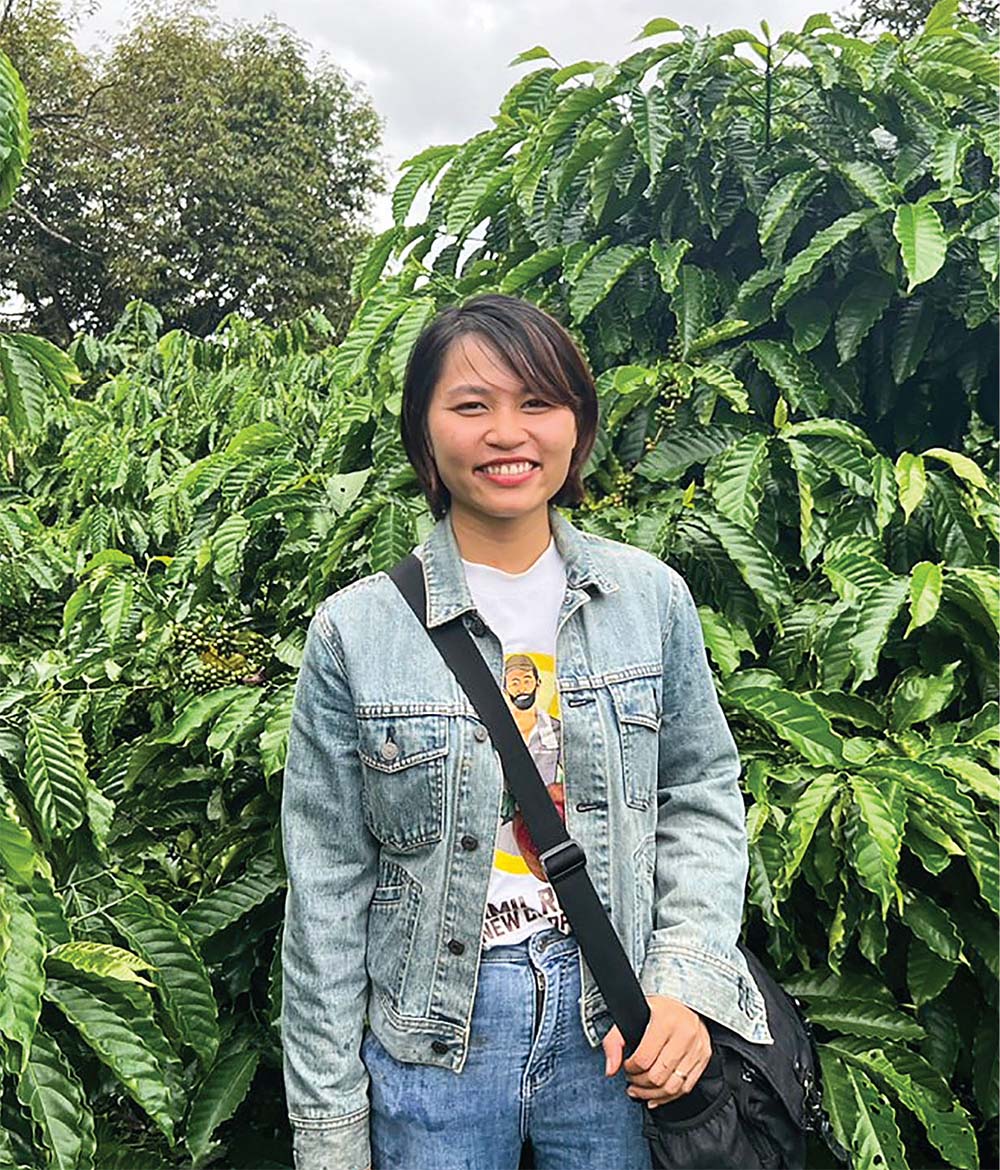 |
| Nguyen Thi Thu Huong, Founder of 48 - Cafe Daklao |
"The 'carrier' of knowledge"
On weekend evenings, the town of Dak Mil (Dak Mil district, Dak Nong province) is usually quiet. In the town center, where numerous cafes and restaurants have sprung up one after another, only a handful of customers can be seen.
But, about 4 km away, deep in an alleyway not yet reached by high-voltage electricity, groups of young men and women bustled in and out. The aroma of coffee and the murmur of conversations permeated the space of 48 - Café Daklao, transforming it into a vibrant little dot amidst the tranquil mountains and forests.
Having a popular coffee shop in a town of only about 17,000 people, where almost every household has a coffee plantation, is no easy feat.
"We don't just sell coffee, we sell the stories of the coffee growers," founder Thu Huong shared about her journey.
Returning to Dak Mil from Ho Chi Minh City in the summer of 2018, Huong founded 48 - Café Daklao, hoping to bring the finest local Robusta coffee beans closer to customers. Prior to that, she had spent seven years working in the coffee industry, roasting, grinding, and brewing, as well as participating in numerous professional barista competitions. The more she interacted with the coffee industry, the more Huong realized that Robusta coffee beans from Dak Nong in general, and Dak Mil in particular, were consistently absent from these competitions, giving way to Arabica beans from Africa and South America.
Concerns about the status of her hometown's coffee beans prompted Huong to take a path no one else in Dak Mil had ever chosen: developing Fine Robusta specialty coffee.
Huong sought out coffee plantations that met standards in the region, proposing technical support and offering to buy the entire harvest at double the market price. She selected plantations that were 20 years old or older, still retaining the old Robusta variety from the French colonial era, and not yet converted to the replanted varieties of later periods. “The old Robusta variety produces the fullest, most complex flavor, is the easiest to create with, and has the longest-lasting aftertaste,” Huong explained.
In this collaborative model with young founders, farmers are guided to develop their orchards using an ecological approach. Instead of monoculture coffee farming, the orchard ecosystem is divided into three layers. The top layer includes plants such as pepper, durian, and avocado; the middle layer grows coffee; and the bottom layer cultivates grass. The plants in the top layer provide shade, protection from dew and wind, and regulate the orchard's temperature; while the grass layer retains water and nutrients for the soil.
During the harvesting stage, unlike the traditional method (where coffee is picked indiscriminately, both green and ripe, then dried outdoors, hulled, and stored), the farmers cooperating with Huong will switch to standardized procedures in each step.
First, they only harvest the coffee when the cherries reach 80% ripeness, then they hand-separate the green and ripe cherries, much like the story of Cinderella sorting rice grains. Next, the coffee is washed, drained, and fermented anaerobically for 36-48 hours before being slowly sun-dried for 25-30 days. Only when it's ready for roasting and processing is the outer parchment layer peeled off, revealing the yellowish-white bean inside.
"Coffee farmers have the advantage of experience and resilience. My remaining challenge is to find passionate individuals who are willing to change and share my knowledge with them," the founder, born in 1993, affirmed.
During the 2023-2024 crop season, coffee prices fluctuated significantly, so Thu Huong did not expand the number of cooperating farmers, maintaining the same 12 households as the previous season. She purchased coffee from farmers at prices ranging from 95,000 to 125,000 VND/kg depending on quality, while the market price was only around 70,000 VND/kg. The founder plans to produce approximately 10-13 tons of Fine Robusta coffee to serve at her own cafe, as well as to share with some colleagues in the industry.
 |
Spreading the new standard for Robusta beans.
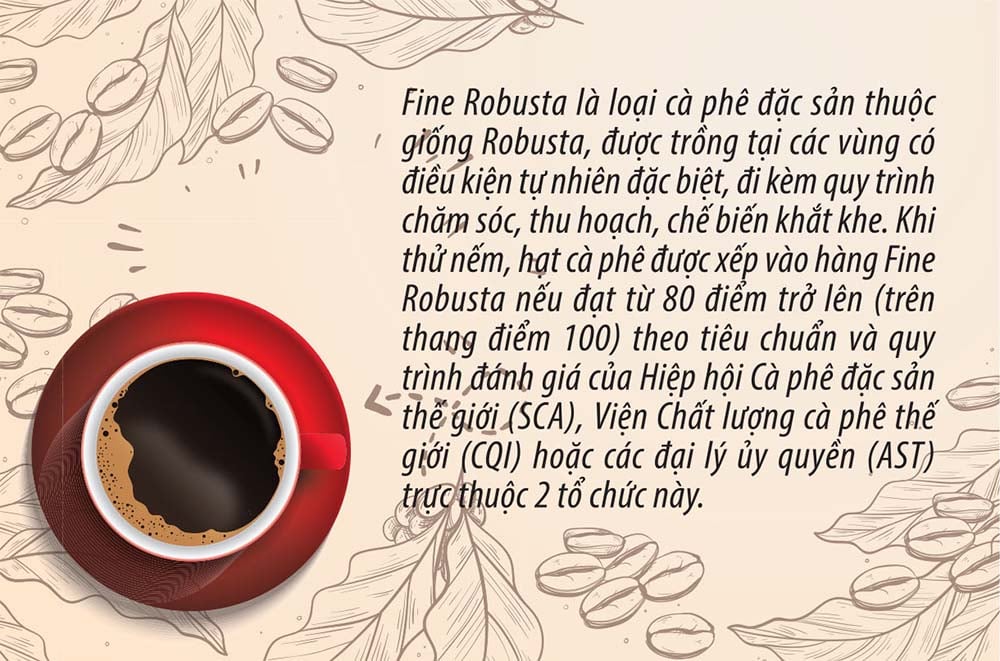
Huong explains the figure of 12 farming households after 5 years of cooperation with one fact: making Fine Robusta coffee is difficult, even extremely difficult.
During harvesting, the coffee beans ripen continuously, with each farmer collecting hundreds of kilograms a day, making it extremely difficult to separate the green and ripe beans. Similarly, during drying, while traditional methods only require drying on the patio for a maximum of 10 days, Fine Robusta beans need to be dried for 25-30 days. Every two hours, farmers need to turn the beans over to ensure even drying; at the end of the day, they are stored in bags to allow the moisture inside to balance with the outside, and then brought out to dry again the next day.
In the early years of their partnership, many farmers gave up because of the complicated production process. Some even mixed high-quality seeds with ordinary ones to sell at a higher price. When she disagreed, they called her picky and demanding.
Initially, Huong found it difficult to accept, but later, the founder redefined her mindset, realizing that working with farmers required real perseverance. Huong acknowledged her own fault in the breakdown of the partnership, noting that besides demanding high technical skills, she had also suggested that the farmers invest tens of millions of dong to build greenhouses for drying coffee beans. "You need to live in the farmers' shoes to understand them," the founder concluded.
 |
Later, Huong gradually changed her approach, focusing on the simplest yet most effective methods. For example, instead of building greenhouses, farmers simply lined the bottom with a thick layer of tarpaulin to prevent the coffee beans from coming into direct contact with the soil, while also ensuring the drying area was protected from external factors. As a result, most coffee samples from the farms cooperating with Huong met the Fine Robusta standard; some samples even entered competitions in Japan and won first prize.
At the end of 2018, Huong became the first person in the province to organize a Robusta coffee tasting event for farmers, called Dakmil Robusta News Crop. Here, high-quality coffee samples from Dak Mil district and some samples from other growing regions were brewed for everyone to evaluate. According to Huong, this event will give farmers a new perspective on cultivation, changing the values they produce and ensuring their family's economic stability, instead of chasing high-value agricultural trends and always facing risks.
In the following years, the event gradually expanded in scale, attracting not only farmers from Dak Mil district but also many farmers from other districts. From about 20 people at the first event, by 2022, Dakmil Robusta News Crop had become a gathering place for all participants in the coffee chain: farmers, cooperatives, producers, roasters, and experts. At the event, coffee industry experts directly met with producers and farmers, tasted and evaluated coffee, and then contributed ideas to improve the process.
In 2023, Huong temporarily suspended the Dakmil Robusta News Crop event to allow more time for thorough preparation. The founder of 48 - Café Daklao is actively collecting samples of the new crop of Robusta coffee, along with production information, and plans to bring the event back in April 2024. This year, the highlight of the event will be the live scoring by experts on each coffee sample, according to Fine Robusta standards. Huong herself can also be considered an expert in the industry, as in December 2023, she achieved the Q Robusta Grader certification - a professional certification for evaluating and assessing the quality of Robusta coffee according to the standards of the World Coffee Quality Institute.
Looking back on her journey in pursuing the Fine Robusta coffee bean production trend, Huong said she always remembers the migration to the "new economic zones" of her grandparents' generation, along with the government's agricultural development policies and the favorable conditions of nature for the Central Highlands in the field of coffee cultivation. All of these things have created a foundation for the next generation to inherit, but also come with the responsibility of continuing to write the fascinating story of the native Robusta coffee plant.
“The development of coffee cultivation is the development of all aspects of the lives of farmers, an essential part of the coffee industry and the global coffee trends. Whether development is better, faster, or slower depends on many factors, but I believe that if the whole community works together, that development will be remarkable and create even more miracles,” shared the founder of 48 - Café Daklao.
Source


![[Photo] Prime Minister Pham Minh Chinh presides over a meeting on private sector economic development.](/_next/image?url=https%3A%2F%2Fvphoto.vietnam.vn%2Fthumb%2F1200x675%2Fvietnam%2Fresource%2FIMAGE%2F2025%2F12%2F20%2F1766237501876_thiet-ke-chua-co-ten-40-png.webp&w=3840&q=75)



































































Comment (0)